

Trump urges allies to patrol Strait of Hormuz
Trump urges allies to patrol Strait of Hormuz
Posted March. 16, 2026 09:18,
Updated March. 16, 2026 09:19
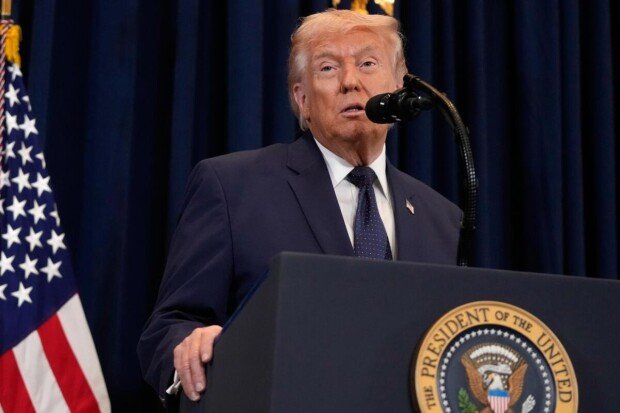
U.S. President Donald Trump on Friday called on five countries, including South Korea, Japan, China, the United Kingdom and France, to dispatch warships to the Strait of Hormuz, where Iran has been blocking maritime traffic.
With Iran disrupting tanker transit through the strait and sending global crude prices sharply higher, raising fears of a full-scale oil shock, Trump appealed to major powers, particularly U.S. allies, to join a multinational naval effort.
Trump made the remarks on Truth Social, writing, “Many Countries, especially those who are affected by Iran’s attempted closure of the Hormuz Strait, will be sending War Ships, in conjunction with the United States of America, to keep the Strait open and safe.”
He added that hopefully, China, France, Japan, South Korea, the United Kingdom, and other countries affected by this artificial restriction would send vessels to the area. It marked the first time since launching the war with Iran that Trump has publicly called on third countries, aside from Israel, to take part in the military operation.
The presidential office in Seoul plans to monitor the responses of neighboring countries before making any immediate decision on a deployment. Some observers say South Korea may leave open the option of sending a naval vessel for escort duties rather than a combat deployment.
A senior presidential office official said Saturday that the matter requires internal review, noting that Trump had only expressed his position and that the government intends to examine the issue carefully. Another government official said Seoul had already anticipated the possibility that Washington might request troop deployments or weapons support, adding that while the government hopes to avoid sending forces, discussions will likely be unavoidable.
Within the government, some officials believe it could be difficult for Seoul to reject the U.S. request given South Korea’s heavy dependence on crude oil imports passing through the Strait of Hormuz. One option under discussion is dispatching the Cheonghae Unit, the South Korean naval anti-piracy contingent stationed in the Gulf of Aden, for escort operations as part of a joint mission with other countries rather than a formal troop deployment.
However, the National Assembly resolution authorizing the Cheonghae Unit’s deployment designates the Gulf of Aden as its operational area. Operating in the Strait of Hormuz could therefore require additional parliamentary approval.
Meanwhile, tensions between the two sides over oil infrastructure have continued to escalate. The United States said Friday it carried out precision strikes on about 90 military facilities on Iran’s Kharg Island, a key hub for the country’s oil exports.
Kharg Island, a coral island in the northern Persian Gulf, serves as the terminal responsible for roughly 90 percent of Iran’s crude oil exports. Trump said all military targets at the site, which he described as Iran’s “crown jewel,” had been completely destroyed. In response, Iran launched an attack on the port of Fujairah in the United Arab Emirates, which is widely regarded as a key alternative route for exporting oil that bypasses the Strait of Hormuz.
Keun-Hyung Yoo noel@donga.com







 About Dong-A Ilbo