

Iran plants naval mines in Strait of Hormuz
Iran plants naval mines in Strait of Hormuz
Posted March. 12, 2026 08:41,
Updated March. 12, 2026 08:41
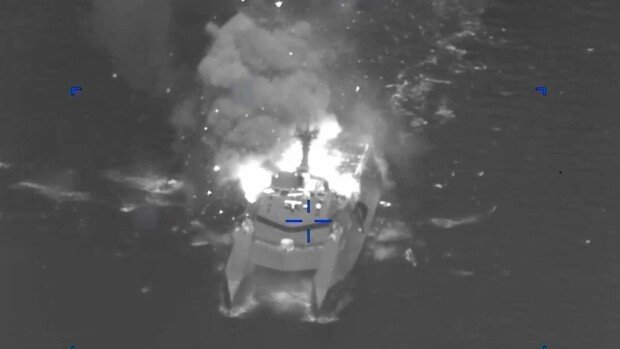
Iran has begun laying naval mines in the Strait of Hormuz in an apparent effort to block the strategic waterway, according to reports Tuesday from U.S. broadcaster CNN and other media outlets. The mines, which detonate automatically when approached by ships or submarines, appear intended to effectively shut down traffic through the strait and send shockwaves through the global economy, including the United States.
U.S. President Donald Trump warned the same day that Iran must immediately remove the mines or face an unprecedented military strike. U.S. Central Command, which oversees American military operations in the Middle East, said it had sunk 16 Iranian vessels, including ships used to deploy mines, and released video footage of the operation. Analysts say control of the Strait of Hormuz, a critical global oil shipping lane with major influence on international crude prices, could determine the outcome of the conflict between the United States and Iran.
According to CNN and CBS, U.S. intelligence agencies recently detected signs that Iran has deployed dozens of new mines in the Strait of Hormuz. Small boats are reportedly placing two or three mines at a time, and hundreds could be installed within a short period. Iran is believed to possess up to 6,000 mines, either produced domestically or imported from China and Russia. Once deployed, naval mines are difficult to recover, and ocean currents can move them from their original locations, making their exact positions hard to track. Concerns are growing that the strait could remain blocked for an extended period.
The Islamic Revolutionary Guard Corps has also issued increasingly hardline warnings about closing the strait. It recently declared that vessels attempting to pass through the Strait of Hormuz would be burned and that not even “one liter of crude oil” would be allowed to leave the region. At its narrowest navigable point, the strait is about 3.2 kilometers wide. Many analysts say that if mines are laid in such a confined passage, commercial shipping would effectively become impossible. Such a situation would likely complicate Washington’s plan to escort oil tankers from multiple countries through the waterway.
Meanwhile, the British daily The Guardian reported Tuesday that Iran had rejected two ceasefire messages sent by Steve Witkoff, the White House special envoy for the Middle East. Unlike Trump, who must consider rising oil prices and potential domestic and international political pressure ahead of the November midterm elections, Iran appears to be pursuing a strategy of endurance based on the belief that time is on its side. The White House said the end of military operations against Iran would depend on when Trump determines that the mission’s objectives have been fully achieved. Analysts say the remark suggests the United States could end the operation unilaterally without an explicit Iranian surrender or a formal ceasefire agreement.
Keun-Hyung Yoo noel@donga.com


![[김승련 칼럼]장동혁의 버티기, 한동훈의 패러독스](https://dimg.donga.com/c/138/175/90/1/wps/NEWS/IMAGE/2026/04/26/133816038.1.jpg)





 About Dong-A Ilbo