

Kim Jong Un tightens grip at party congress
Kim Jong Un tightens grip at party congress
Posted February. 24, 2026 08:45,
Updated February. 24, 2026 08:45
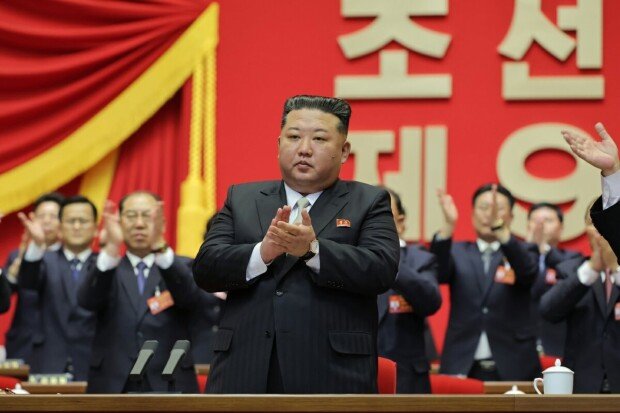
North Korean leader Kim Jong Un was reappointed as general secretary of the ruling Workers’ Party at its ninth Party Congress, reaffirming his control over the party’s top post. Analysts said the congress marked the formal launch of a new “Kim Jong Un era,” highlighted by sweeping personnel reshuffles that removed veteran officials who had supported him since the early years of his rule from the party’s Central Committee.
According to the Korean Central News Agency on Sunday, Kim was reappointed during the fourth-day session of the congress held Saturday. The party credited him with energetically leading efforts to transform the Korean People’s Army into an elite and formidable force capable of proactively countering any threat of aggression and fully prepared for any type of war.
In a proposal nominating Kim for the post, party secretary Ri Il Hwan said the era had come when there was no need to debate whether national defense or the economy should take priority. “While our people once believed that even without candy they must have bullets, that conviction has now evolved,” Ri said. “They believe they should have both, and they have the confidence that they can produce anything once they resolve to do so.”
The remarks highlighted what the party portrayed as Kim’s accomplishments in advancing a parallel buildup of defense and the economy, a goal that his predecessors, state founder Kim Il Sung and former leader Kim Jong Il, did not fully achieve. At a briefing Sunday, South Korean Unification Ministry spokesperson Yoon Min-ho said Kim’s reappointment appeared to further consolidate his standing within the regime.
The congress also brought extensive changes to the Workers’ Party Central Committee and its alternate members, who constitute the core of North Korea’s power structure. Choe Ryong Hae, chairman of the Standing Committee of the Supreme People’s Assembly and long treated as a second-in-command figure representing the so-called second generation of anti-Japanese guerrillas, was not included among Central Committee members. Other senior officials who stepped down included Pak Jong Chon, party secretary and prominent military elder; O Il Jong, director of the party’s Civil Defense Department and another member of the guerrilla second generation; Kim Yong Chol, party adviser who had overseen inter-Korean affairs; and Ri Son Gwon, head of the party’s 10th Bureau.
In their place, Kim filled the Central Committee with figures he personally selected. Jang Kum Chol, who became head of the United Front Department in 2019 after the collapse of North Korea-U.S. negotiations and succeeded Kim Yong Chol in that role, was named to the Central Committee. It has not been disclosed whether the party charter was revised to formally codify the concept of two hostile states.
“The exit of the old guard and the shift toward loyal, working-level officials rather than senior statesmen reflects a calculated governing strategy aimed at securing both momentum and discipline,” Hong Min, senior research fellow at the Korea Institute for National Unification, said.
North Korea's large-scale military parade is expected to be held within a day or two at Kim Il Sung Square in Pyongyang following the close of the congress. “A newly unveiled North Korean ballistic missile submarine and a new multiple-warhead submarine-launched ballistic missile designed for deployment on the vessel could be showcased,” observers in and outside the military said.
Na-Ri Shin journari@donga.com

![[사설]사전투표 역대 최고… ‘부정선거 음모론’ 심판한 유권자들](https://dimg.donga.com/c/138/175/90/1/wps/NEWS/IMAGE/2026/05/31/134025975.1.png)
![[천광암 칼럼]노동 장관의 ‘위험한 불장난’](https://dimg.donga.com/c/138/175/90/1/wps/NEWS/IMAGE/2026/05/31/134025926.1.jpg)
![[오늘의 운세/6월 1일]](https://dimg.donga.com/c/138/175/90/1/wps/NEWS/IMAGE/2026/06/01/134026254.1.jpg)


 About Dong-A Ilbo