

U.S. Supreme Court blocks Trump's global tariffs
U.S. Supreme Court blocks Trump's global tariffs
Posted February. 23, 2026 08:32,
Updated February. 23, 2026 08:32
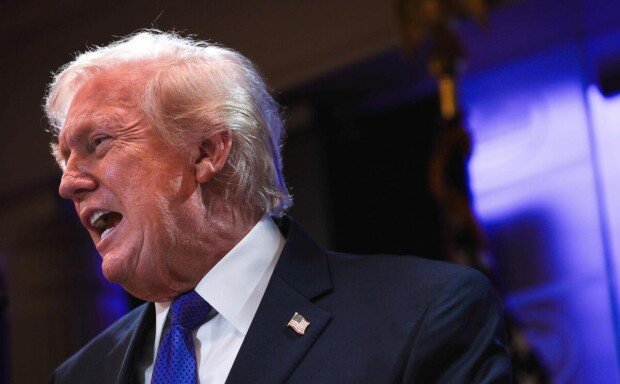
The U.S. Supreme Court ruled Thursday that tariffs imposed by President Donald Trump under the International Emergency Economic Powers Act, or IEEPA, were unlawful. The measures included reciprocal tariffs applied worldwide beginning in April last year, as well as duties on China, Mexico and Canada that the administration had justified as a response to the inflow of the narcotic fentanyl.
In response, Trump swiftly invoked Section 122 of the Trade Act, imposing a substitute 10 percent tariff on all countries and raising the rate to 15 percent the following day. While he has sought to preserve the practical effect of the original tariffs through alternative executive actions, analysts say the ruling strikes at the heart of his trade strategy. The decision directly blocks what had been widely viewed as a cornerstone of his economic agenda.
In its opinion, the justices said the IEEPA, enacted in 1977, does not authorize the president to unilaterally impose broad import tariffs on trading partners without congressional approval. The court found that Trump was claiming extraordinary authority to levy tariffs without limits on quantity, duration or scope. Such expansive powers, the justices added, require explicit authorization from Congress.
Six of the nine life-tenured justices concluded that the reciprocal tariffs were unlawful. The majority included Chief Justice John Roberts, along with two conservative justices appointed during Trump’s first term, Neil Gorsuch and Amy Coney Barrett.
Trump responded forcefully. Speaking at a White House news conference shortly after the ruling, he criticized the justices and said countries that had “exploited” the United States for years were celebrating and “dancing in the streets.” He also formally announced the 10 percent substitute tariff.
On Friday, Trump wrote on Truth Social that he would immediately raise the substitute tariff to 15 percent. Section 122 of the Trade Act permits the president to impose tariffs of up to 15 percent for a period of 150 days to address trade deficits. Trump chose to apply the maximum rate allowed under the statute.
Separately, the South Korean presidential office said Friday that the November memorandum of understanding on South Korea-U.S. strategic investment would move forward as planned despite the court’s decision invalidating the reciprocal tariffs. The office suggested there was little reason to provoke Washington at a time when the legal basis of U.S. tariff policy has been thrown into uncertainty.
A senior official said the administration might adopt a more complex response amid perceptions that it had been placed on the defensive by the ruling, adding that renegotiation would not be easy. The presidential office convened an interagency meeting on South Korea-U.S. trade issues the previous day, chaired by National Security Adviser Wi Sung-lac and Presidential Policy Chief Kim Yong-beom. Another tariff-related trade review meeting was held Friday.
Jin-Woo Shin niceshin@donga.com






 About Dong-A Ilbo