

Korea advances US investment bill amid tariff turmoil
Korea advances US investment bill amid tariff turmoil
Posted February. 23, 2026 08:31,
Updated February. 23, 2026 08:31
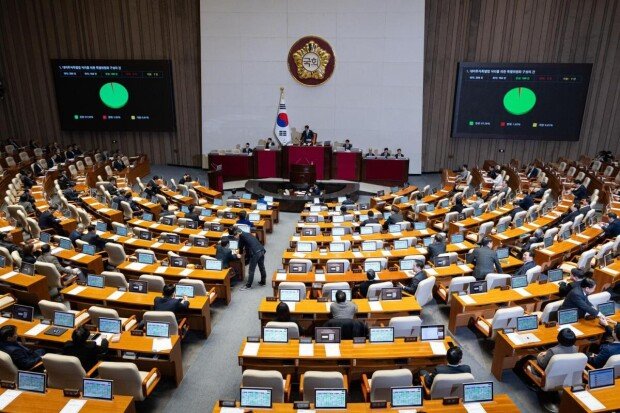
The South Korean presidential office said it will move forward without disruption in the legislative process for the proposed Special Act on Investment in the United States, despite a ruling by the U.S. Supreme Court invalidating reciprocal tariffs. Rival parties also agreed to proceed with deliberations as scheduled, including a public hearing set for Tuesday.
On Saturday afternoon, the presidential office convened an interagency meeting on South Korea-U.S. trade issues, chaired by National Security Adviser Wi Sung-lac and Presidential Policy Chief Kim Yong-beom, to discuss response measures following the court’s decision. In a written briefing, presidential spokesperson Kang Yoo-jung said participants reviewed the status of the proposed legislation and agreed to keep related procedures, including the public hearing, on track.
Both the ruling Democratic Party of Korea and the main opposition People Power Party said they remain committed to passing the bill by March 9. Rep. Kim Sang-hoon of the People Power Party, who chairs the special committee overseeing the measure, said Sunday that the court’s ruling does not appear to justify canceling planned investment in the United States and that uncertainty surrounding export conditions persists. He added that the public hearing will proceed as scheduled on Tuesday. The People Power Party also plans to meet separately that morning with the Federation of Korean Industries and Hyundai Motor Company to solicit input from the business community.
Han Jeong-ae, policy committee chair of the Democratic Party of Korea, said Saturday that although the Supreme Court struck down reciprocal tariffs, sectoral tariffs on items such as automobiles remain in effect, making it virtually impossible to revise the current framework of the memorandum of understanding at this stage. She said the party would proceed with the special act as originally planned.
However, escalating tensions between the two parties over a package of so-called judicial reform bills advanced by the Democratic Party of Korea could complicate the legislative timetable. The proposals include establishing a constitutional complaint system, expanding the number of Supreme Court justices and creating a new criminal offense related to distortion of the law. The Democratic Party intends to convene a plenary session beginning Tuesday, the same day the special committee meeting is scheduled, to pass the measures. The People Power Party, however, has condemned the bills as unconstitutional encroachments on judicial authority.
An official from the opposition floor leadership said that if the ruling party forces the legislation through, it will employ all available procedural tools, including a filibuster, to block it. Under such circumstances, the official added, it would be difficult to proceed smoothly with deliberations on the special act.
Some within the ruling party have argued that there is no need to rush passage of the bill given rapidly shifting conditions in the United States. An official involved in the special committee said that, amid numerous uncertainties, South Korea could monitor developments in other countries rather than accelerate the legislation. The official added that resistance from the People Power Party could serve as grounds for delaying its passage.
Civic groups have also called for a pause. In a statement Sunday, People’s Solidarity for Participatory Democracy said it was difficult to understand why the government continues to adhere to the South Korea-U.S. agreement even after the reciprocal tariffs that prompted the investment negotiations were invalidated. The group urged the government to initiate discussions with the United States on renegotiation instead of pressing ahead with the special legislation.
이지운기자 easy@donga.com


![“코 스프레이 2번 뿌렸더니 기억력 쑥”…치매 치료 가능성 [노화설계]](https://dimg.donga.com/c/138/175/90/1/wps/NEWS/IMAGE/2026/05/29/134018314.3.jpg)





 About Dong-A Ilbo