

Kospi surges above 5,900 on U.S. ruling
Kospi surges above 5,900 on U.S. ruling
Posted February. 24, 2026 08:43,
Updated February. 24, 2026 08:43
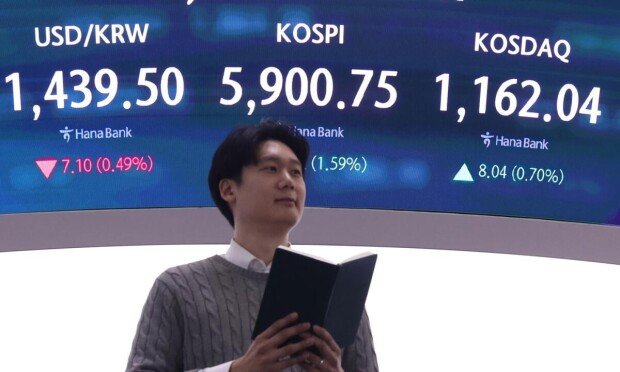
Reduced uncertainty over U.S. tariffs pushed the Kospi above 5,900 for the first time in intraday trading. Analysts said the benchmark index could reach as high as 8,000 this year, supported by a strong upcycle in semiconductors.
On Monday, the Kospi closed at 5,846.09, up 0.65 percent from the previous session, setting a record high on a closing basis. The index opened at 5,903.11 and climbed to an intraday high of 5,931.86 in early trading, marking its first move into the 5,900 range. Gains later narrowed as foreign and institutional investors took profits, posting net sales of 1.09 trillion won and 140 billion won, respectively. Retail investors were net buyers of 1.08 trillion won.
Investor sentiment was boosted after the U.S. Supreme Court ruled on Feb. 20 that the Donald Trump administration’s imposition of reciprocal tariffs under the International Emergency Economic Powers Act was unlawful. Although Trump later said he would impose a 15 percent tariff under Section 122 of the Trade Act, the announcement did not dampen South Korean equities.
Export-driven shares led the advance. Samsung Electronics rose 1.53 percent, Hyundai Motor gained 2.75 percent and HD Hyundai Electric jumped 5.54 percent. Market participants said the gains reflected expectations that external conditions had become more favorable for South Korean exporters in sectors including semiconductors, automobiles and power equipment.
Separately, Nomura Financial Investment on Monday raised its year-end Kospi target range to between 7,500 and 8,000. The brokerage cited a boom in memory semiconductors, strong earnings in the defense sector and a reassessment of the value of physical artificial intelligence as factors likely to support the market.
According to FnGuide, the average consensus forecast from 24 securities firms for this year’s operating profit is 167 trillion won for Samsung Electronics and 143 trillion won for SK hynix. A month earlier, the corresponding estimates were 120 trillion won and 98 trillion won, but have risen sharply amid a rebound in memory chip prices.
홍석호 will@donga.com

![근력 vs 유산소, 뭐가 더 좋을까…정답은 ‘□□’ [건강팩트체크]](https://dimg.donga.com/c/138/175/90/1/wps/NEWS/IMAGE/2026/04/30/133835512.3.jpg)




 About Dong-A Ilbo