

Food prices squeeze South Korean households
Food prices squeeze South Korean households
Posted January. 07, 2026 09:00,
Updated January. 07, 2026 09:00
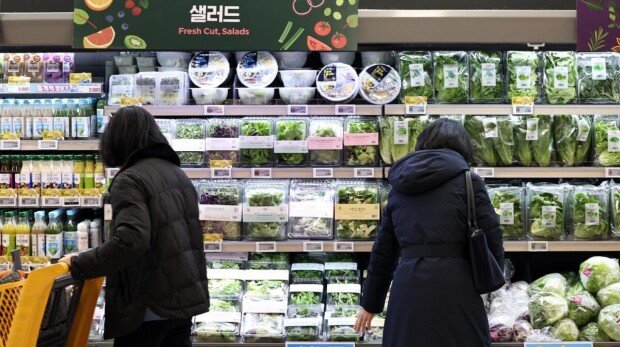
Jeon, a 39-year-old office worker, was taken aback when he reviewed his household accounts from last year at the start of the new year. His monthly food expense alone, covering groceries, lunches, and family dining out, averaged two million won. Adding 2.5 million won in monthly mortgage payments, 1.5 million won for his two children’s education, and one million won for insurance premiums and telecommunications fees pushed his fixed monthly expenses to seven million won.
“Even with the monthly post-tax income of 8.5 million won from me and my wife combined, we are left with only about 1.5 million won,” Jeon said. “To cut costs, I decided to start bringing lunch from home.”
Amid a weak won and so-called climateflation, a combination of climate-related shocks and inflation, food prices have surged. As a result, monthly food expense for four-person households in South Korea has risen above 1.4 million won, the highest level on record.
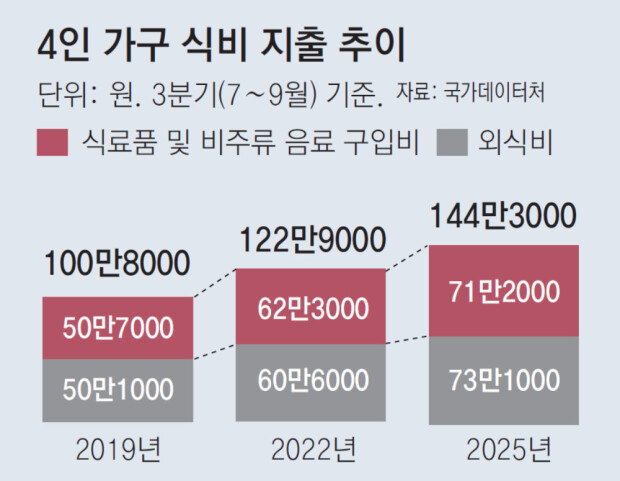
According to the National Data Center’s Household Trends Survey released on Jan. 6, the average monthly food spending for four-person households in the third quarter of last year, from July through September, totaled 1.443 million won, up 3.9 percent from a year earlier. Dining-out expenses averaged 731,000 won a month, exceeding spending on home-cooked meals, at 712,000 won, for the first time since the survey began in 2019. Analysts attribute the shift to rising prices for key food ingredients and the growing number of dual-income households, which have made dining out a routine part of daily life rather than an occasional alternative to home cooking.
Rising food prices have been driven in part by disruptions to agricultural supply caused by abnormal weather, including heat waves and heavy rainfall. As of December last year, rice prices had climbed 18.2 percent from a year earlier. Prices for commonly consumed vegetables also rose sharply, including napa cabbage, up 18.1 percent, spinach, up 17.9 percent, and potatoes, up 11.4 percent.
The weak won, trading in the 1,400-won range against the U.S. dollar, has further pushed up food costs. Higher prices for major imported items such as beef and fruit have added to the burden on household grocery bills and dining-out expenses. With restaurant prices, including coffee, rising one after another at the start of the new year, the upward pressure on food costs is expected to continue this year.
The Engel coefficient, which measures the share of food spending in total household expenditures, is also rising. While the traditional Engel coefficient reflected only the cost of home-cooked meals, a modified version that includes dining-out expenses is now more widely used.
In the third quarter of last year, the Engel coefficient for four-person households stood at 29.5 percent, up 2.8 percentage points from 26.7 percent in 2019. Over the same period, average monthly food expenditure increased 43.2 percent, while current income rose by only 27.1 percent.
“With the weak won becoming the new normal and climateflation unlikely to ease in the short term, there are clear limits to short-term supply measures,” said Lee Jung-hee, a professor of economics at Chung-Ang University. “A medium- to long-term strategy is needed to reduce price volatility stemming from shifts in the external environment.”
세종=정순구 soon9@donga.com







 About Dong-A Ilbo