

North Korea missile launch heightens regional tension
North Korea missile launch heightens regional tension
Posted January. 05, 2026 09:28,
Updated January. 05, 2026 09:28
North Korea’s ballistic missile launch on Jan. 4 is widely viewed as a signal of displeasure and an effort to assert its presence ahead of the summit scheduled for Jan. 5 between President Lee Jae-myung and Chinese President Xi Jinping. The launch may also reflect Pyongyang’s unease over the possibility that denuclearization could be discussed between the South Korean and Chinese leaders.
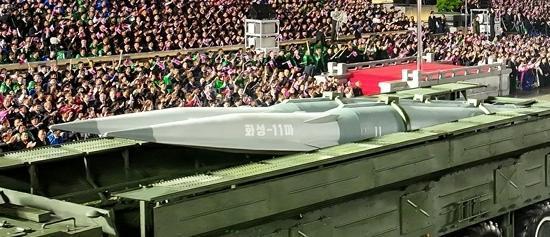
According to South Korea’s Joint Chiefs of Staff, the missile was launched from the vicinity of Pyongyang at about 7:50 a.m. on Jan. 4 and flew roughly 900 kilometers before landing in the East Sea. While the military assessed the detected flight distance at about 900 kilometers, the missile’s actual range is believed to have approached 1,000 kilometers. The launch marked North Korea’s first ballistic missile provocation in two months, following a test on Nov. 7 last year, and the third since the inauguration of the Lee Jae-myung administration. Military authorities believe the North may have attempted a maximum-range launch of the hypersonic short-range ballistic missile known as the Hwasong-11ma.
First unveiled at a North Korean weapons exhibition in early October last year and later showcased at a military parade, the Hwasong-11ma is a modified version of the KN-23, often described as North Korea’s Iskander-type missile. It is equipped with a glider-type hypersonic glide vehicle mounted on the warhead section. Experts note that if the missile carries a hypersonic warhead and performs low-altitude, irregular flight at speeds exceeding five times the speed of sound, it would pose a serious challenge to the South Korea-U.S. missile defense network.
Some analysts said the launch appeared to be directed at the United States, noting that it came shortly after U.S. President Donald Trump announced that Venezuelan President Nicolas Maduro had been removed through a military operation and transferred to the United States. Cha Du-hyeon, a senior fellow at the Asan Institute for Policy Studies, said North Korea was sending a message that it remains a far more serious security threat and that provoking it could carry significant consequences. He said Pyongyang was highlighting that, unlike Venezuela, it possesses nuclear weapons and advanced missile capabilities.
Attention is also focused on how the launch could affect North Korea-U.S. dialogue. Lim Eul-chul, a professor at Kyungnam University’s Institute for Far Eastern Studies, said the arrest of President Maduro could reinforce Kim Jong Un’s belief that giving up nuclear weapons would endanger regime survival. Lim said this perception is likely to further complicate negotiations over denuclearization on the Korean Peninsula.
Lee Jun-seok, leader of the New Reform Party, wrote on Facebook that U.S. Attorney General Pam Bondi described President Maduro not as a head of state but as the leader of a transnational criminal organization. Lee cited U.S. allegations that Maduro was involved in cocaine trafficking into the United States and used the proceeds to support terrorist groups. He said the same reasoning could be applied to Kim and stressed that South Korea must clearly convey to the international community that unilateral use of force should never be accepted as a normal way to resolve international disputes.
Sang-Ho Yun ysh1005@donga.com







 About Dong-A Ilbo