

ECONNECT: AI Optimizes Waste Recycling, Capturing Both Sustainability and Economic Viability
ECONNECT: AI Optimizes Waste Recycling, Capturing Both Sustainability and Economic Viability
Posted December. 17, 2025 10:59,
Updated December. 17, 2025 11:00
- ECONNECT, a South Korean startup founded by Min-hyung Cho and Young-woo Noh, uses AI and Big Data to optimize waste recycling, proving that sustainability and economic viability can be achieved together.
- Their AI solution, Regenport, matches recycled material properties with supply and demand, serving major corporations and expanding into global markets.
- By leveraging data-driven processes and international networks, ECONNECT is overcoming startup challenges and actively growing both domestically and overseas.
It has long been considered difficult for companies to simultaneously pursue both environmental sustainability and economic viability. The prevailing notion was that pursuing eco-friendliness drove up costs, while prioritizing profitability meant sacrificing the environment. However, ECONNECT, led by CEO Min-hyung Cho, is overturning this formula using Big Data and AI technology. Through its AI solution, Regenport, which optimizes waste recycling, the company is proving that both sustainability and economic returns can be achieved.
ECONNECT is a South Korean circular economy startup founded in 2022. Cho and Director Young-woo Noh joined forces to establish the firm, which now operates a B2B business supplying customized recycled raw materials and products based on waste data. The company is generating revenue from major domestic Korean conglomerates and is beginning to see significant results in the U.S., European, and Middle Eastern markets.
The reporting team recently met with CEO Cho and Director Noh at the Seoul Startup Hub Gongdeok in Mapo-gu, Seoul, to hear ECONNECT’s growth story and future vision.
Starting a business with even close friends is rarely easy. What was the catalyst for the two of you joining forces?
Cho: This is my third time starting a business. I launched two ventures in college: the first was a local document delivery service, and the second was a beauty salon O2O platform. From the first, I learned the importance of persistence, and from the second, I learned that there is no such thing as a complete blue ocean. My past trials and errors have become a guide for my current business.
Noh: Cho and I were classmates in the Reserve Officers' Training Corps (ROTC). After my discharge from the military, I handled overseas sales at POSCO International, where I worked with eco-friendly raw materials. While cultivating an entrepreneurial dream, I met Cho, and we began preparing for the startup in 2021. ECONNECT was finally founded in 2022.
We heard ECONNECT went through two pivots. What was the process to arrive at the current business model?
Cho: We initially started with an eco-friendly toothbrush business. Access to sustainable raw materials was easy thanks to Director Noh’s network from his previous job. At the time, eco-friendly materials were not as common as they are now. However, while selling products through B2C and B2B channels, buyers showed more interest in the raw materials themselves than the toothbrushes.
So, in 2023, we introduced a service that built an eco-friendly materials database and curated it for purchasing managers. Yet, simple brokerage had its limitations. It was closer to a one-time service and posed a problem for sustainability.
Noh: The idea itself was in demand in the market, but it was difficult to build a sustainable business model purely on that. We decided to leverage the capabilities of our data-handling team to develop a better model.
Cho: That’s why we transitioned to an AI solutions business based on waste data starting in the second half of 2024. There are thousands of companies in Korea that produce recycled materials, and we determined that the party with the data would be able to capture greater demand. This is what we now call Regenport.
What exactly is the Regenport solution?
Cho: Regenport is an AI solution that optimizes waste recycling. It goes beyond simple recycling to match material properties (mul-seong, or physical/chemical characteristics) and supply and demand. Just as plastic waste cannot immediately become a finished product, an intermediate blending process is necessary, and our AI recommends the optimal blend. Furthermore, unlike crude oil, the volume of waste generated fluctuates, making supply stabilization crucial—a problem our solution also addresses.
We can supply various packaging materials—such as films, injection-molded, and thermoformed products—through OEM/ODM arrangements. The brand name for the solution is 'Regenport,' meaning "a port for rebirth," and the resulting products supplied through it are called 'Regenplast.' It is fundamentally a 100% B2B business.
That’s an intriguing business model. Who are your main customers?
Noh: Regenport focuses on supplying raw materials through waste circularity, making major corporations and large-scale manufacturing plants our key customers. Regenplast, which involves finished products or components, targets a broader range of customers, including brand owners, distributors, and retailers. Simply put, customers who need raw materials use Regenport, and those who need something closer to a finished product use Regenplast.
Cho: We have much clearer targeting than in our previous business. While we previously targeted eco-friendly raw materials in general, we now concentrate only on recycled materials based on waste. Focusing on one thing rather than trying to do everything is the know-how gained from past trials and errors.
It seems there are other similar businesses. What is your differentiating factor?
Cho: Companies with similar business models already exist. The biggest difference is that we base the entire business on a data solution.
Noh: It’s difficult for companies to find the specific recycled raw materials they need. Our differentiator is utilizing our Big Data to analyze the material properties desired by the customer and find the optimal solution.
You mentioned Big Data and know-how as differentiators. Could you elaborate on the specific service delivery process?
Cho: There are three steps. If a customer wants to create a product, such as packaging, they can send us their existing product or raw material; if they don't have an existing product, they can send a similar one. We receive it, inspect its properties, search our database for the most optimal method, blend the raw materials, and create a sample (prototyping).
The second method involves taking the waste the customer is already discharging and using it to create raw materials or packaging—this is known as a Closed Loop system. Based on the customer's product samples or the waste they generate, we can propose the best result.
Is it genuinely possible to simultaneously enhance both sustainability and economic viability? It seems idealistic and difficult to realize.
Noh: It is indeed not easy to pursue both. But this is precisely our core know-how. The Big Data we have secured is the key. The painful mistakes of the past have now become invaluable experience that money cannot buy.
Cho: We conduct an extensive data search. This covers not just Korea but the entire world. All-directional searching to acquire high-quality data is essential. We scour both online and offline sources, and we are actively engaging on the global stage. It’s a cliché, but it’s easier said than done. Having gone through numerous trials and errors in the past, we have abandoned the idea of taking shortcuts.
What is the market reaction like? You seem to be active in both domestic and international markets.
Cho: The domestic market is not as heated as the overseas market because environmental regulations in Korea are not as strict. However, our customer base is steadily growing because the reputation that we can satisfy both sustainability and economic viability is gradually spreading.
For a specific example, a major integrated food company, whose name everyone would recognize, had a need to switch their packaging to eco-friendly options. We presented an alternative that met both their environmental and economic needs. Subsequently, we also began a project to recycle the waste they generate back into packaging materials.
Noh: We established our U.S. subsidiary in the first half of 2025. We are exporting to Europe, the U.S., and the Middle East, where environmental regulations are tightening. Regulations requiring a certain percentage of recycled raw materials are favorable to our product sales.
In the U.S., while we supply raw materials, packaging supply is our main focus. Our primary customers are U.S. retailers; we are exporting eco-friendly packaging to a major supermarket franchise. We strive to keep track of various news and trends to pioneer overseas markets. Last year, upon hearing that environmental regulations were strengthening, I went on a two-week business trip to sell our solutions. We mobilized our existing network and engaged in feet-on-the-ground sales. When we sold with sincerity, people recognized our value.
In Europe, we started with the raw materials business. Knowing that regulations in the European automotive industry are strong, we proposed our solution to an automotive parts factory. We are now supplying recycled raw materials to an automotive parts company in Italy. The common factor is the strong appeal we make to solve their challenges in responding to the ever-tightening environmental regulations. Both domestic and overseas customers are invaluable to us.
You mentioned many trials and errors. What difficulties have you faced in developing the business so far?
Cho: Because we are a small company, it was very difficult to land initial deals. This is a common struggle for any startup. It’s hard to do sales and marketing when brand awareness is low, which poses a significant hurdle.
Noh: As the company grows, we need to hire talent, but recruiting excellent personnel is challenging. It is a fact that a company needs good people to grow.
Cho: By constantly engaging and working hard, we are establishing references domestically and steadily building them up overseas. There is no royal road. We must thoroughly analyze customer challenges and be able to solve them. Every country has different cultures and different holidays. We are dedicating significant effort to understanding local business cultures.
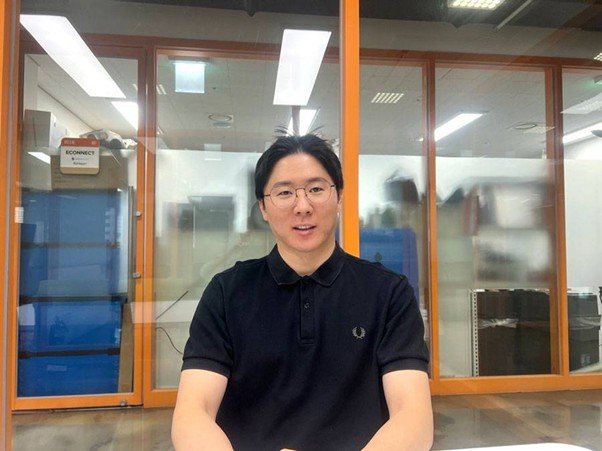
You seem to be actively utilizing support programs from the Seoul Metropolitan Government and the Seoul Business Agency (SBA). How helpful have they been?
Noh: The various support programs from the Seoul Metropolitan Government and the SBA are a huge help. Specifically, the provision of office space was extremely beneficial. Beyond just securing physical space, the formation of various networks through this has also been very impressive.
Cho: Working here leads to the creation of diverse networks. We are also collaborating based on those networks. The Seoul Startup Hub is home to many companies with technologies or features we don't possess. Furthermore, various support programs, especially the global expansion programs, have been helpful to us. Connecting with local networks has been particularly beneficial. Connecting us with capable people in the field—people who know the market well—is incredibly helpful. I sincerely recommend it to other startups. I strongly encourage them to maximize the utilization of the support provided.
What are your future plans, and is there a message you would like to convey to people?
Cho: We will, of course, grow our revenue, but more importantly, we will focus on enhancing the quality of our Big Data and maximizing the utility of our AI solution to boost our company's competitiveness. I want to convey the message to more people that sustainability and economic viability can be compatible. We want to change the perception that being eco-friendly only increases costs. We are proving that possibility.
Noh: We want to continue expanding the business. We aim to meet more customers and supply better products in the waste industry. We have begun overseas operations in places like the U.S. and will expand into wider markets in the future. Korea is a good market, but there are limitations to expansion.
We hope this article leads to contact from potential customers. Anyone who needs a solution that protects the environment and increases economic viability should contact us anytime. ECONNECT goes beyond simply recycling waste—we optimize it with data and AI. Our challenge to capture both the eco-friendly and economic viability rabbits continues. Feet-on-the-ground sales, data exploration, and sincere customer service—this is the secret to ECONNECT's success in domestic and international markets.
By Young-woo Kim (pengo@itdonga.com)
* This article was written with support from SBA and Seoul City.
- Their AI solution, Regenport, matches recycled material properties with supply and demand, serving major corporations and expanding into global markets.
- By leveraging data-driven processes and international networks, ECONNECT is overcoming startup challenges and actively growing both domestically and overseas.
It has long been considered difficult for companies to simultaneously pursue both environmental sustainability and economic viability. The prevailing notion was that pursuing eco-friendliness drove up costs, while prioritizing profitability meant sacrificing the environment. However, ECONNECT, led by CEO Min-hyung Cho, is overturning this formula using Big Data and AI technology. Through its AI solution, Regenport, which optimizes waste recycling, the company is proving that both sustainability and economic returns can be achieved.
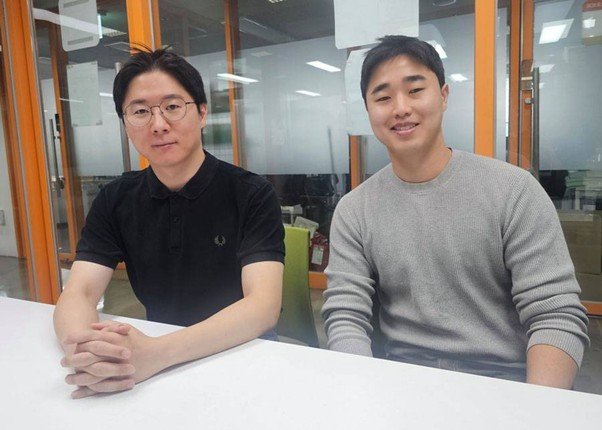
Min-hyung Cho, CEO of ECONNECT(left) and Young-woo Noh, Director(right) / source=IT dongA
ECONNECT is a South Korean circular economy startup founded in 2022. Cho and Director Young-woo Noh joined forces to establish the firm, which now operates a B2B business supplying customized recycled raw materials and products based on waste data. The company is generating revenue from major domestic Korean conglomerates and is beginning to see significant results in the U.S., European, and Middle Eastern markets.
The reporting team recently met with CEO Cho and Director Noh at the Seoul Startup Hub Gongdeok in Mapo-gu, Seoul, to hear ECONNECT’s growth story and future vision.
Starting a business with even close friends is rarely easy. What was the catalyst for the two of you joining forces?
Cho: This is my third time starting a business. I launched two ventures in college: the first was a local document delivery service, and the second was a beauty salon O2O platform. From the first, I learned the importance of persistence, and from the second, I learned that there is no such thing as a complete blue ocean. My past trials and errors have become a guide for my current business.
Noh: Cho and I were classmates in the Reserve Officers' Training Corps (ROTC). After my discharge from the military, I handled overseas sales at POSCO International, where I worked with eco-friendly raw materials. While cultivating an entrepreneurial dream, I met Cho, and we began preparing for the startup in 2021. ECONNECT was finally founded in 2022.
We heard ECONNECT went through two pivots. What was the process to arrive at the current business model?
Cho: We initially started with an eco-friendly toothbrush business. Access to sustainable raw materials was easy thanks to Director Noh’s network from his previous job. At the time, eco-friendly materials were not as common as they are now. However, while selling products through B2C and B2B channels, buyers showed more interest in the raw materials themselves than the toothbrushes.
So, in 2023, we introduced a service that built an eco-friendly materials database and curated it for purchasing managers. Yet, simple brokerage had its limitations. It was closer to a one-time service and posed a problem for sustainability.
Noh: The idea itself was in demand in the market, but it was difficult to build a sustainable business model purely on that. We decided to leverage the capabilities of our data-handling team to develop a better model.
Cho: That’s why we transitioned to an AI solutions business based on waste data starting in the second half of 2024. There are thousands of companies in Korea that produce recycled materials, and we determined that the party with the data would be able to capture greater demand. This is what we now call Regenport.
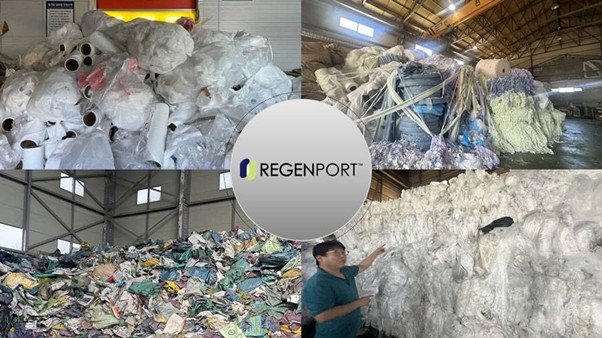
Regenport, focusing on the supply of raw materials based on waste / source=ECONNECT
What exactly is the Regenport solution?
Cho: Regenport is an AI solution that optimizes waste recycling. It goes beyond simple recycling to match material properties (mul-seong, or physical/chemical characteristics) and supply and demand. Just as plastic waste cannot immediately become a finished product, an intermediate blending process is necessary, and our AI recommends the optimal blend. Furthermore, unlike crude oil, the volume of waste generated fluctuates, making supply stabilization crucial—a problem our solution also addresses.
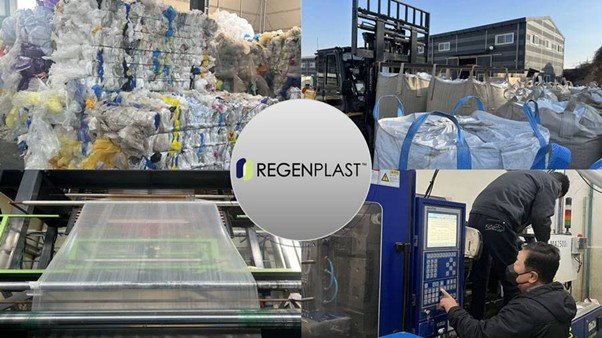
We can supply various packaging materials—such as films, injection-molded, and thermoformed products—through OEM/ODM arrangements. The brand name for the solution is 'Regenport,' meaning "a port for rebirth," and the resulting products supplied through it are called 'Regenplast.' It is fundamentally a 100% B2B business.
That’s an intriguing business model. Who are your main customers?
Noh: Regenport focuses on supplying raw materials through waste circularity, making major corporations and large-scale manufacturing plants our key customers. Regenplast, which involves finished products or components, targets a broader range of customers, including brand owners, distributors, and retailers. Simply put, customers who need raw materials use Regenport, and those who need something closer to a finished product use Regenplast.
Cho: We have much clearer targeting than in our previous business. While we previously targeted eco-friendly raw materials in general, we now concentrate only on recycled materials based on waste. Focusing on one thing rather than trying to do everything is the know-how gained from past trials and errors.
Regenplast, for customers needing finished products or components based on recycled materials / source=IT dongA
It seems there are other similar businesses. What is your differentiating factor?
Cho: Companies with similar business models already exist. The biggest difference is that we base the entire business on a data solution.
Noh: It’s difficult for companies to find the specific recycled raw materials they need. Our differentiator is utilizing our Big Data to analyze the material properties desired by the customer and find the optimal solution.
You mentioned Big Data and know-how as differentiators. Could you elaborate on the specific service delivery process?
Cho: There are three steps. If a customer wants to create a product, such as packaging, they can send us their existing product or raw material; if they don't have an existing product, they can send a similar one. We receive it, inspect its properties, search our database for the most optimal method, blend the raw materials, and create a sample (prototyping).
The second method involves taking the waste the customer is already discharging and using it to create raw materials or packaging—this is known as a Closed Loop system. Based on the customer's product samples or the waste they generate, we can propose the best result.
Is it genuinely possible to simultaneously enhance both sustainability and economic viability? It seems idealistic and difficult to realize.
Noh: It is indeed not easy to pursue both. But this is precisely our core know-how. The Big Data we have secured is the key. The painful mistakes of the past have now become invaluable experience that money cannot buy.
Cho: We conduct an extensive data search. This covers not just Korea but the entire world. All-directional searching to acquire high-quality data is essential. We scour both online and offline sources, and we are actively engaging on the global stage. It’s a cliché, but it’s easier said than done. Having gone through numerous trials and errors in the past, we have abandoned the idea of taking shortcuts.
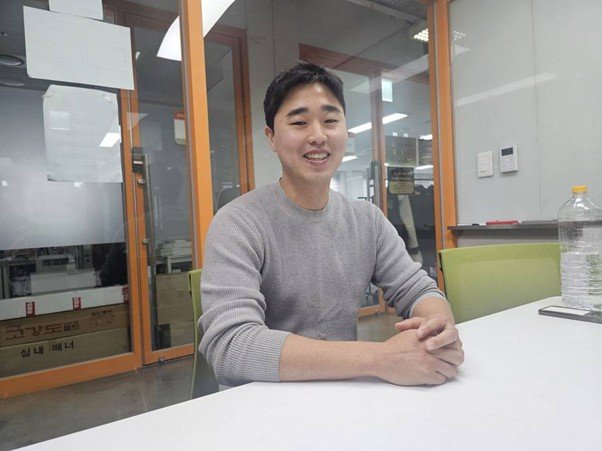
Young-woo Noh, Director of ECONNECT / source=IT dongA
What is the market reaction like? You seem to be active in both domestic and international markets.
Cho: The domestic market is not as heated as the overseas market because environmental regulations in Korea are not as strict. However, our customer base is steadily growing because the reputation that we can satisfy both sustainability and economic viability is gradually spreading.
For a specific example, a major integrated food company, whose name everyone would recognize, had a need to switch their packaging to eco-friendly options. We presented an alternative that met both their environmental and economic needs. Subsequently, we also began a project to recycle the waste they generate back into packaging materials.
Noh: We established our U.S. subsidiary in the first half of 2025. We are exporting to Europe, the U.S., and the Middle East, where environmental regulations are tightening. Regulations requiring a certain percentage of recycled raw materials are favorable to our product sales.
In the U.S., while we supply raw materials, packaging supply is our main focus. Our primary customers are U.S. retailers; we are exporting eco-friendly packaging to a major supermarket franchise. We strive to keep track of various news and trends to pioneer overseas markets. Last year, upon hearing that environmental regulations were strengthening, I went on a two-week business trip to sell our solutions. We mobilized our existing network and engaged in feet-on-the-ground sales. When we sold with sincerity, people recognized our value.
In Europe, we started with the raw materials business. Knowing that regulations in the European automotive industry are strong, we proposed our solution to an automotive parts factory. We are now supplying recycled raw materials to an automotive parts company in Italy. The common factor is the strong appeal we make to solve their challenges in responding to the ever-tightening environmental regulations. Both domestic and overseas customers are invaluable to us.
You mentioned many trials and errors. What difficulties have you faced in developing the business so far?
Cho: Because we are a small company, it was very difficult to land initial deals. This is a common struggle for any startup. It’s hard to do sales and marketing when brand awareness is low, which poses a significant hurdle.
Noh: As the company grows, we need to hire talent, but recruiting excellent personnel is challenging. It is a fact that a company needs good people to grow.
Cho: By constantly engaging and working hard, we are establishing references domestically and steadily building them up overseas. There is no royal road. We must thoroughly analyze customer challenges and be able to solve them. Every country has different cultures and different holidays. We are dedicating significant effort to understanding local business cultures.
Min-hyung Cho, CEO of ECONNECT / source=IT dongA
You seem to be actively utilizing support programs from the Seoul Metropolitan Government and the Seoul Business Agency (SBA). How helpful have they been?
Noh: The various support programs from the Seoul Metropolitan Government and the SBA are a huge help. Specifically, the provision of office space was extremely beneficial. Beyond just securing physical space, the formation of various networks through this has also been very impressive.
Cho: Working here leads to the creation of diverse networks. We are also collaborating based on those networks. The Seoul Startup Hub is home to many companies with technologies or features we don't possess. Furthermore, various support programs, especially the global expansion programs, have been helpful to us. Connecting with local networks has been particularly beneficial. Connecting us with capable people in the field—people who know the market well—is incredibly helpful. I sincerely recommend it to other startups. I strongly encourage them to maximize the utilization of the support provided.
What are your future plans, and is there a message you would like to convey to people?
Cho: We will, of course, grow our revenue, but more importantly, we will focus on enhancing the quality of our Big Data and maximizing the utility of our AI solution to boost our company's competitiveness. I want to convey the message to more people that sustainability and economic viability can be compatible. We want to change the perception that being eco-friendly only increases costs. We are proving that possibility.
Noh: We want to continue expanding the business. We aim to meet more customers and supply better products in the waste industry. We have begun overseas operations in places like the U.S. and will expand into wider markets in the future. Korea is a good market, but there are limitations to expansion.
We hope this article leads to contact from potential customers. Anyone who needs a solution that protects the environment and increases economic viability should contact us anytime. ECONNECT goes beyond simply recycling waste—we optimize it with data and AI. Our challenge to capture both the eco-friendly and economic viability rabbits continues. Feet-on-the-ground sales, data exploration, and sincere customer service—this is the secret to ECONNECT's success in domestic and international markets.
By Young-woo Kim (pengo@itdonga.com)
* This article was written with support from SBA and Seoul City.


![[단독]노태악, 선관위서 수당 4년간 1.8억 받아…3배 ‘셀프 증액’도](https://dimg.donga.com/c/138/175/90/1/wps/NEWS/IMAGE/2026/06/19/134144622.1.jpg)


 About Dong-A Ilbo