

Silent theft preys on Koreans with dementia
Silent theft preys on Koreans with dementia
Posted December. 17, 2025 08:35,
Updated December. 17, 2025 08:35
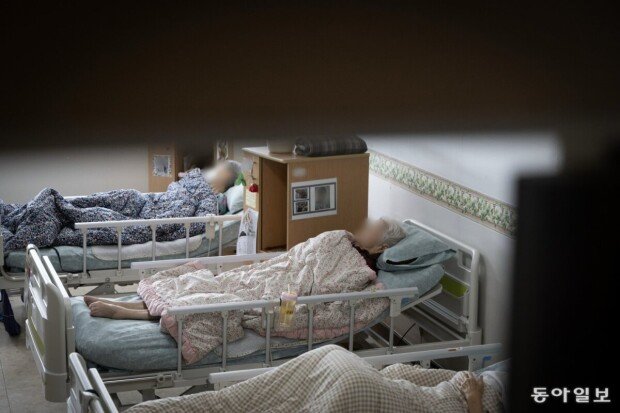
A silver cart piled high with white linen sheets, diapers and disposable plastic bags rolled down the corridor. As diapers soiled overnight by elderly residents spilled out, a sharp ammonia odor spread through the hallway, cutting through the stinging scent of disinfectant. “Whirr, whirr.” The steady hum of washing machines and the hurried footsteps of care workers quickly filled what had moments earlier been a silent passage.
The cart came to a stop at Room 706. When the half-closed sliding door was pulled fully open, eight eyes hovering above four beds turned toward the doorway in unison. Some still carried the weight of lingering sleep. As a care worker skillfully replaced the wet diapers and laid fresh linen on the beds, daylight slowly filtered in beyond the window, its blinds still drawn. This was how the morning unfolded on the seventh floor of Uri Nursing Home on Nov. 19.
Behind this seemingly ordinary nursing home scene, one that could be found in any city, lay a hidden national tragedy of systematic exploitation. There was the elderly resident in Room 701, whose basic pension was quietly siphoned off month after month, leaving his bank account completely empty. In Room 703 was another resident whose nursing home fees had gone unpaid for more than a year, even as his children never once came to visit. In Room 702, a resident lost 80 percent of his assets within just months of being admitted.
They are only three among more than 310,000 dementia patients living in 5,917 long-term care facilities nationwide. After contacting 321 facilities in cooperation with the Korea Association of Senior Long-Term Care Institutions, The Dong-A Ilbo’s Hero Content Team identified signs of what it calls “dementia money hunting” at 54 of them. From large nursing hospitals in major cities to small care homes in rural villages, elderly residents were found to be having their assets stripped away, even at this very moment, by people listed as family members or neighbors. Only one facility reported having a resident whose assets were protected by a legally appointed guardian.
The reporting team spent 24 hours observing daily life in the seventh-floor ward of Uri Nursing Home, where 43 elderly residents with dementia live. It closely examined the lives of three residents who had lost their assets and become cut off from the outside world. In the gaps of a fragile protection system, deep blind spots had taken root, making it alarmingly easy to take the property of elderly people whose memories are steadily fading.

![[단독]“거부도 못해” 요양병원 ‘콧줄 환자’ 8만명](https://dimg.donga.com/c/138/175/90/1/wps/NEWS/IMAGE/2026/03/02/133450041.2.jpg)






 About Dong-A Ilbo