

Korea completes first public-private rocket launch
Korea completes first public-private rocket launch
Posted November. 28, 2025 07:12,
Updated November. 28, 2025 07:12
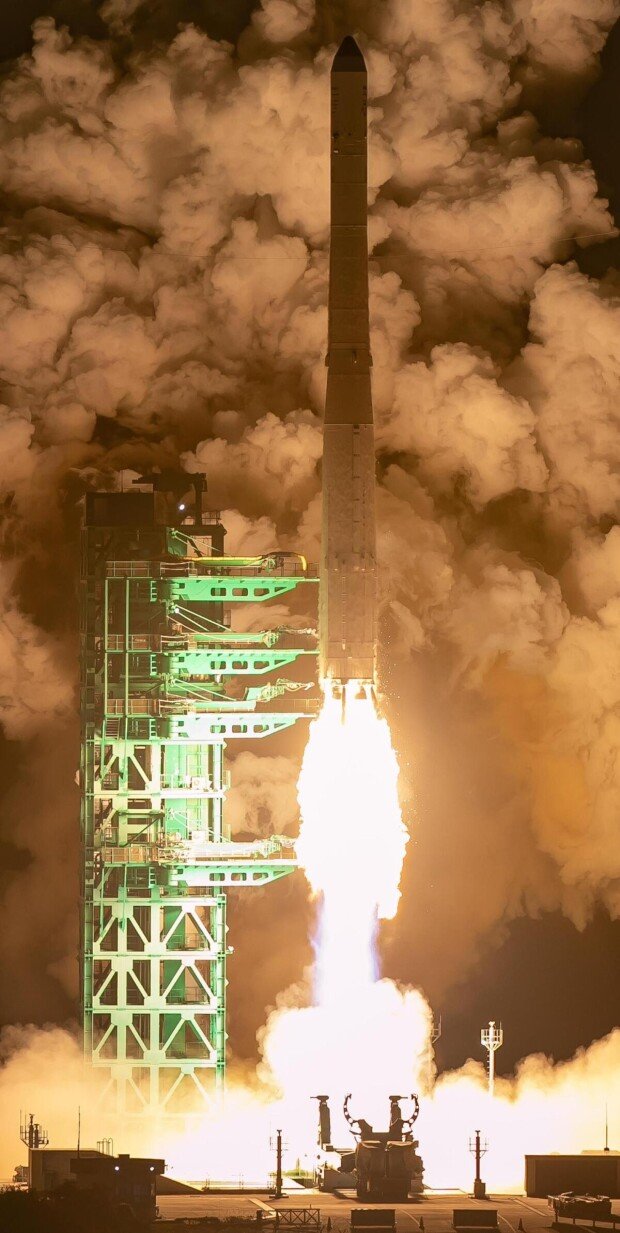
“5, 4, 3, 2, 1, Nuri has launched.”
At 1:13 a.m. on Nov. 27 at the Naro Space Center in Goheung, South Jeolla Province, cheers erupted as the countdown marked the fourth launch of the Nuri rocket, a Korean launch vehicle developed using domestic technology. Amid the support of citizens, Nuri soared through the dark sky, sequentially separating its first stage, the fairing covering the third stage carrying the satellite, and the second stage, successfully deploying the main payload, the Next-Generation Medium Satellite 3.
The remaining 12 satellites were released sequentially. When the Antarctic King Sejong Station ground station successfully established initial contact with the Next-Generation Medium Satellite 3 at 1:55 a.m., the Korea Aerospace Research Institute officially confirmed the success of the fourth Nuri launch at 2:40 a.m.
For the first three launches, the Korea Aerospace Research Institute oversaw production and launch operations. However, the fourth launch marked the first time a private company, Hanwha Aerospace, led assembly and overall production management. This signaled the start of a “New Space” era in South Korea, similar to the United States, where private companies take the lead in space development.
“This launch is significant both for ensuring the reliability of the launch vehicle and for transferring technology to the private sector," said Jin Jeong-geun, a professor of aerospace engineering at KAIST. "It is especially meaningful because companies internalized the technology themselves, showing the potential for future privately led launch vehicle development.”
The fourth Nuri launch was also the first night launch. Just before liftoff, an anomaly occurred in the umbilical recovery pressure sensor, delaying the launch from the originally scheduled 12:55 a.m. to 1:13 a.m., a delay of 18 minutes. Despite this, the launch proceeded without incident. “Night launches are not technically more difficult, but the biggest concern was the potential drop in concentration among launch personnel," Park Jong-chan, head of the Korean Launch Vehicle Advancement Project at the Korea Aerospace Research Institute. "To prepare, we conducted multiple full-scale rehearsal exercises in advance.” The fifth launch is scheduled for next year, with the sixth planned for 2027.
At a briefing on the launch results, Deputy Prime Minister and Minister of Science and ICT Bae Gyeong-hoon highlighted the success, saying, “This not only proves once again that South Korea has independent space transport capabilities, but also marks the first public-private joint launch conducted as a unified team by the government, private companies, and national research institutes.”
President Lee Jae-myung posted on Facebook the same day, calling the launch a moment that opened a new chapter in South Korea’s space development history.
고흥=최지원 jwchoi@donga.com



![“앤트로픽 버렸다” 미국 개발자들이 중국 AI로 갈아타는 이유[딥다이브]](https://dimg.donga.com/c/138/175/90/1/wps/NEWS/IMAGE/2026/06/24/134171473.1.jpg)



 About Dong-A Ilbo