

Lee proposes flexible approach to South Korea-U.S. exercises
Lee proposes flexible approach to South Korea-U.S. exercises
Posted November. 25, 2025 08:19,
Updated November. 25, 2025 08:19
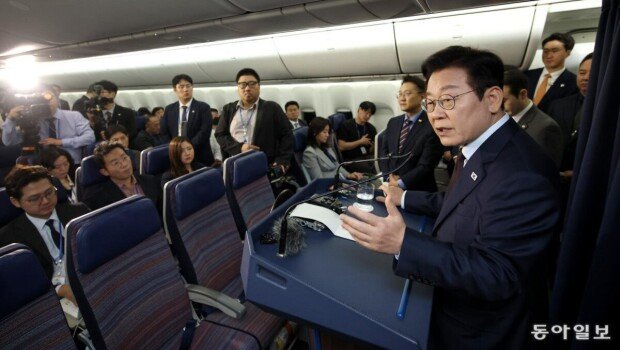
President Lee Jae-myung said on Nov. 23, local time, “What North Korea is most sensitive about is the South Korea-U.S. joint military exercises,” adding, “If a firm peace regime is established between the two Koreas, it would be desirable not to conduct them.” His remarks suggested the joint drills could be used as a bargaining tool in efforts to build a peace framework with North Korea.
During a press briefing aboard Air Force One while traveling to Türkiye, the final stop of his tour of four Middle Eastern and African nations, Lee said, “Some argue that we should consider preemptively reducing or postponing the scale of the drills,” before reiterating his position. “If a solid peace regime is established between the two Koreas, not conducting them would be preferable,” he said. “Depending on the situation, it could serve as leverage or become a result. It is difficult to say anything definitive at this point.” His comments indicated that suspending the joint drills could be used as an incentive to restart inter-Korean or U.S.-North Korea dialogue.
The National Intelligence Service told the National Assembly Intelligence Committee during a Nov. 4 hearing that North Korea may prioritize contact with the United States by leveraging its closer ties with Russia and improving relations with China. The agency assessed that the joint exercises scheduled for next March could become a turning point for restarting U.S.-North Korea talks. In September, Kim Yo Jong, deputy director of the North Korean Workers’ Party, criticized the exercises as “a reckless show of force.”
Lee said South Korea must ultimately take responsibility for its own defense and establish a firm peace regime in which military exercises and war are unnecessary. He added, “In that case, we would not need joint military exercises that President Donald Trump does not like because they cost money.”
He also emphasized that South Korea still does not have wartime operational control and that some people misunderstand or distort the situation, as if the country cannot defend itself without external support. “This must be corrected as soon as possible,” he said. According to the joint statement from the South Korea-U.S. Security Consultative Meeting, the two countries agreed to speed up the transition of wartime operational control by completing Phase 2 verification next year.
Meanwhile, Lee paid a state visit to Türkiye the same day and held a summit with President Recep Tayyip Erdogan. During the meeting, he discussed ways to strengthen cooperation in defense, nuclear energy and biotechnology, and the two leaders signed memorandums of understanding.
Hoon-Sang Park tigermask@donga.com






 About Dong-A Ilbo