

Lee announces reform agenda to boost growth potential
Lee announces reform agenda to boost growth potential
Posted November. 14, 2025 07:36,
Updated November. 14, 2025 07:36
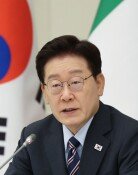
President Lee Jae-myung on Nov. 13 outlined plans to pursue structural reforms in six key areas: regulation, finance, public enterprises, pensions, education, and labor. He said that maintaining the current economic and social systems alone would make it difficult to increase South Korea’s declining potential growth rate. He also urged the presidential office and the government to prepare so that next year could mark the start of a national transformation through structural reform.
During a meeting with senior presidential aides on Nov. 12, Lee said, “Each time a new administration takes office, the potential growth rate drops by one percentage point, and it could soon turn negative. With the spark of economic recovery now ignited, this is the right time for structural reform.” His comments signal an intention to accelerate reforms next year, leveraging the near-completion of South Korea-U.S. tariff negotiations and improvements in economic indicators such as consumer spending. The rise in public approval following the Asia-Pacific Economic Cooperation summit may also have influenced the timing.
The Korea Development Institute recently raised its growth forecast for this year from 0.8 percent to 0.9 percent, reflecting a recovery in semiconductor demand and domestic consumption. It also revised next year’s growth forecast from 1.6 percent to 1.8 percent. Despite this potential economic rebound, the projections still fall short of the administration’s goal of restoring a 3 percent potential growth rate. Potential growth rate refers to the maximum growth an economy can achieve without triggering inflation.
The areas identified by the president, including regulation, finance, and labor, are closely linked to economic growth. In advanced countries, industries such as autonomous vehicles and urban air mobility, or UAM, are approaching commercialization, but in South Korea they remain constrained by extensive regulations. The financial system, which relies primarily on housing loans, is inadequate for nurturing innovative industries. Labor markets marked by intense conflicts between employers and employees are a major factor eroding national competitiveness. Education systems that fail to supply talent needed in the artificial intelligence era, pension systems that only delay depletion, and poorly managed state-run enterprises are also urgent areas for reform.
In this context, the decision to accelerate reforms early in the term appears timely. However, as seen with unresolved issues such as exemptions for semiconductor R&D personnel from the 52-hour workweek, disagreements and conflicts among stakeholders are likely unavoidable. Since the stated goal of the reforms is to enhance growth potential, their success will depend on the government’s ability to present policies aligned with this objective and to persuade those with differing views.

![[속보]트럼프 “이란과 14일 합의 서명”…혁명수비대 “절대 없을 것”](https://dimg.donga.com/c/138/175/90/1/wps/NEWS/IMAGE/2026/06/14/134105551.1.jpg)




 About Dong-A Ilbo