

DXR Helps Automation of Manufacturing Process with RoV and SynthVision.
DXR Helps Automation of Manufacturing Process with RoV and SynthVision.
Posted November. 13, 2025 16:19,
- DXR develops AI-driven manufacturing automation solutions, including RoV, a robot vision inspection system, and SynthVision, a toolkit for generating virtual defective data to train AI models.
- After successful proof-of-concept tests with automotive parts companies, DXR secured supply contracts and received positive feedback for both solutions.
- DXR plans to enhance its offerings, expand globally, and contribute to revitalizing the domestic manufacturing industry.
DXR is developing manufacturing process automation solutions leveraging AI vision, robotics, and digital twin technologies. Its core solution is RoV (Robot Vision), an AI inspection automation solution. RoV attaches a camera and lighting to the end of a robot arm, scanning all surfaces of a product in real-time. This design allows for easy application in high-mix production, non-standard product inspection, and even mixed-model production lines where multiple products are manufactured on a single line.
Concurrently, the company is developing SynthVision, a toolkit for generating virtual defective data for training AI models. By creating defective data from images of non-defective products, SynthVision helps companies adopting AI to save time and costs associated with dataset construction.
After launching RoV 1.0 last December, DXR conducted Proof of Concept (PoC) tests with three mid-sized enterprises specializing in automotive parts. Following successful validation of its performance and effectiveness, the company secured supply contracts. SynthVision has also been provided to AI-adopting enterprises through government support programs, receiving positive feedback. DXR aims to contribute to the revitalization of the domestic manufacturing industry through solution enhancement, business expansion, and global market entry.
We met withEun-ho Kim, CEO of DXR, to discuss the company, RoV, and SynthVision.
DXR: Providing Manufacturing Process Automation Solutions
Please introduce yourself.
I am Eun-ho Kim of DXR. I graduated with a Master's in Artificial Intelligence from Sungkyunkwan University, and my primary research field is AI vision. As a student, I was in a control robotics lab, where I also researched AI vision for mobile robot platforms. After graduation, I worked as a researcher at the LG Electronics Production Engineering Research Institute (PRI) and at Hyundai Mobis, participating in the development of vision inspection solutions for secondary batteries and lane recognition solutions. I then joined DXR in 2023.
What led you to join DXR?
Throughout my university and graduate school years, I experienced various process automation projects involving mobile robots and manipulators (robot arms that handle and move objects). Later, working in the industry, I realized the competitiveness of process automation. During that time, my graduate school colleagues and I often discussed that there weren't many standout startups in the robotics and manipulator fields, and we talked about building an innovative company in that space ourselves. This eventually led me to join DXR. DXR was incorporated in 2022 and explored several avenues, but we began full-scale business development in 2023 when I joined with my former lab colleagues.
What kind of company is DXR?
DXR is a startup that supplies manufacturing process automation solutions. The company name is an acronym for 'Digital Transformation Research,' signifying our commitment to providing solutions for digital transformation. We operate under the mission 'Creating a future of shared growth with customers through innovative technology' and the vision 'Realizing a future where humans and robots coexist.' We are developing automation solutions for manufacturing processes. We have filed for 8 patents related to AI, robotics, and digital twin technology, with one patent registered and one Patent Cooperation Treaty (PCT) application filed, as we continue to secure intellectual property.
RoV: A Robot Arm Equipped with Camera and Lighting
Please introduce DXR's main solutions and their features.
The manufacturing industry is shifting from low-mix, high-volume production to high-mix, low-volume production. However, existing automation solutions struggle to adequately respond to this change. They face limitations such as securing quality data and the high reconfiguration costs and time required when products change. We are developing automation solutions tailored to this manufacturing trend using AI vision, robotics, and digital twin technology.
Our core solution is RoV, the AI inspection automation solution. RoV uses AI vision and robotics to inspect the external quality of products. Its biggest feature is the design: a camera and lighting attached to the end of a robot arm. By setting an optimal scan path tailored to the product, the robot moves and scans all surfaces in real-time.
Thanks to this, it can be applied to mixed-model production lines that manufacture multiple products on one line. Most existing AI vision inspection solutions are stationary. Because the camera and lighting are fixed in a specific position, changing the product requires additional cost and time to reconfigure them. This is not suitable for mixed-model production. However, RoV only requires changing the robot arm's settings, making it easily applicable to such lines. Naturally, this also reduces reconfiguration costs and time. Actual PoC results showed a reduction in reconfiguration costs by about 70% compared to existing solutions.
Furthermore, RoV can inspect products in real-time as they move on a conveyor belt. Existing stationary solutions often have to stop the belt for capture, which can disrupt production volume or process cycle time. RoV captures images continuously while moving, so it does not affect production volume or cycle time. It is also advantageous for inspecting non-standard products. Because the robot moves and captures all surfaces, it can detect defects that stationary inspection solutions might miss.
We are also developing 'AI Picking' and 'DX Universe.' AI Picking is a solution that picks up an object from a specific location and moves it to another. Its feature is the ability to accurately grasp the required product and move it to a specific location, even when mixed with other objects. AI Picking has completed PoC and is awaiting a supply contract.
DX Universe is a robot control automation solution that generates a robot simulation screen using digital twin technology, allowing users to configure the robot arm's movements. This enables even non-experts to easily set the robot arm's position, movements, and desired tasks. We are preparing to offer DX Universe along with RoV and AI Picking as a total manufacturing automation solution.
SynthVision: Creating Defective Data from Non-Defective Images
Besides process automation, I heard you are also developing SynthVision. What kind of solution is it?
SynthVision is a toolkit that virtually generates defective data. Because our solutions are AI-based, we need both non-defective and defective data to train the AI models. However, collecting defective data is not easy.
SynthVision utilizes Generative AI and 3D deformation technology to superimpose scratches, dents, and other defects onto images of non-defective products, thereby creating virtual defective data. The size and location can be freely adjusted. Unlike other solutions, SynthVision's differentiator is that it generates defective data using only non-defective images. No separate defective data is needed. It also actively incorporates feedback from on-site workers to enhance accuracy and efficiency.
SynthVision was launched in the first quarter of this year. Through PoCs, we confirmed its effectiveness in reducing the cost and time for AI model dataset construction by over 50% and cutting AI vision inspection solution deployment time by over 90%. We are currently upgrading the solution by expanding defect types and improving data accuracy.
From PoC Completion to Supply Contracts
Please tell us about your business progress so far.
For RoV, after launching version 1.0 in December 2024, we conducted PoCs with three mid-sized enterprises in the automotive parts sector. The results confirmed effects of over 30% in labor cost reduction and a 40% improvement in defect detection rates. This performance was recognized, leading to supply contracts, and we are currently negotiating additional contracts.
Automotive parts processes are often high-mix and involve mixed-model lines, making it difficult to introduce AI vision inspection. RoV not only has high inspection accuracy but also provides process automation, labor cost reduction, and reduced worker fatigue, resulting in high customer satisfaction. One customer mentioned they had been reviewing inspection automation for 10 years, but this was the first time it led to an actual supply contract.
In the case of SynthVision, we have completed sales through government support programs. We are receiving positive feedback, such as how it has enabled companies that adopted AI inspection solutions to train their AI models more easily.
Additionally, we secured seed investment from KingoSpring in 2024. As of last December, we are conducting various government-supported projects, including TIPS (Tech Incubator Program for Startups), the ‘Didimdol’ R&D program, and the Early Stage Startup Package. The Seoul AI Hub, where we are currently located, is another example. We require a large space to accommodate our robots, and the ample space provided here has significantly increased our work efficiency.
You are currently receiving support from the ‘SeoulTech Early Stage Startup Package’. What kind of support did you receive?
Through the SeoulTech Early Stage Startup Package program, we received commercialization funds and support from various growth programs. We gained opportunities to participate in 1:1 meetups with investors and open innovation programs. We are receiving practical help necessary for our company's growth. (SeoulTech: Seoul National University of Science and Technology)
Finally, please tell us about DXR's future plans.
We plan to release RoV 2.0 within this year. We are developing it by reflecting customer feedback on aspects like shooting speed and volume, lighting optimization, robot control algorithm optimization, and AI model performance enhancement. We expect overall performance to improve. Furthermore, by launching manufacturing automation solutions like AI Picking and DX Universe, we plan to expand our automation business beyond automotive parts into other manufacturing areas, such as displays and F&B.
We are also preparing for our Pre-Series A funding round. Through this, we plan to secure additional R&D talent and advance our solutions, focusing further on securing technological competitiveness. Concurrently, we plan to establish an overseas branch next year for a full-scale entry into the global market. We are currently considering the North American market, which has a large market size. Ultimately, we aim to build a total smart factory solution that fits the current manufacturing trends, thereby contributing to the revitalization of the stagnant domestic manufacturing industry.
By Man-hyuk Han (mh@itdonga.com)
- After successful proof-of-concept tests with automotive parts companies, DXR secured supply contracts and received positive feedback for both solutions.
- DXR plans to enhance its offerings, expand globally, and contribute to revitalizing the domestic manufacturing industry.
DXR is developing manufacturing process automation solutions leveraging AI vision, robotics, and digital twin technologies. Its core solution is RoV (Robot Vision), an AI inspection automation solution. RoV attaches a camera and lighting to the end of a robot arm, scanning all surfaces of a product in real-time. This design allows for easy application in high-mix production, non-standard product inspection, and even mixed-model production lines where multiple products are manufactured on a single line.
Concurrently, the company is developing SynthVision, a toolkit for generating virtual defective data for training AI models. By creating defective data from images of non-defective products, SynthVision helps companies adopting AI to save time and costs associated with dataset construction.
After launching RoV 1.0 last December, DXR conducted Proof of Concept (PoC) tests with three mid-sized enterprises specializing in automotive parts. Following successful validation of its performance and effectiveness, the company secured supply contracts. SynthVision has also been provided to AI-adopting enterprises through government support programs, receiving positive feedback. DXR aims to contribute to the revitalization of the domestic manufacturing industry through solution enhancement, business expansion, and global market entry.
We met withEun-ho Kim, CEO of DXR, to discuss the company, RoV, and SynthVision.
DXR: Providing Manufacturing Process Automation Solutions
Please introduce yourself.
I am Eun-ho Kim of DXR. I graduated with a Master's in Artificial Intelligence from Sungkyunkwan University, and my primary research field is AI vision. As a student, I was in a control robotics lab, where I also researched AI vision for mobile robot platforms. After graduation, I worked as a researcher at the LG Electronics Production Engineering Research Institute (PRI) and at Hyundai Mobis, participating in the development of vision inspection solutions for secondary batteries and lane recognition solutions. I then joined DXR in 2023.
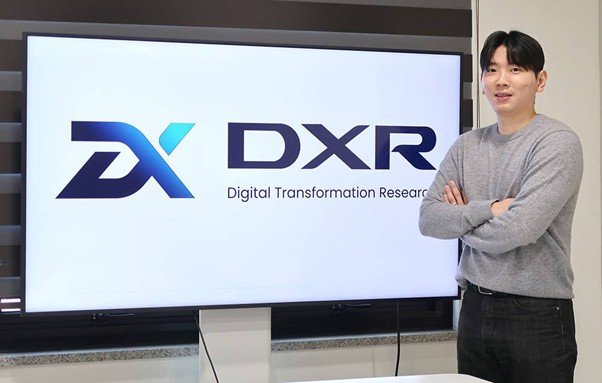
Eun-ho Kim, CEO of DXR / source=IT dongA
What led you to join DXR?
Throughout my university and graduate school years, I experienced various process automation projects involving mobile robots and manipulators (robot arms that handle and move objects). Later, working in the industry, I realized the competitiveness of process automation. During that time, my graduate school colleagues and I often discussed that there weren't many standout startups in the robotics and manipulator fields, and we talked about building an innovative company in that space ourselves. This eventually led me to join DXR. DXR was incorporated in 2022 and explored several avenues, but we began full-scale business development in 2023 when I joined with my former lab colleagues.
What kind of company is DXR?
DXR is a startup that supplies manufacturing process automation solutions. The company name is an acronym for 'Digital Transformation Research,' signifying our commitment to providing solutions for digital transformation. We operate under the mission 'Creating a future of shared growth with customers through innovative technology' and the vision 'Realizing a future where humans and robots coexist.' We are developing automation solutions for manufacturing processes. We have filed for 8 patents related to AI, robotics, and digital twin technology, with one patent registered and one Patent Cooperation Treaty (PCT) application filed, as we continue to secure intellectual property.
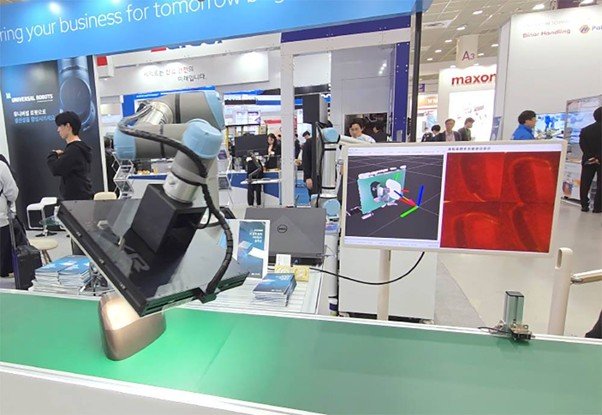
AI inspection automation solution, ROV / source=DXR
RoV: A Robot Arm Equipped with Camera and Lighting
Please introduce DXR's main solutions and their features.
The manufacturing industry is shifting from low-mix, high-volume production to high-mix, low-volume production. However, existing automation solutions struggle to adequately respond to this change. They face limitations such as securing quality data and the high reconfiguration costs and time required when products change. We are developing automation solutions tailored to this manufacturing trend using AI vision, robotics, and digital twin technology.
Our core solution is RoV, the AI inspection automation solution. RoV uses AI vision and robotics to inspect the external quality of products. Its biggest feature is the design: a camera and lighting attached to the end of a robot arm. By setting an optimal scan path tailored to the product, the robot moves and scans all surfaces in real-time.
Thanks to this, it can be applied to mixed-model production lines that manufacture multiple products on one line. Most existing AI vision inspection solutions are stationary. Because the camera and lighting are fixed in a specific position, changing the product requires additional cost and time to reconfigure them. This is not suitable for mixed-model production. However, RoV only requires changing the robot arm's settings, making it easily applicable to such lines. Naturally, this also reduces reconfiguration costs and time. Actual PoC results showed a reduction in reconfiguration costs by about 70% compared to existing solutions.
Furthermore, RoV can inspect products in real-time as they move on a conveyor belt. Existing stationary solutions often have to stop the belt for capture, which can disrupt production volume or process cycle time. RoV captures images continuously while moving, so it does not affect production volume or cycle time. It is also advantageous for inspecting non-standard products. Because the robot moves and captures all surfaces, it can detect defects that stationary inspection solutions might miss.
We are also developing 'AI Picking' and 'DX Universe.' AI Picking is a solution that picks up an object from a specific location and moves it to another. Its feature is the ability to accurately grasp the required product and move it to a specific location, even when mixed with other objects. AI Picking has completed PoC and is awaiting a supply contract.
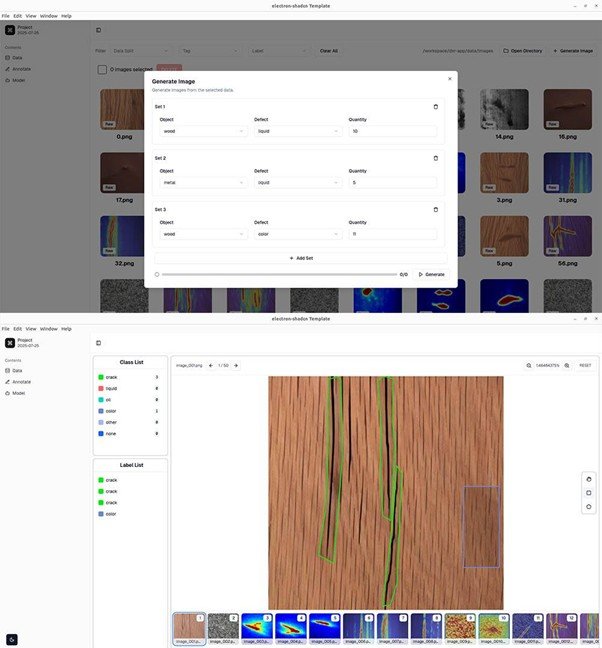
SynthVision, toolkit that virtually generates defective data / source=DXR
DX Universe is a robot control automation solution that generates a robot simulation screen using digital twin technology, allowing users to configure the robot arm's movements. This enables even non-experts to easily set the robot arm's position, movements, and desired tasks. We are preparing to offer DX Universe along with RoV and AI Picking as a total manufacturing automation solution.
SynthVision: Creating Defective Data from Non-Defective Images
Besides process automation, I heard you are also developing SynthVision. What kind of solution is it?
SynthVision is a toolkit that virtually generates defective data. Because our solutions are AI-based, we need both non-defective and defective data to train the AI models. However, collecting defective data is not easy.
SynthVision utilizes Generative AI and 3D deformation technology to superimpose scratches, dents, and other defects onto images of non-defective products, thereby creating virtual defective data. The size and location can be freely adjusted. Unlike other solutions, SynthVision's differentiator is that it generates defective data using only non-defective images. No separate defective data is needed. It also actively incorporates feedback from on-site workers to enhance accuracy and efficiency.
SynthVision was launched in the first quarter of this year. Through PoCs, we confirmed its effectiveness in reducing the cost and time for AI model dataset construction by over 50% and cutting AI vision inspection solution deployment time by over 90%. We are currently upgrading the solution by expanding defect types and improving data accuracy.
From PoC Completion to Supply Contracts
Please tell us about your business progress so far.
For RoV, after launching version 1.0 in December 2024, we conducted PoCs with three mid-sized enterprises in the automotive parts sector. The results confirmed effects of over 30% in labor cost reduction and a 40% improvement in defect detection rates. This performance was recognized, leading to supply contracts, and we are currently negotiating additional contracts.
Automotive parts processes are often high-mix and involve mixed-model lines, making it difficult to introduce AI vision inspection. RoV not only has high inspection accuracy but also provides process automation, labor cost reduction, and reduced worker fatigue, resulting in high customer satisfaction. One customer mentioned they had been reviewing inspection automation for 10 years, but this was the first time it led to an actual supply contract.
In the case of SynthVision, we have completed sales through government support programs. We are receiving positive feedback, such as how it has enabled companies that adopted AI inspection solutions to train their AI models more easily.
Additionally, we secured seed investment from KingoSpring in 2024. As of last December, we are conducting various government-supported projects, including TIPS (Tech Incubator Program for Startups), the ‘Didimdol’ R&D program, and the Early Stage Startup Package. The Seoul AI Hub, where we are currently located, is another example. We require a large space to accommodate our robots, and the ample space provided here has significantly increased our work efficiency.
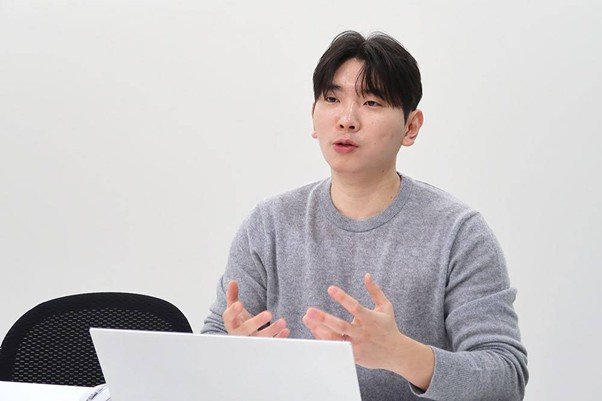
Kim explained RoV and SynthVision / source=IT dongA
You are currently receiving support from the ‘SeoulTech Early Stage Startup Package’. What kind of support did you receive?
Through the SeoulTech Early Stage Startup Package program, we received commercialization funds and support from various growth programs. We gained opportunities to participate in 1:1 meetups with investors and open innovation programs. We are receiving practical help necessary for our company's growth. (SeoulTech: Seoul National University of Science and Technology)
Finally, please tell us about DXR's future plans.
We plan to release RoV 2.0 within this year. We are developing it by reflecting customer feedback on aspects like shooting speed and volume, lighting optimization, robot control algorithm optimization, and AI model performance enhancement. We expect overall performance to improve. Furthermore, by launching manufacturing automation solutions like AI Picking and DX Universe, we plan to expand our automation business beyond automotive parts into other manufacturing areas, such as displays and F&B.
We are also preparing for our Pre-Series A funding round. Through this, we plan to secure additional R&D talent and advance our solutions, focusing further on securing technological competitiveness. Concurrently, we plan to establish an overseas branch next year for a full-scale entry into the global market. We are currently considering the North American market, which has a large market size. Ultimately, we aim to build a total smart factory solution that fits the current manufacturing trends, thereby contributing to the revitalization of the stagnant domestic manufacturing industry.
By Man-hyuk Han (mh@itdonga.com)




![‘탱크 탑승’은 후계의 상징…김정은 26세, 주애는 13세에 올라[청계천 옆 사진관]](https://dimg.donga.com/c/138/175/90/1/wps/NEWS/IMAGE/2026/04/01/133646988.1.jpg)



 About Dong-A Ilbo