

NUCODE implements a module-based ecosystem that anyone easily makes IoT products/services.
NUCODE implements a module-based ecosystem that anyone easily makes IoT products/services.
Posted November. 13, 2025 15:38,
Updated November. 13, 2025 15:41
- NUCODE is a Korean startup that develops micro-sized, low-power IoT modules and an AI-powered development environment, making it easy for anyone—even non-experts—to create IoT products and services.
- Their core technology enables devices to operate efficiently in power-scarce environments, and they offer solutions that address security vulnerabilities found in foreign modules by developing everything in-house.
- NUCODE also collaborates with educational institutions and global partners, aiming to build a comprehensive domestic IoT ecosystem and expand commercialization of products like the AI-powered, wireless CCTV HoduCam.
With the rise of the Artificial Intelligence (AI) era, another field has gained prominence: the Internet of Things (IoT). This technology connects all devices used in daily life or industrial sites to a network, allowing them to exchange data and interoperate.
However, the domestic IoT market in Korea is highly dependent on foreign products. This has created a difficult situation for domestic developers seeking technical support. As security issues have also emerged, the need for a domestic IoT ecosystem has grown even stronger.
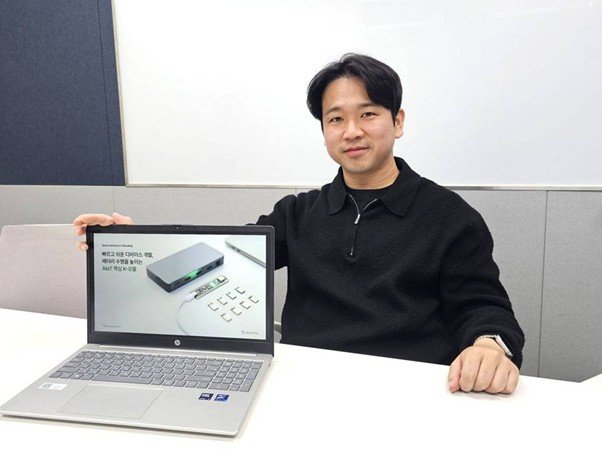
‘NUCODE’ (CEO Bruce Lee) is a startup that has stepped up to solve these problems. By introducing its low-power 'NU Module' and a development environment accessible to non-experts, it is helping anyone easily develop IoT products or services.
We spoke with CEO Bruce Lee, who worked as an automotive parts design engineer in Germany before returning to Korea to found the company, about his entrepreneurial journey and NUCODE's innovative technology.
What inspired you to start a company in the IoT field? Does the company name 'NUCODE' have a special meaning?
I was originally a mechanical engineer designing automotive parts in Germany, but during the COVID-19 pandemic, I was preparing to start a business in remote healthcare. I found that the electronics and computer fields were completely different, and the process was incredibly complex. Even with a good idea, the path from prototyping to mass production was not easy.
That’s when I learned about global module companies and noticed that there were no prominent Korean brands making low-power modules or Bluetooth IoT modules. Domestic engineers were forced to use foreign modules, which meant it was difficult to get technical support, and all the documentation was in English or Chinese, preventing them from using 100% of the features.
The name 'NUCODE' was inspired by the recent trend of 'No-code' (a development method that allows software creation without programming knowledge). It embodies our mission to enable even those who don't know much about coding to easily develop IoT-linked services.
What are the key features of NUCODE's core solution? And what specific problems can it solve?
We are making a micro-sized, low-power IoT module called the 'NU Module.' It's a module for devices that uses Bluetooth and Wi-Fi with low power consumption. It operates in the unlicensed 2.4GHz, 5GHz, and 6GHz frequency bands. This module enables the development of various products and services equipped with diverse IoT functions.
It is specialized for situations where power is scarce, such as small devices that need long battery life or real-time data collection equipment used in remote outdoor locations. We can boost power efficiency by about four times compared to competitors. To put it simply, a pair of earphones with a one-hour battery life could become earphones with a four-hour battery life.
This level of performance is only achievable when hardware, firmware, and software are all implemented in harmony. If even one part is missing, you cannot achieve low power. Because we are a company that handles all three—hardware, firmware, and software—we were able to apply a design that considers the entire mass production process for our clients' products.
I heard you provide not just the module but a development environment as well. What is that?
To properly utilize a low-power module, the product design difficulty increases. We are focused on enabling even first-time users to design well. We built a development environment called 'NU-Works,' which contains an AI model that generates a system architecture diagram. It's our own proprietary model combining an LLM (Large Language Model) with our own data.
Many projects involve linking Bluetooth functions to apps or websites, and the development process for such features is not simple. We provide a prototyping development board and convenient programming tools that are easy for beginners to use. We especially self-developed a compatibility program so our products can be easily used even in environments preferred by coding novices.
In October of this year, we held the Bluetooth-based 'VIBE Coding Hackathon'. All non-developer participants successfully developed a Bluetooth-linked app in just three hours. There were planners, elementary school students, university designers, entrepreneurs, and even a tax accountant. It proved that anyone can develop a product to a mass-producible level very easily if they use it alongside popular tools like ChatGPT.
Security vulnerabilities have recently been found in some IoT products. Can NUCODE's solutions address these issues?
Recently, many hidden security problems in modules have been exposed. A backdoor (hidden malware) was recently discovered in a module from a famous overseas company, and it was a module widely used in home cams distributed in Korea. A backdoor in a home cam means video hacking is possible. As this is becoming a major problem, it is crucial for CCTV and home cam businesses to find alternative modules and upgrade their products in advance.
Generally, companies that sell modules in Korea are often just distributors for foreign companies. However, NUCODE develops its own modules, holds the source code in-house, and designs the development boards itself. In a situation where there are few domestically developed modules and boards, we believe we can be the alternative.
We are also an official partner of Norway's 'Nordic Semiconductor,' a global leader in low-power Bluetooth. You will be able to see our products at the Nordic Semiconductor booth at the AIoT Show this year and at CES next year.
Have you developed any other products besides the module and development environment?
Through an unlicensed frequency demonstration project commissioned by the Ministry of Science and ICT (MSIT), we developed 'HoduCam' (tentative name), an AI low-power CCTV for remote outdoor locations. The development period was about six months. It's a device capable of vehicle number recognition through on-device AI.
Currently, the most expensive parts of installing CCTV in parking lots or remote areas are the data and power cable installations. Our product eliminates all of that and is completely wireless. The CCTVs can communicate with each other, sharing not only power but also data wirelessly.
Its battery efficiency is also excellent. Even if solar charging is unavailable, it can operate for four days to a week. And if equipped with a solar charging system, it's designed to automatically recover and recharge even if the system goes down. Its key feature is that it can achieve 'maintenance-free' operation.
HoduCam is scheduled for commercialization starting next year. Foreign-made CCTVs were highly controversial in Korea this year, and this is a secure, high-performance camera module and product that can replace them.
What has been the most difficult part of running the company?
These days, many domestic educational curriculums for embedded systems and IoT have disappeared. So even though this is a globally competitive market, it's difficult to find suitable talent. While Korea has quite a few skilled senior developers who built this nation into an IT powerhouse, there's a disconnect; it's hard to find young talent domestically, and even when we do, they often go abroad.
Still, we are fortunate. The current executives at NUCODE are young, talented engineers who are hard to find in Korea, and they are each pulling the weight of a hundred people in their respective fields. I want to describe them as 'hidden masters of the field' who will lead the future of embedded systems and physical AI. NUCODE is also striving to cultivate IoT talent through hackathons and webinars. We are always open to collaborations with specialized high schools, universities, domestic robot competitions, and influencers.
How are your investment attraction and commercialization efforts progressing?
We founded the company last June, received investment from Korea Investment Accelerator three months later, and in December, we were selected for the MSS TIPS program (Tech Incubator Program for Startups by the Ministry of SMEs and Startups). These were significant achievements within six months of founding. This year, we are focused on upgrading our system, and we plan to raise another round of funding early next year.
How helpful was the ‘SeoulTech Early Stage Startup Package’'s Global Competency Program?
We are utilizing not only the Early Stage Startup Package program but also many other programs run by the SeoulTech Industry-University Cooperation Foundation itself. As a university that has extensive equipment and actively promotes industry-university cooperation, there is definitely strong synergy with us. (SeoulTech: Seoul National University of Science and Technology)
In particular, SeoulTech helped us run our hackathon and provided various forms of support, such as securing investor networks and legal consulting. The diverse infrastructure that SeoulTech possesses is impressive. We have received significant help for our business by leveraging it.
Do you have any future plans or an additional message you'd like to share?
Just as NVIDIA has not only the hardware (GPU) but also the CUDA platform, NUCODE wants to create such a platform in the MCU (Microcontroller) field. Most low-power IoT operates based on MCUs and RTOS (Real-Time Operating Systems). Rather than designing our own IP, we are working to make design easier by creating modules that skillfully weave together various technologies in cooperation with global brands.
And NUCODE plans to build a platform for creating comprehensive module-based products by discovering various partners, including sensor, app, and dashboard companies, as well as LTE module makers. If we can build a domestic ecosystem that isn't envious of foreign companies like Xiaomi, Tuya, or TP-Link, anyone will be able to easily create products with price competitiveness and high polish. At the center of that will be NUCODE's low-power technology and our AI-based, no-code development environment.
By Young-woo Kim (pengo@itdonga.com)
- Their core technology enables devices to operate efficiently in power-scarce environments, and they offer solutions that address security vulnerabilities found in foreign modules by developing everything in-house.
- NUCODE also collaborates with educational institutions and global partners, aiming to build a comprehensive domestic IoT ecosystem and expand commercialization of products like the AI-powered, wireless CCTV HoduCam.
With the rise of the Artificial Intelligence (AI) era, another field has gained prominence: the Internet of Things (IoT). This technology connects all devices used in daily life or industrial sites to a network, allowing them to exchange data and interoperate.
However, the domestic IoT market in Korea is highly dependent on foreign products. This has created a difficult situation for domestic developers seeking technical support. As security issues have also emerged, the need for a domestic IoT ecosystem has grown even stronger.
Bruce Lee, CEO of NUCODE / source=IT dongA
‘NUCODE’ (CEO Bruce Lee) is a startup that has stepped up to solve these problems. By introducing its low-power 'NU Module' and a development environment accessible to non-experts, it is helping anyone easily develop IoT products or services.
We spoke with CEO Bruce Lee, who worked as an automotive parts design engineer in Germany before returning to Korea to found the company, about his entrepreneurial journey and NUCODE's innovative technology.
What inspired you to start a company in the IoT field? Does the company name 'NUCODE' have a special meaning?
I was originally a mechanical engineer designing automotive parts in Germany, but during the COVID-19 pandemic, I was preparing to start a business in remote healthcare. I found that the electronics and computer fields were completely different, and the process was incredibly complex. Even with a good idea, the path from prototyping to mass production was not easy.
That’s when I learned about global module companies and noticed that there were no prominent Korean brands making low-power modules or Bluetooth IoT modules. Domestic engineers were forced to use foreign modules, which meant it was difficult to get technical support, and all the documentation was in English or Chinese, preventing them from using 100% of the features.
The name 'NUCODE' was inspired by the recent trend of 'No-code' (a development method that allows software creation without programming knowledge). It embodies our mission to enable even those who don't know much about coding to easily develop IoT-linked services.
What are the key features of NUCODE's core solution? And what specific problems can it solve?
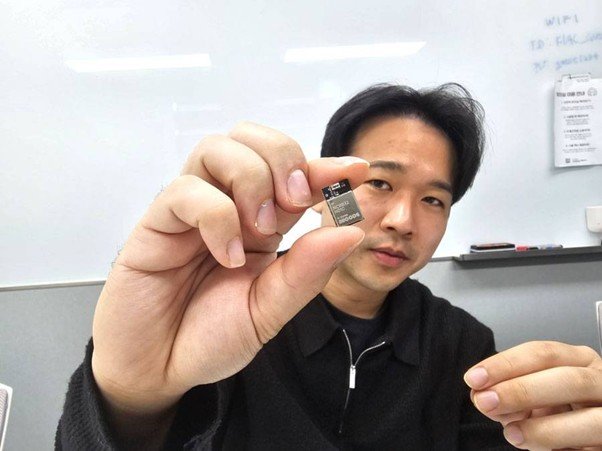
We are making a micro-sized, low-power IoT module called the 'NU Module.' It's a module for devices that uses Bluetooth and Wi-Fi with low power consumption. It operates in the unlicensed 2.4GHz, 5GHz, and 6GHz frequency bands. This module enables the development of various products and services equipped with diverse IoT functions.
It is specialized for situations where power is scarce, such as small devices that need long battery life or real-time data collection equipment used in remote outdoor locations. We can boost power efficiency by about four times compared to competitors. To put it simply, a pair of earphones with a one-hour battery life could become earphones with a four-hour battery life.
This level of performance is only achievable when hardware, firmware, and software are all implemented in harmony. If even one part is missing, you cannot achieve low power. Because we are a company that handles all three—hardware, firmware, and software—we were able to apply a design that considers the entire mass production process for our clients' products.
Lee introduced low-power IoT module, 'NU Module’ / source=IT dongA
I heard you provide not just the module but a development environment as well. What is that?
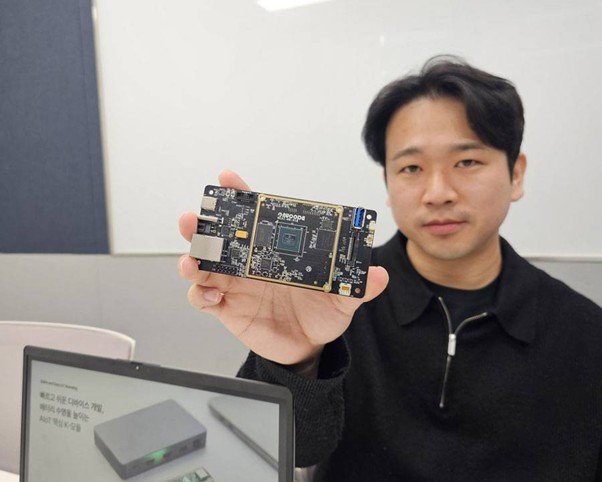
To properly utilize a low-power module, the product design difficulty increases. We are focused on enabling even first-time users to design well. We built a development environment called 'NU-Works,' which contains an AI model that generates a system architecture diagram. It's our own proprietary model combining an LLM (Large Language Model) with our own data.
Many projects involve linking Bluetooth functions to apps or websites, and the development process for such features is not simple. We provide a prototyping development board and convenient programming tools that are easy for beginners to use. We especially self-developed a compatibility program so our products can be easily used even in environments preferred by coding novices.
In October of this year, we held the Bluetooth-based 'VIBE Coding Hackathon'. All non-developer participants successfully developed a Bluetooth-linked app in just three hours. There were planners, elementary school students, university designers, entrepreneurs, and even a tax accountant. It proved that anyone can develop a product to a mass-producible level very easily if they use it alongside popular tools like ChatGPT.
Security vulnerabilities have recently been found in some IoT products. Can NUCODE's solutions address these issues?
Recently, many hidden security problems in modules have been exposed. A backdoor (hidden malware) was recently discovered in a module from a famous overseas company, and it was a module widely used in home cams distributed in Korea. A backdoor in a home cam means video hacking is possible. As this is becoming a major problem, it is crucial for CCTV and home cam businesses to find alternative modules and upgrade their products in advance.
Generally, companies that sell modules in Korea are often just distributors for foreign companies. However, NUCODE develops its own modules, holds the source code in-house, and designs the development boards itself. In a situation where there are few domestically developed modules and boards, we believe we can be the alternative.
We are also an official partner of Norway's 'Nordic Semiconductor,' a global leader in low-power Bluetooth. You will be able to see our products at the Nordic Semiconductor booth at the AIoT Show this year and at CES next year.
Have you developed any other products besides the module and development environment?
Through an unlicensed frequency demonstration project commissioned by the Ministry of Science and ICT (MSIT), we developed 'HoduCam' (tentative name), an AI low-power CCTV for remote outdoor locations. The development period was about six months. It's a device capable of vehicle number recognition through on-device AI.
Currently, the most expensive parts of installing CCTV in parking lots or remote areas are the data and power cable installations. Our product eliminates all of that and is completely wireless. The CCTVs can communicate with each other, sharing not only power but also data wirelessly.
Its battery efficiency is also excellent. Even if solar charging is unavailable, it can operate for four days to a week. And if equipped with a solar charging system, it's designed to automatically recover and recharge even if the system goes down. Its key feature is that it can achieve 'maintenance-free' operation.
HoduCam is scheduled for commercialization starting next year. Foreign-made CCTVs were highly controversial in Korea this year, and this is a secure, high-performance camera module and product that can replace them.
HoduCam, an AI low-power CCTV / source=IT dongA
What has been the most difficult part of running the company?
These days, many domestic educational curriculums for embedded systems and IoT have disappeared. So even though this is a globally competitive market, it's difficult to find suitable talent. While Korea has quite a few skilled senior developers who built this nation into an IT powerhouse, there's a disconnect; it's hard to find young talent domestically, and even when we do, they often go abroad.
Still, we are fortunate. The current executives at NUCODE are young, talented engineers who are hard to find in Korea, and they are each pulling the weight of a hundred people in their respective fields. I want to describe them as 'hidden masters of the field' who will lead the future of embedded systems and physical AI. NUCODE is also striving to cultivate IoT talent through hackathons and webinars. We are always open to collaborations with specialized high schools, universities, domestic robot competitions, and influencers.
How are your investment attraction and commercialization efforts progressing?
We founded the company last June, received investment from Korea Investment Accelerator three months later, and in December, we were selected for the MSS TIPS program (Tech Incubator Program for Startups by the Ministry of SMEs and Startups). These were significant achievements within six months of founding. This year, we are focused on upgrading our system, and we plan to raise another round of funding early next year.
How helpful was the ‘SeoulTech Early Stage Startup Package’'s Global Competency Program?
We are utilizing not only the Early Stage Startup Package program but also many other programs run by the SeoulTech Industry-University Cooperation Foundation itself. As a university that has extensive equipment and actively promotes industry-university cooperation, there is definitely strong synergy with us. (SeoulTech: Seoul National University of Science and Technology)
In particular, SeoulTech helped us run our hackathon and provided various forms of support, such as securing investor networks and legal consulting. The diverse infrastructure that SeoulTech possesses is impressive. We have received significant help for our business by leveraging it.
Do you have any future plans or an additional message you'd like to share?
Just as NVIDIA has not only the hardware (GPU) but also the CUDA platform, NUCODE wants to create such a platform in the MCU (Microcontroller) field. Most low-power IoT operates based on MCUs and RTOS (Real-Time Operating Systems). Rather than designing our own IP, we are working to make design easier by creating modules that skillfully weave together various technologies in cooperation with global brands.
And NUCODE plans to build a platform for creating comprehensive module-based products by discovering various partners, including sensor, app, and dashboard companies, as well as LTE module makers. If we can build a domestic ecosystem that isn't envious of foreign companies like Xiaomi, Tuya, or TP-Link, anyone will be able to easily create products with price competitiveness and high polish. At the center of that will be NUCODE's low-power technology and our AI-based, no-code development environment.
By Young-woo Kim (pengo@itdonga.com)








 About Dong-A Ilbo