

Seoul-area landfill ban raises confusion and public concern
Seoul-area landfill ban raises confusion and public concern
Posted November. 13, 2025 07:52,
Updated November. 13, 2025 07:52
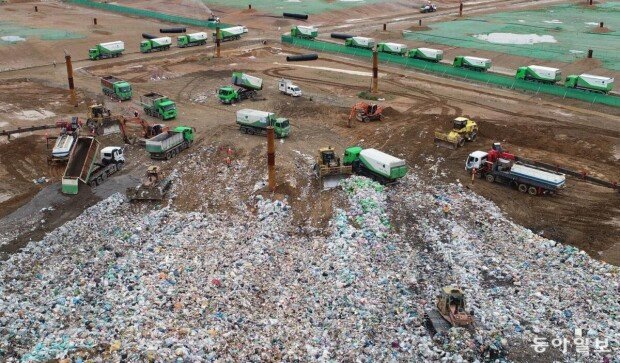
“I’m worried we will end up scrambling for somewhere to dispose of waste by January. The enforcement date is almost here, but I have no idea when the government plans to make a decision,” said a waste management official at a district office in Seoul on Nov. 12.
Starting next year, direct landfilling of household waste will be banned in the greater Seoul area. With only about 50 days remaining before the policy takes effect, the government has not confirmed whether it will proceed, leaving local officials uncertain. Authorities are concerned the region lacks sufficient incineration facilities to handle the waste.
Although four years have passed since the enforcement rules were announced, not a single new incineration plant has been built. Seoul considered Mapo as a potential site, while Gwangju, Goyang, and Bucheon in Gyeonggi Province, and Bupyeong in Incheon were also under review. However, all plans stalled amid local opposition, and none have broken ground. District officials responsible for waste disposal in Seoul are growing increasingly frustrated. One official said, “We just want a decision as soon as possible. We can’t even decide how to respond, and the confusion on the ground keeps growing.”
The ban on direct landfilling of household waste prohibits dumping household or business waste into landfills without prior incineration or sorting. In 2021, the Ministry of Environment, now the Ministry of Climate, Energy and Environment, amended the Waste Management Act’s enforcement rules to ban direct landfilling of household waste in standard trash bags in the greater Seoul area starting Jan. 1, 2026, and in other regions beginning in 2030. Only residues from incineration or sorting will be allowed in landfills.
Seoul and Gyeonggi Province have requested a postponement, saying they have no facilities ready to handle the waste after repeated failures to build new incinerators. In contrast, Incheon, which hosts the metropolitan landfill site, says it can no longer accept waste from Seoul and Gyeonggi and that the ban must take effect as scheduled. With the three metropolitan governments sharply divided and the central government yet to make a decision, concerns are growing over a potential “waste crisis.”
Experts warn that even if the ban is postponed, the same problems will recur without practical measures, such as financial support or incentives to build new incineration facilities.
송진호 기자 jino@donga.com






 About Dong-A Ilbo