

Nobel physics advisor calls for Korea’s research reform
Nobel physics advisor calls for Korea’s research reform
Posted November. 03, 2025 08:05,
Updated November. 03, 2025 08:05
“One truly inspiring idea out of a thousand is enough to make me happy.”
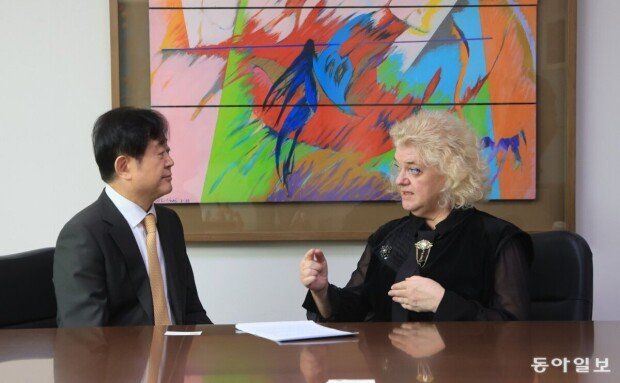
On Oct. 30 at Seoul National University in Gwanak District, Seoul, Eva Olsson, a Nobel Committee member for Physics and a professor at Chalmers University of Technology in Sweden, quoted Alfred Nobel in her remarks. She emphasized the importance of encouraging young researchers to take risks, fostering a social culture that accepts failure, and creating an environment that supports these efforts.
In recent years, including this year, Japan has consistently produced Nobel laureates in science, while South Korea has yet to produce a winner in these fields. This was the context for Professor Olsson’s discussion with Kim Joo-han, Seoul National University’s vice president for research, titled “Tasks for Korean Science to Foster the Next Nobel-Class Researchers.” A world-renowned expert in nanoscience and biophysics, Olsson is also a leading authority in microscopic analysis.
Professor Olsson emphasized the need to foster a research culture that values autonomy and tolerates failure. “To make a major leap forward, researchers need courage and an experimental mindset,” she said. “But if they are required to produce results every two or three years under short-term projects, who would take such risks?”
Most of South Korea’s research funding programs evaluate outcomes on two- or three-year cycles. Vice President Kim agreed, saying, “The current research evaluation system emphasizes quantity, such as the number of papers and patents. We need to create an environment, like at the Massachusetts Institute of Technology, that allows young researchers to focus on long-term projects.”
Professor Olsson also highlighted the importance of active international networking for fostering new discoveries. “Being open to the research and ideas of others creates opportunities for fresh inspiration,” she said. “Breakthroughs often arise during discussions at international conferences.”
Responding to assessments that South Korea excels in applied sciences such as semiconductors and artificial intelligence but remains weaker in basic sciences such as physics and chemistry, she said, “Basic and applied sciences are not opposed. They are two interacting pillars. Serendipitous discoveries come from well-prepared basic research.”
Vice President Kim added, “Korea’s young scientists are already conducting world-class research, but we lack an academic tradition that links generations. A Nobel Prize is not the achievement of a single generation. It is the result of a cumulative culture.”
최효정 기자 hyoehyoe22@donga.com








 About Dong-A Ilbo