

Banks earn double profits lending to private lenders
Banks earn double profits lending to private lenders
Posted October. 23, 2025 07:52,
Updated October. 23, 2025 07:52
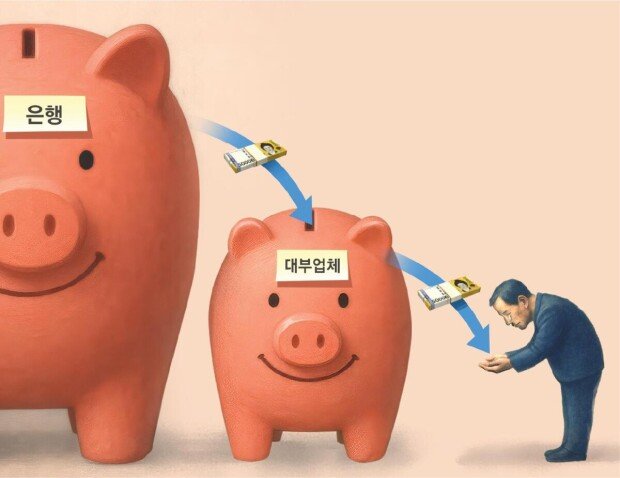
South Korean banks face criticism for lending capital to private loan companies, effectively earning interest twice. Low-income borrowers who cannot meet strict bank standards turn to high-interest private lenders, which borrow from banks at low rates and re-lend the money at higher rates.
Data submitted by Rep. Kang Min-kook of the People Power Party to the National Assembly’s Political Affairs Committee on Oct. 22 show that from 2020 through August 2025, commercial banks and secondary financial institutions, including savings banks and capital firms, lent a total of 38.2 trillion won to private lenders. Interest income from those loans reached 2.54 trillion won. Banks lent 275.8 billion won to private lenders last year, and in the first eight months of 2025, the amount rose to 237 billion won, or 86 percent of last year’s total. The Industrial Bank of Korea issued the largest number of loans, while Woori Bank provided the highest total amount.
Although lending to private lenders is legal, banks have traditionally avoided it. Industry observers viewed such loans as inappropriate, particularly when banks faced criticism for not expanding credit to low-income borrowers. A Financial Supervisory Service official said banks once viewed lending to private lenders as improper but are now doing so as demand rises from financially vulnerable borrowers.
Critics say banks are expanding easy profit-making practices while already facing backlash for relying on deposit-lending margins. Rep. Kang said institutional lenders that fund private loan companies and earn interest are neglecting their public duty.
Seo Ji-yong, a business professor at Sangmyung University, said the government should use policy finance tools, including partial guarantees for low- and mid-credit borrowers, to steer them toward mid-interest loans from secondary financial institutions instead of high-interest private lenders.
Joo-Young Jeon aimhigh@donga.com

![‘반쯤 열린 노트북’ 곳곳에…웃픈 현실인가 유행인가[트렌디깅]](https://dimg.donga.com/c/138/175/90/1/wps/NEWS/IMAGE/2026/05/13/133913539.3.jpg)






 About Dong-A Ilbo