

Korean AI agent 'Selto' Begins Major Performance Verification for On-Screen Automation.
Korean AI agent 'Selto' Begins Major Performance Verification for On-Screen Automation.
Posted October. 14, 2025 10:49,
Updated October. 14, 2025 13:48
- Selto, developed by Korean AI automation startup, Infofla, is an AI Agent
platform that automates business tasks by directly recognizing and
interacting with on-screen elements, making it applicable to any software
without complex API integration.
- Its unique vision-based approach and on-premise deployment option have
attracted interest from major companies across industries such as
construction, manufacturing, finance, public sector, and retail, where it is
currently undergoing proof-of-concept testing.
- As demand for business automation grows, Selto aims to address the specific
needs of the Korean market and compete with global AI solutions by
supporting legacy systems and ensuring high security.
The Artificial Intelligence (AI) service market is reaching a new inflection point. If the previous era was defined by conversational AI chatbots like ChatGPT that answered user questions with text, the curtain is now rising on the age of the "AI Agent"—a technology designed to take over and execute actual business tasks.
Unlike chatbots, AI Agents automate real-world tasks. / Source: Generated by Gemini
Interest in the AI Agent market surged following OpenAI's launch of the ‘ChatGPT Agent’ in July 2025. Capable of automatically performing web searches, summarizing information, generating documents, and analyzing data, AI Agents are fundamentally different from their chatbot predecessors. They don't just answer questions; they complete entire work processes.
Driving this shift is a critical corporate need for efficiency. By delegating repetitive and time-consuming tasks to AI, employees can focus on more creative and strategic initiatives.
Korean AI Agent 'Selto' Differentiates with Screen Recognition
Amid this global trend, ‘Selto,’ an AI Agent platform from the Korean AI automation firm Infofla (CEO: In-mook Choi), is capturing the attention of major domestic companies and institutions.
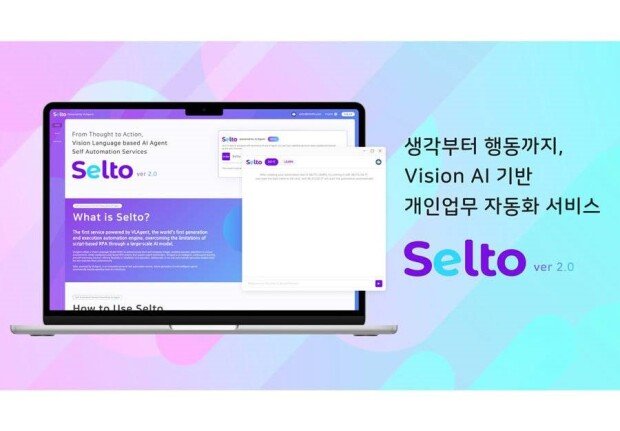
Selto's key differentiator lies in its use of a Vision Language Model (VLM) to perform tasks by directly recognizing the screen. While most existing AI Agents rely on API integrations with specific applications or services, Selto ‘sees’ and interprets the screen to execute tasks, mirroring how a human user operates a computer with a mouse and keyboard.
The advantage of this approach is its universal applicability. Any application installed on a system can be automated, from accounting programs and ERP systems to legacy systems that were designed without any consideration for AI or automation. This is achieved without the need for complex API integration projects.
Furthermore, while most AI Agent services are offered exclusively in the cloud, Selto provides an on-premise option. This allows companies to install and operate the platform on their own internal servers, ensuring a high level of security. For sectors where security is paramount, such as finance, government, and large enterprises often hesitant to adopt cloud-based AI, Selto's on-premise solution offers a practical and secure alternative.
Through its V2 update in July, Selto significantly enhanced its practicality by adding features like conditional branching, variable storage, and the ability to directly review the screens the AI has learned. Intriguingly, this update coincided with the launch of OpenAI's ChatGPT Agent, demonstrating that Korean AI technology is evolving in lockstep with global trends.
According to Infofla, Selto is currently undergoing Proof of Concept (PoC) testing or is under review for adoption by more than eight companies and institutions. As interest in business automation grows, the platform is being rigorously tested across a diverse range of industries.
• Construction: One major construction firm is testing Selto’s automation
capabilities from September through December, focusing on document
processing and system integration tasks. The company is evaluating its
potential for digitizing various documents and automating information updates.
• Manufacturing: The manufacturing sector is also showing keen interest. One
manufacturer is assessing the automation potential of Selto's vision
recognition technology for logistics and inventory management, with plans to
pilot a process for inputting field data into its systems from September to
December. A second
manufacturing company is exploring its use for synchronizing information within
its logistics system and automating data exchange between distribution centers.
• Finance: In the financial sector, one firm aims to complete a PoC for document
recognition and task automation by October, with a primary goal of verifying
improvements in user-friendliness compared to existing RPA solutions. Another
financial company will begin testing its applicability for customer information
management and various document processing tasks from November to
December.
• Public Sector: Government agencies are also actively considering the
technology. One public institution held a demonstration to explore the
possibility of adopting Selto for its IT infrastructure operations management
by 2026. Another is reviewing the application of Selto's technology for a project
to ensure compliance with government-standard UI/UX guidelines.
• Retail: A retail company is exploring the potential of using Selto for customer
data processing and OCR-based task automation.
"Reflecting the Unique Needs of the Korean Market"
"We have focused on closing the technology gap with global IT giants while also applying differentiating factors that reflect the unique characteristics of the domestic market," said Choi. "Legacy systems and proprietary work processes, which are still widely used in the Korean corporate environment, are often difficult to address with foreign-made solutions."
He added, "Through our ongoing PoC projects, we are validating the value that Selto can deliver in real-world business environments. Based on these results, we aim to play a meaningful role in the domestic AI Agent market."
Experts predict that the AI Agent market will experience explosive growth over the next few years. Amid global economic uncertainty, the corporate drive for efficiency is expected to further increase demand for AI-based automation. The results of these diverse PoC projects will be a key indicator of whether Selto can establish itself as a competitive choice in the burgeoning Korean AI Agent market.
By Young-woo Kim (pengo@itdonga.com)
platform that automates business tasks by directly recognizing and
interacting with on-screen elements, making it applicable to any software
without complex API integration.
- Its unique vision-based approach and on-premise deployment option have
attracted interest from major companies across industries such as
construction, manufacturing, finance, public sector, and retail, where it is
currently undergoing proof-of-concept testing.
- As demand for business automation grows, Selto aims to address the specific
needs of the Korean market and compete with global AI solutions by
supporting legacy systems and ensuring high security.
The Artificial Intelligence (AI) service market is reaching a new inflection point. If the previous era was defined by conversational AI chatbots like ChatGPT that answered user questions with text, the curtain is now rising on the age of the "AI Agent"—a technology designed to take over and execute actual business tasks.
Unlike chatbots, AI Agents automate real-world tasks. / Source: Generated by Gemini
Interest in the AI Agent market surged following OpenAI's launch of the ‘ChatGPT Agent’ in July 2025. Capable of automatically performing web searches, summarizing information, generating documents, and analyzing data, AI Agents are fundamentally different from their chatbot predecessors. They don't just answer questions; they complete entire work processes.
Driving this shift is a critical corporate need for efficiency. By delegating repetitive and time-consuming tasks to AI, employees can focus on more creative and strategic initiatives.
Korean AI Agent 'Selto' Differentiates with Screen Recognition
Amid this global trend, ‘Selto,’ an AI Agent platform from the Korean AI automation firm Infofla (CEO: In-mook Choi), is capturing the attention of major domestic companies and institutions.
Infofla’s Selto with V2 Update in July / source=Infofla
Selto's key differentiator lies in its use of a Vision Language Model (VLM) to perform tasks by directly recognizing the screen. While most existing AI Agents rely on API integrations with specific applications or services, Selto ‘sees’ and interprets the screen to execute tasks, mirroring how a human user operates a computer with a mouse and keyboard.
The advantage of this approach is its universal applicability. Any application installed on a system can be automated, from accounting programs and ERP systems to legacy systems that were designed without any consideration for AI or automation. This is achieved without the need for complex API integration projects.
Furthermore, while most AI Agent services are offered exclusively in the cloud, Selto provides an on-premise option. This allows companies to install and operate the platform on their own internal servers, ensuring a high level of security. For sectors where security is paramount, such as finance, government, and large enterprises often hesitant to adopt cloud-based AI, Selto's on-premise solution offers a practical and secure alternative.
Through its V2 update in July, Selto significantly enhanced its practicality by adding features like conditional branching, variable storage, and the ability to directly review the screens the AI has learned. Intriguingly, this update coincided with the launch of OpenAI's ChatGPT Agent, demonstrating that Korean AI technology is evolving in lockstep with global trends.
According to Infofla, Selto is currently undergoing Proof of Concept (PoC) testing or is under review for adoption by more than eight companies and institutions. As interest in business automation grows, the platform is being rigorously tested across a diverse range of industries.
• Construction: One major construction firm is testing Selto’s automation
capabilities from September through December, focusing on document
processing and system integration tasks. The company is evaluating its
potential for digitizing various documents and automating information updates.
• Manufacturing: The manufacturing sector is also showing keen interest. One
manufacturer is assessing the automation potential of Selto's vision
recognition technology for logistics and inventory management, with plans to
pilot a process for inputting field data into its systems from September to
December. A second
manufacturing company is exploring its use for synchronizing information within
its logistics system and automating data exchange between distribution centers.
• Finance: In the financial sector, one firm aims to complete a PoC for document
recognition and task automation by October, with a primary goal of verifying
improvements in user-friendliness compared to existing RPA solutions. Another
financial company will begin testing its applicability for customer information
management and various document processing tasks from November to
December.
• Public Sector: Government agencies are also actively considering the
technology. One public institution held a demonstration to explore the
possibility of adopting Selto for its IT infrastructure operations management
by 2026. Another is reviewing the application of Selto's technology for a project
to ensure compliance with government-standard UI/UX guidelines.
• Retail: A retail company is exploring the potential of using Selto for customer
data processing and OCR-based task automation.
"Reflecting the Unique Needs of the Korean Market"
"We have focused on closing the technology gap with global IT giants while also applying differentiating factors that reflect the unique characteristics of the domestic market," said Choi. "Legacy systems and proprietary work processes, which are still widely used in the Korean corporate environment, are often difficult to address with foreign-made solutions."
He added, "Through our ongoing PoC projects, we are validating the value that Selto can deliver in real-world business environments. Based on these results, we aim to play a meaningful role in the domestic AI Agent market."
Experts predict that the AI Agent market will experience explosive growth over the next few years. Amid global economic uncertainty, the corporate drive for efficiency is expected to further increase demand for AI-based automation. The results of these diverse PoC projects will be a key indicator of whether Selto can establish itself as a competitive choice in the burgeoning Korean AI Agent market.
By Young-woo Kim (pengo@itdonga.com)


![스쿼트 개수는 ‘하체 나이’ 지표… 연령별 기준 몇 개?[노화설계]](https://dimg.donga.com/c/138/175/90/1/wps/NEWS/IMAGE/2026/05/08/133884776.3.jpg)





 About Dong-A Ilbo