

A.Cure, “Catching Hidden Heart Disease with Voice… AI Healthcare Solution ‘Heart to Voice’ ”
A.Cure, “Catching Hidden Heart Disease with Voice… AI Healthcare Solution ‘Heart to Voice’ ”
Posted September. 25, 2025 13:59,
Updated September. 25, 2025 14:18
- A.Cure has developed an AI-powered voice analysis solution called ‘Heart to
Voice’ to detect heart failure and assess its severity by analyzing subtle
changes in a patient's voice.
- This non-invasive method simplifies complex examinations, supports health
management, and enables early intervention.
- The company aims to refine the technology to provide tailored care and expand
its applications to both medical and wellness markets.
Heart failure occurs when the heart, the body’s pump, fails to function properly. People with chronic illnesses such as hypertension, diabetes, or obesity are all at risk. The problem is that its early symptoms are often vague or mild, making timely detection difficult.
According to the latest ‘2025 Heart Failure Fact Sheet’ released by the Korean Society of Heart Failure, an estimated 1.75 million people in Korea suffer from the disease. Data from the Society and the Health Insurance Review and Assessment Service show that half of patients relapse within one year of diagnosis, and the five-year mortality rate also reaches 50%. Despite the urgency, conventional diagnostics require multiple tests, are expensive, and complicate early detection. Annual treatment costs per patient average around 6000 USD. To tackle this challenge, digital healthcare startup A.Cure is turning to AI and voice technology.
The company’s solution, Heart to Voice, uses AI-powered voice analysis to detect heart failure and assess its severity. By analyzing subtle changes in a patient’s voice, the system can non-invasively determine risk levels. It simplifies complex examinations, supports health management, and enables early intervention. This year, A.Cure aims to refine severity analysis to provide tailored care, including medication guidance and exercise schedules.
Building on Digital Therapeutics Expertise
Kyoung-ho Jung, CEO of A.Cure, has extensive experience overseeing the development of digital therapeutics, from clinical trials to commercialization. His longtime colleague and co-founder, Professor Eung-joo Kim of Korea University, won recognition at the American Heart Association in 2023 for research on an AI model for heart failure detection. Inspired by the global acknowledgment of the technology, Jung officially launched A.Cure in 2024.
“Early symptoms such as shortness of breath or fatigue are nonspecific, making diagnosis difficult. Since heart failure cannot be cured, its one-year recurrence rate exceeds 50% without continuous management,” Jung said. “Heart to Voice was designed to complement existing systems by capturing minute vocal changes that signal early risk. This enables patients to seek treatment in time, avoiding costly emergency admissions and surgeries while improving survival rates.”
Voice-Based Heart Failure Detection with Heart to Voice

At the core of Heart to Voice is voice-driven diagnostics. Pulmonary congestion caused by heart failure induces subtle changes in vocal patterns, which AI detects to assess both presence and severity. “Patients are asked to say simple phrases such as ‘Daehanminguk manse’ (means ‘Long live Korea’). The 20-second recordings are broken into one-second clips, then divided further into 100 units for feature extraction,” Jung explained. “By the end of this year, we aim to make detection possible through natural conversations alone.”
To enhance accuracy, A.Cure is combining voice data with nine clinical indicators—including blood tests (NT-proBNP), echocardiography, and electrocardiograms. “Heart failure isn’t something that can be diagnosed with a single number like blood pressure,” Jung noted. “It requires multiple tests and physician judgment, which makes AI development particularly challenging.”
The company applies unsupervised learning, clustering unlabeled data to identify patterns and classify patients into four categories: normal, mild, moderate, and severe. “We’re conducting clinical trials with 124 participants at four institutions, with current accuracy at 90.4%. Our goal is to push this to 95% by year’s end,” Jung said. “Ultimately, we aim to deliver diagnostic results comparable to traditional methods—using voice alone.”
Targeting Both Medical and Wellness Markets
A.Cure is pursuing a dual-track strategy. On the medical side, it is developing hospital diagnostic devices, personal monitoring tools, and digital therapeutics linked to medication. Following clinical trials and regulatory approval from the Ministry of Food and Drug Safety (MFDS), the company plans to roll out its solutions in primary care institutions and nursing homes. In the long term, Heart to Voice could guide drug dosages and timing, evolving into a digital therapeutic complementing traditional care.
“Approval from the MFDS takes time but guarantees safety and clinical reliability,” Jung said. “We plan to begin clinical trials for regulatory clearance next year, moving step by step. By tailoring diuretic prescriptions based on severity, we can avoid unnecessary treatments and provide optimal therapy.”
In the wellness field, A.Cure is focusing on preventive care. By linking with AI speakers and wearables, the company aims to deliver premium healthcare services in senior residences, nursing homes, and public health centers. “When users naturally interact with AI speakers or smartwatches, their voices are analyzed to detect early warning signs,” Jung explained. To this end, A.Cure will conduct pilot programs at facilities operated by Lotte Hotels.
The company is also targeting mobility. Installed in vehicles, the solution could monitor driver safety, from detecting heart failure risk to measuring alcohol levels. Eventually, the technology will be integrated into smartphones and smartwatches. “With user consent, we’re collecting high-quality voice data from high-risk groups in senior facilities and health centers,” Jung added. “This virtuous cycle will strengthen the AI model and enhance diagnostic accuracy.”
Expanding into Emergency Care and Global Markets

In 2024, A.Cure spun off from Korea University Medical Center through a technology transfer agreement. Since then, it has secured government-backed projects and attracted investment. By leveraging the center’s medical data and research, the company aims to complete confirmatory clinical trials and secure MFDS approval next year.
At the same time, global expansion is underway, with a focus on the United States, Japan, Singapore, and China. Selection as a partner for Oracle Cloud Infrastructure (OCI) has been a major boost. “Through the Miracle Program, we built environments for algorithm development and service operations, and connected with international investors for joint clinical trials and distribution,” Jung said.
Looking further ahead, A.Cure envisions becoming a voice-based prediction platform for emergency diseases beyond heart failure. Once its technology gains broader trust, the company plans to expand into conditions such as asthma. In the developmental disorders field, A.Cure is already participating in national projects with Seoul National University and Yonsei University, researching early detection of autism spectrum disorder by analyzing children’s voices and behaviors.
Though digital healthcare still faces significant challenges, Jung remains ambitious. “I want A.Cure to set a precedent for success, inspire future challengers, and lead the growth of the digital healthcare industry,” he said.
By Ye-ji Kim (yj@itdonga.com)
* This article was written with support from Seoul National University of Science and Technology.
Voice’ to detect heart failure and assess its severity by analyzing subtle
changes in a patient's voice.
- This non-invasive method simplifies complex examinations, supports health
management, and enables early intervention.
- The company aims to refine the technology to provide tailored care and expand
its applications to both medical and wellness markets.
Heart failure occurs when the heart, the body’s pump, fails to function properly. People with chronic illnesses such as hypertension, diabetes, or obesity are all at risk. The problem is that its early symptoms are often vague or mild, making timely detection difficult.
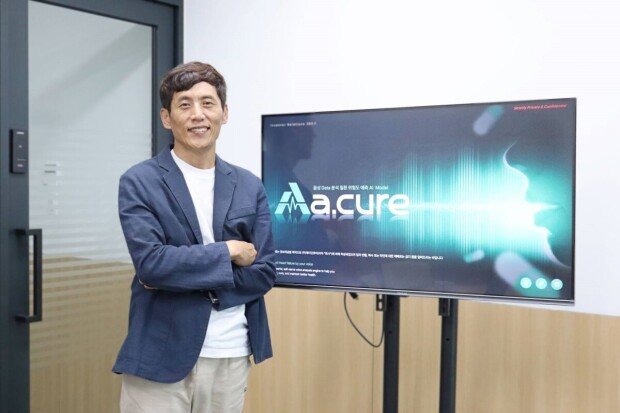
Kyung-ho Jung, CEO of A.Cure / Source=IT dongA
According to the latest ‘2025 Heart Failure Fact Sheet’ released by the Korean Society of Heart Failure, an estimated 1.75 million people in Korea suffer from the disease. Data from the Society and the Health Insurance Review and Assessment Service show that half of patients relapse within one year of diagnosis, and the five-year mortality rate also reaches 50%. Despite the urgency, conventional diagnostics require multiple tests, are expensive, and complicate early detection. Annual treatment costs per patient average around 6000 USD. To tackle this challenge, digital healthcare startup A.Cure is turning to AI and voice technology.
The company’s solution, Heart to Voice, uses AI-powered voice analysis to detect heart failure and assess its severity. By analyzing subtle changes in a patient’s voice, the system can non-invasively determine risk levels. It simplifies complex examinations, supports health management, and enables early intervention. This year, A.Cure aims to refine severity analysis to provide tailored care, including medication guidance and exercise schedules.
Building on Digital Therapeutics Expertise
Kyoung-ho Jung, CEO of A.Cure, has extensive experience overseeing the development of digital therapeutics, from clinical trials to commercialization. His longtime colleague and co-founder, Professor Eung-joo Kim of Korea University, won recognition at the American Heart Association in 2023 for research on an AI model for heart failure detection. Inspired by the global acknowledgment of the technology, Jung officially launched A.Cure in 2024.
“Early symptoms such as shortness of breath or fatigue are nonspecific, making diagnosis difficult. Since heart failure cannot be cured, its one-year recurrence rate exceeds 50% without continuous management,” Jung said. “Heart to Voice was designed to complement existing systems by capturing minute vocal changes that signal early risk. This enables patients to seek treatment in time, avoiding costly emergency admissions and surgeries while improving survival rates.”
Voice-Based Heart Failure Detection with Heart to Voice
AI voice analysis-based heart failure detection and severity prediction solution Heart to Voice / Source=A.Cure
At the core of Heart to Voice is voice-driven diagnostics. Pulmonary congestion caused by heart failure induces subtle changes in vocal patterns, which AI detects to assess both presence and severity. “Patients are asked to say simple phrases such as ‘Daehanminguk manse’ (means ‘Long live Korea’). The 20-second recordings are broken into one-second clips, then divided further into 100 units for feature extraction,” Jung explained. “By the end of this year, we aim to make detection possible through natural conversations alone.”
To enhance accuracy, A.Cure is combining voice data with nine clinical indicators—including blood tests (NT-proBNP), echocardiography, and electrocardiograms. “Heart failure isn’t something that can be diagnosed with a single number like blood pressure,” Jung noted. “It requires multiple tests and physician judgment, which makes AI development particularly challenging.”
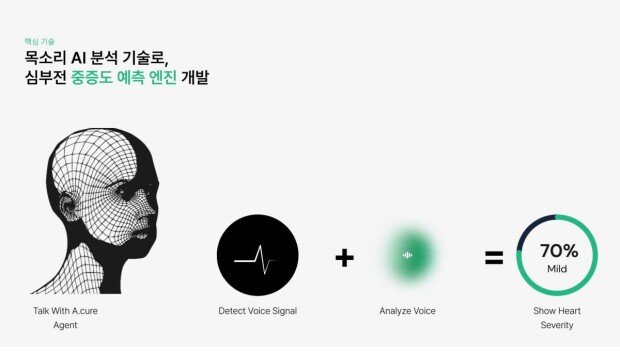
A.Cure’s voice AI analysis technology / Source=A.Cure
The company applies unsupervised learning, clustering unlabeled data to identify patterns and classify patients into four categories: normal, mild, moderate, and severe. “We’re conducting clinical trials with 124 participants at four institutions, with current accuracy at 90.4%. Our goal is to push this to 95% by year’s end,” Jung said. “Ultimately, we aim to deliver diagnostic results comparable to traditional methods—using voice alone.”
Targeting Both Medical and Wellness Markets
A.Cure is pursuing a dual-track strategy. On the medical side, it is developing hospital diagnostic devices, personal monitoring tools, and digital therapeutics linked to medication. Following clinical trials and regulatory approval from the Ministry of Food and Drug Safety (MFDS), the company plans to roll out its solutions in primary care institutions and nursing homes. In the long term, Heart to Voice could guide drug dosages and timing, evolving into a digital therapeutic complementing traditional care.
“Approval from the MFDS takes time but guarantees safety and clinical reliability,” Jung said. “We plan to begin clinical trials for regulatory clearance next year, moving step by step. By tailoring diuretic prescriptions based on severity, we can avoid unnecessary treatments and provide optimal therapy.”
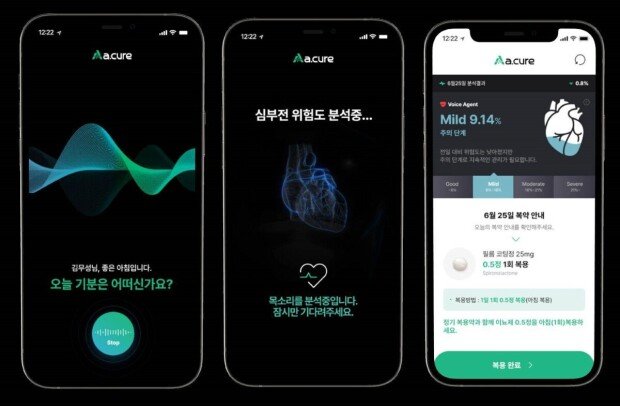
A.Cure app image / Source=A.Cure
In the wellness field, A.Cure is focusing on preventive care. By linking with AI speakers and wearables, the company aims to deliver premium healthcare services in senior residences, nursing homes, and public health centers. “When users naturally interact with AI speakers or smartwatches, their voices are analyzed to detect early warning signs,” Jung explained. To this end, A.Cure will conduct pilot programs at facilities operated by Lotte Hotels.
The company is also targeting mobility. Installed in vehicles, the solution could monitor driver safety, from detecting heart failure risk to measuring alcohol levels. Eventually, the technology will be integrated into smartphones and smartwatches. “With user consent, we’re collecting high-quality voice data from high-risk groups in senior facilities and health centers,” Jung added. “This virtuous cycle will strengthen the AI model and enhance diagnostic accuracy.”
Expanding into Emergency Care and Global Markets
Kyung-ho Jung, CEO of A.Cure / Source=IT dongA
In 2024, A.Cure spun off from Korea University Medical Center through a technology transfer agreement. Since then, it has secured government-backed projects and attracted investment. By leveraging the center’s medical data and research, the company aims to complete confirmatory clinical trials and secure MFDS approval next year.
At the same time, global expansion is underway, with a focus on the United States, Japan, Singapore, and China. Selection as a partner for Oracle Cloud Infrastructure (OCI) has been a major boost. “Through the Miracle Program, we built environments for algorithm development and service operations, and connected with international investors for joint clinical trials and distribution,” Jung said.
Looking further ahead, A.Cure envisions becoming a voice-based prediction platform for emergency diseases beyond heart failure. Once its technology gains broader trust, the company plans to expand into conditions such as asthma. In the developmental disorders field, A.Cure is already participating in national projects with Seoul National University and Yonsei University, researching early detection of autism spectrum disorder by analyzing children’s voices and behaviors.
Though digital healthcare still faces significant challenges, Jung remains ambitious. “I want A.Cure to set a precedent for success, inspire future challengers, and lead the growth of the digital healthcare industry,” he said.
By Ye-ji Kim (yj@itdonga.com)
* This article was written with support from Seoul National University of Science and Technology.




![하루 방귀 몇 번이 정상일까? 가장 많이 뀌는 시간대는…[건강팩트체크]](https://dimg.donga.com/c/138/175/90/1/wps/NEWS/IMAGE/2026/06/12/134098245.3.jpg)



 About Dong-A Ilbo