

Lee’s U.N. proposal raises concerns over nuclear recognition
Lee’s U.N. proposal raises concerns over nuclear recognition
Posted September. 25, 2025 07:59,
Updated September. 25, 2025 07:59
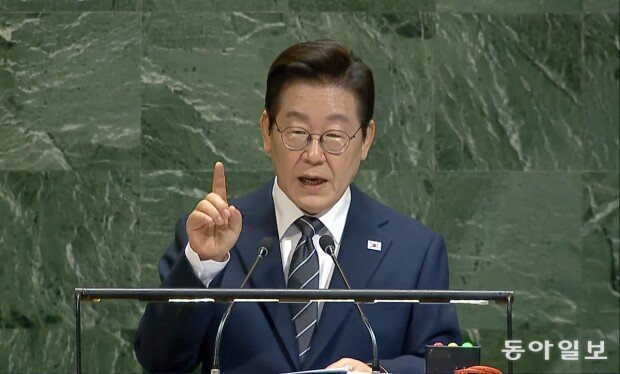
National Security Adviser Wi Sung-lac said on Sept. 23 local time that President Lee Jae-myung’s “E.N.D. Initiative,” presented in his keynote address to the U.N. General Assembly, would be pursued as a framework in which three elements — Exchange, Normalization, and Denuclearization — reinforce one another through inter-Korean and U.S.-North Korea dialogue. His remarks suggested that South Korea is open to normalizing relations between Washington and Pyongyang, including the establishment of diplomatic ties, even before North Korea’s nuclear dismantlement is complete, to create momentum for denuclearization.
Speaking at a press conference in New York, Wi said, “There is no priority or sequence among the three elements.” This indicates Seoul could accept a U.S. approach that initiates normalization with Pyongyang, such as establishing diplomatic relations, even without a denuclearization agreement. Since North Korean leader Kim Jong Un has said there is “no reason not to stand face-to-face” with U.S. President Donald Trump if denuclearization is excluded from the agenda, Seoul’s position suggests support for dialogue that omits the nuclear issue. Washington has previously linked normalization with Pyongyang to different formulas: as the final reward for denuclearization during the six-party talks, and as part of a comprehensive settlement tied to complete denuclearization at the Singapore summit.
Shortly after his address, Lee met with U.N. Secretary-General António Guterres and explained the E.N.D. Initiative, urging the U.N. to help create a platform of dialogue and cooperation that goes beyond conflict and confrontation between the two Koreas.
Concerns are growing, however, that the initiative could weaken the goal of denuclearizing North Korea. Allowing normalization before Pyongyang abandons its nuclear arsenal could effectively amount to recognizing the North as a nuclear power. In an earlier interview with the BBC, Lee was asked whether he would accept a U.S.-North Korea agreement without a denuclearization pledge. He replied that he could accept the Trump-Kim agreement in which North Korea would freeze production rather than fully dismantle its nuclear weapons.
A South Korean presidential office official rejected suggestions that the policy recognizes North Korea as a nuclear state, saying, “Exchange and normalization do not mean accepting the North’s nuclear status or abandoning denuclearization.” A U.S. State Department spokesperson reaffirmed on Sept. 23 that the United States’ policy remains the complete denuclearization of North Korea.
On Sept. 24, South Korea's People Power Party criticized the initiative, calling it “an approach that will end with tolerating North Korea’s nuclear program.” Party leader Jang Dong-hyuk wrote on Facebook that it is a fake peace initiative that gives away everything, gains nothing, and brings destruction to the Korean Peninsula through nuclear weapons.
Hoon-Sang Park tigermask@donga.com

![[사설]“尹 계엄 하려 北 도발 유도”… 무지한 건지, 무모한 건지](https://dimg.donga.com/c/138/175/90/1/wps/NEWS/IMAGE/2026/06/12/134104085.1.jpg)
![국비 지원받아 무료로 중장비 면허 딴 60대 女농사꾼[은퇴 레시피]](https://dimg.donga.com/c/138/175/90/1/wps/NEWS/IMAGE/2026/06/13/134102134.5.jpg)




 About Dong-A Ilbo