

MIRAEIN TECHNOLOGY: “20 Years of HR Expertise, Captured in QFit HR”
MIRAEIN TECHNOLOGY: “20 Years of HR Expertise, Captured in QFit HR”
Posted September. 08, 2025 10:57,
Updated September. 08, 2025 10:59
- MIRAEIN TECHNOLOGY, led by CEO Min-Seong Jung, has developed QFit HR,
an AI-powered HR evaluation platform built on over 4,000 templates and
Jung's extensive experience.
- The platform allows companies to establish customized HR evaluation systems
quickly and easily, addressing the challenges of varying evaluation criteria
and processes across organizations.
- MIRAEIN TECHNOLOGY aims to expand its market presence globally, leveraging
partnerships and AI-driven enhancements to drive growth.
One of the most crucial elements of corporate management is the evaluation of human resources (HR). Companies must accurately assess the capabilities and performance of their employees. In the past, managers often relied on intuition or personal experience, but this approach lacked objectivity.
To address this, many companies have adopted software-based HR evaluation systems designed to operate under clear and objective standards. Yet these systems present a dilemma: because evaluation criteria and processes vary across organizations, it is difficult to apply standardized HR packages. Building a fully customized system can require billions of won and more than a year of development.
MIRAEIN TECHNOLOGY (CEO: Min-Seong Jung) is a startup tackling this problem head-on. With more than 20 years of hands-on experience in HR systems as both an engineer and a sales leader, Jung developed QFit HR, an AI-powered evaluation platform built on over 4,000 templates combined with his own professional expertise. “With just one or two hours of consultation, companies can establish a customized HR evaluation system with us,” Jung explained. In this interview, he shares his unconventional approach.
You started out as an engineer and later built diverse experience in the industry. What led you to move into sales?
“I majored in computer engineering at the graduate level and worked as an engineer for many years. But I also believed it was important to hear directly from the field, so I became a project manager as well,” Jung explained. Over the past two decades, he has led major projects such as the Dong-A Ilbo ERP implementation and the National Emergency Management Agency system upgrade.
Since ERP covers HR management, performance evaluation, and recruitment modules, Jung developed a strong interest in HR systems, eventually joining a specialized HR firm. His engineering background proved invaluable in sales: “When I explained technical aspects to clients, their response was far more positive than when PMs or sales staff did. My practical experience made all the difference.”
Why did you pay attention to the future potential of the HR market?
“Traditional HR system packages were often tied to system integration (SI) projects that demanded massive investments of money and manpower. Unlike simple software deliveries, these projects required long and complex optimization processes—usually more than a year and sometimes costing tens of billions of won,” Jung noted.
Recognizing that HR management would only grow in importance, he joined a major ERP company in the early 2010s, where he worked in HR consulting and technical sales for more than a decade. Convinced that a simpler yet more flexible HR system was possible, he founded MIRAEIN TECHNOLOGY in 2022. The result: QFit HR.
What is the core of QFit HR, and what does the name mean?
“At its core, QFit HR is a rule-based system. While HR evaluations may look similar across companies, each is different,” Jung explained. “We wanted to provide services that are both quick and a perfect fit—hence the name QFit HR.”
Because evaluation criteria and workflows differ across organizations, adopting a single system is difficult. Even after implementation, if organizations restructure, HR managers often need to manually adjust processes with IT support. QFit HR solves this by enabling administrators to configure rules easily without IT assistance.
Drawing on Jung’s two decades of experience across industries—including retail, manufacturing, and defense—the platform supports both on-premise and cloud environments, and integrates with legacy systems like Duzon.
Can you explain in more detail what you mean by “simple customized service” in QFit HR?
QFit HR is powered by extensive big data and a library of more than 4,000 templates, for which the company has even secured Korea’s first patent in this field. Systems can be customized to match each company’s unique characteristics, with KPIs (key performance indicators) serving as one of the baselines.
“In most cases, especially for SMEs, just an hour or two of consultation is enough,” Jung explained. The company is also preparing an AI-driven function that will automatically configure evaluation rules with only minimal input from managers.
After adopting the product, how can customers use it? What features are particularly noteworthy?
Once adopted, companies can leverage several core functions:
• Evaluation Navigation: A role-based process map that guides each step of the evaluation.
• Evaluation Results Analysis: Quick insights by category, timeline, and question type, based on manager-defined criteria.
• Unstructured Data Search: Comprehensive queries across variables such as education, career, awards/penalties, personality type, and health records.
Another highly praised feature is evaluation progress management, which visually tracks goal completion and progress rates, allowing proactive issue resolution.
Since HR evaluation is difficult because of so many variables, on what basis does QFit HR actually evaluate?
QFit HR supports multiple evaluation types, including:
• Performance Evaluation: Quantifying what an employee has accomplished.
• Competency Evaluation: Assessing whether they possess the skills suited to the company.
• 360-Degree Evaluation: Factoring in peer feedback and reputation.
The system also accommodates collaborative environments by adjusting evaluation weights according to inter-departmental dynamics, ensuring flexibility.
Who are your main customers, and what size of companies are using QFit HR?
“Our clients range widely in size,” Jung noted. “One small fruit distribution company with annual revenues of approximately 3 to 5 billion KRW adopted QFit HR, saying that a fair evaluation system was essential to growth.”
At the other end of the spectrum, MIRAEIN recently won a contract with a general hospital of 12,000 employees, likely making it the first domestic company to deliver an HR evaluation system to an institution of this scale.
Public institutions are also key clients. Cases include a national defense research institute, multiple municipalities, and public enterprises such as Ansan Urban Development, a Jeju-based public corporation, Icheon City, and the Automobile Insurance Compensation Agency.
For a startup, winning contracts with large enterprises is a remarkable achievement. What challenges did you face in the process?
“The biggest hurdles are sales power and talent acquisition,” Jung admitted. “Even with my past sales success, competing as a startup against established firms is a different league.”
Yet progress has been steady. For instance, despite MIRAEIN’s small size, a large hospital agreed to run a PoC (proof of concept) and, after verifying its value, decided to adopt the system. Such cases are increasing, providing crucial momentum.
I heard you made use of SeoulTech’s global collaboration program. How helpful was it in practice?
MIRAEIN also benefited from the Seoul National University of Science and Technology (SeoulTech) global collaboration program. “As a startup, we had to balance technology development with sales. By participating in the program with our project ‘Advancing AI-Based HR Evaluation Systems,’ we received support for personnel and operational costs, which enhanced our capabilities and helped us secure larger clients,” Jung said.
Global partnerships are also expanding. MIRAEIN has begun collaborating with Oracle, using Oracle Cloud Infrastructure (OCI) to apply advanced cloud and AI technologies. Upcoming initiatives include a Seoul city investment forum in September and a planned visit to Oracle’s U.S. headquarters.
Could you share your future plans and vision?
MIRAEIN will continue upgrading QFit HR with AI-driven enhancements while expanding into public and global markets. “We plan joint marketing efforts with Oracle and will pilot our system in Vietnam and Thailand,” Jung revealed.
“In Southeast Asia, many companies still use outdated systems or none at all. Introducing our solution can drive highly effective co-growth.”
Localization will be critical: “One Korean conglomerate once abandoned an overseas HR system because it didn’t fit local conditions. We won’t make the same mistake. Through the global collaboration program, we’re adding multilingual support and optimizing interfaces for each region. We look forward to working with global clients soon.”
By Young-woo Kim (pengo@itdonga.com)
* This article was written with support from Seoul National University of Science and Technology.
an AI-powered HR evaluation platform built on over 4,000 templates and
Jung's extensive experience.
- The platform allows companies to establish customized HR evaluation systems
quickly and easily, addressing the challenges of varying evaluation criteria
and processes across organizations.
- MIRAEIN TECHNOLOGY aims to expand its market presence globally, leveraging
partnerships and AI-driven enhancements to drive growth.
One of the most crucial elements of corporate management is the evaluation of human resources (HR). Companies must accurately assess the capabilities and performance of their employees. In the past, managers often relied on intuition or personal experience, but this approach lacked objectivity.
To address this, many companies have adopted software-based HR evaluation systems designed to operate under clear and objective standards. Yet these systems present a dilemma: because evaluation criteria and processes vary across organizations, it is difficult to apply standardized HR packages. Building a fully customized system can require billions of won and more than a year of development.
MIRAEIN TECHNOLOGY (CEO: Min-Seong Jung) is a startup tackling this problem head-on. With more than 20 years of hands-on experience in HR systems as both an engineer and a sales leader, Jung developed QFit HR, an AI-powered evaluation platform built on over 4,000 templates combined with his own professional expertise. “With just one or two hours of consultation, companies can establish a customized HR evaluation system with us,” Jung explained. In this interview, he shares his unconventional approach.
You started out as an engineer and later built diverse experience in the industry. What led you to move into sales?
“I majored in computer engineering at the graduate level and worked as an engineer for many years. But I also believed it was important to hear directly from the field, so I became a project manager as well,” Jung explained. Over the past two decades, he has led major projects such as the Dong-A Ilbo ERP implementation and the National Emergency Management Agency system upgrade.
Since ERP covers HR management, performance evaluation, and recruitment modules, Jung developed a strong interest in HR systems, eventually joining a specialized HR firm. His engineering background proved invaluable in sales: “When I explained technical aspects to clients, their response was far more positive than when PMs or sales staff did. My practical experience made all the difference.”
Why did you pay attention to the future potential of the HR market?
“Traditional HR system packages were often tied to system integration (SI) projects that demanded massive investments of money and manpower. Unlike simple software deliveries, these projects required long and complex optimization processes—usually more than a year and sometimes costing tens of billions of won,” Jung noted.
Recognizing that HR management would only grow in importance, he joined a major ERP company in the early 2010s, where he worked in HR consulting and technical sales for more than a decade. Convinced that a simpler yet more flexible HR system was possible, he founded MIRAEIN TECHNOLOGY in 2022. The result: QFit HR.
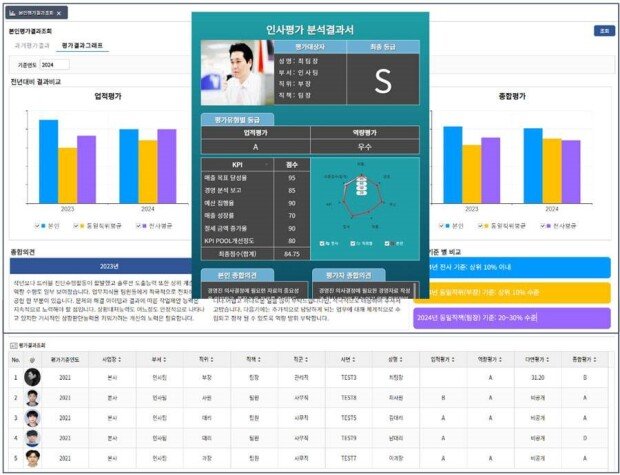
MIRAEIN TECHNOLOGY’s HR evaluation platform ‘QFit HR’ / Source MIRAEIN TECHNOLOGY
What is the core of QFit HR, and what does the name mean?
“At its core, QFit HR is a rule-based system. While HR evaluations may look similar across companies, each is different,” Jung explained. “We wanted to provide services that are both quick and a perfect fit—hence the name QFit HR.”
Because evaluation criteria and workflows differ across organizations, adopting a single system is difficult. Even after implementation, if organizations restructure, HR managers often need to manually adjust processes with IT support. QFit HR solves this by enabling administrators to configure rules easily without IT assistance.
Drawing on Jung’s two decades of experience across industries—including retail, manufacturing, and defense—the platform supports both on-premise and cloud environments, and integrates with legacy systems like Duzon.
Can you explain in more detail what you mean by “simple customized service” in QFit HR?
QFit HR is powered by extensive big data and a library of more than 4,000 templates, for which the company has even secured Korea’s first patent in this field. Systems can be customized to match each company’s unique characteristics, with KPIs (key performance indicators) serving as one of the baselines.
“In most cases, especially for SMEs, just an hour or two of consultation is enough,” Jung explained. The company is also preparing an AI-driven function that will automatically configure evaluation rules with only minimal input from managers.
After adopting the product, how can customers use it? What features are particularly noteworthy?
Once adopted, companies can leverage several core functions:
• Evaluation Navigation: A role-based process map that guides each step of the evaluation.
• Evaluation Results Analysis: Quick insights by category, timeline, and question type, based on manager-defined criteria.
• Unstructured Data Search: Comprehensive queries across variables such as education, career, awards/penalties, personality type, and health records.
Another highly praised feature is evaluation progress management, which visually tracks goal completion and progress rates, allowing proactive issue resolution.
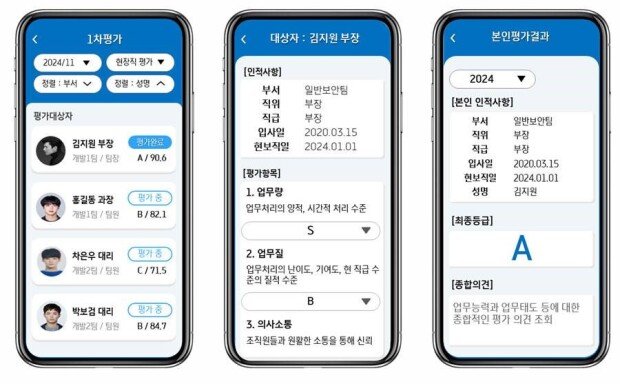
The system can be easily operated in mobile environments / Source=MIRAEIN TECHNOLOGY
Since HR evaluation is difficult because of so many variables, on what basis does QFit HR actually evaluate?
QFit HR supports multiple evaluation types, including:
• Performance Evaluation: Quantifying what an employee has accomplished.
• Competency Evaluation: Assessing whether they possess the skills suited to the company.
• 360-Degree Evaluation: Factoring in peer feedback and reputation.
The system also accommodates collaborative environments by adjusting evaluation weights according to inter-departmental dynamics, ensuring flexibility.
Who are your main customers, and what size of companies are using QFit HR?
“Our clients range widely in size,” Jung noted. “One small fruit distribution company with annual revenues of approximately 3 to 5 billion KRW adopted QFit HR, saying that a fair evaluation system was essential to growth.”
At the other end of the spectrum, MIRAEIN recently won a contract with a general hospital of 12,000 employees, likely making it the first domestic company to deliver an HR evaluation system to an institution of this scale.
Public institutions are also key clients. Cases include a national defense research institute, multiple municipalities, and public enterprises such as Ansan Urban Development, a Jeju-based public corporation, Icheon City, and the Automobile Insurance Compensation Agency.
For a startup, winning contracts with large enterprises is a remarkable achievement. What challenges did you face in the process?
“The biggest hurdles are sales power and talent acquisition,” Jung admitted. “Even with my past sales success, competing as a startup against established firms is a different league.”
Yet progress has been steady. For instance, despite MIRAEIN’s small size, a large hospital agreed to run a PoC (proof of concept) and, after verifying its value, decided to adopt the system. Such cases are increasing, providing crucial momentum.
I heard you made use of SeoulTech’s global collaboration program. How helpful was it in practice?
MIRAEIN also benefited from the Seoul National University of Science and Technology (SeoulTech) global collaboration program. “As a startup, we had to balance technology development with sales. By participating in the program with our project ‘Advancing AI-Based HR Evaluation Systems,’ we received support for personnel and operational costs, which enhanced our capabilities and helped us secure larger clients,” Jung said.
Global partnerships are also expanding. MIRAEIN has begun collaborating with Oracle, using Oracle Cloud Infrastructure (OCI) to apply advanced cloud and AI technologies. Upcoming initiatives include a Seoul city investment forum in September and a planned visit to Oracle’s U.S. headquarters.
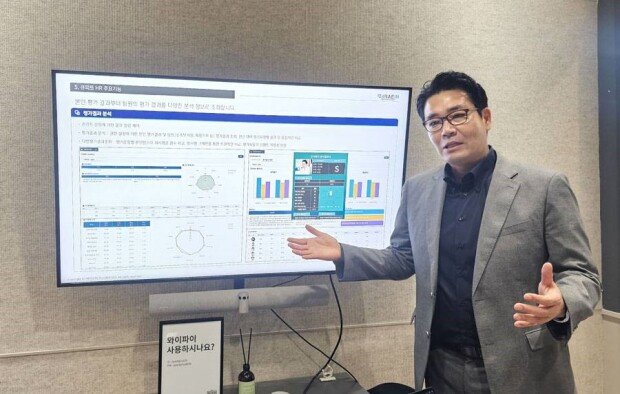
Min-Seong Jung, CEO of MIRAEIN TECHNOLOGY / Source=IT dongA
Could you share your future plans and vision?
MIRAEIN will continue upgrading QFit HR with AI-driven enhancements while expanding into public and global markets. “We plan joint marketing efforts with Oracle and will pilot our system in Vietnam and Thailand,” Jung revealed.
“In Southeast Asia, many companies still use outdated systems or none at all. Introducing our solution can drive highly effective co-growth.”
Localization will be critical: “One Korean conglomerate once abandoned an overseas HR system because it didn’t fit local conditions. We won’t make the same mistake. Through the global collaboration program, we’re adding multilingual support and optimizing interfaces for each region. We look forward to working with global clients soon.”
By Young-woo Kim (pengo@itdonga.com)
* This article was written with support from Seoul National University of Science and Technology.



![[이진영 칼럼]잘난 韓, 못난 尹, 이상한 張](https://dimg.donga.com/c/138/175/90/1/wps/NEWS/IMAGE/2026/01/20/133198367.1.jpg)




 About Dong-A Ilbo