

Lee and Trump meet on trade, defense cooperation
Lee and Trump meet on trade, defense cooperation
Posted August. 26, 2025 07:45,
Updated August. 26, 2025 07:45
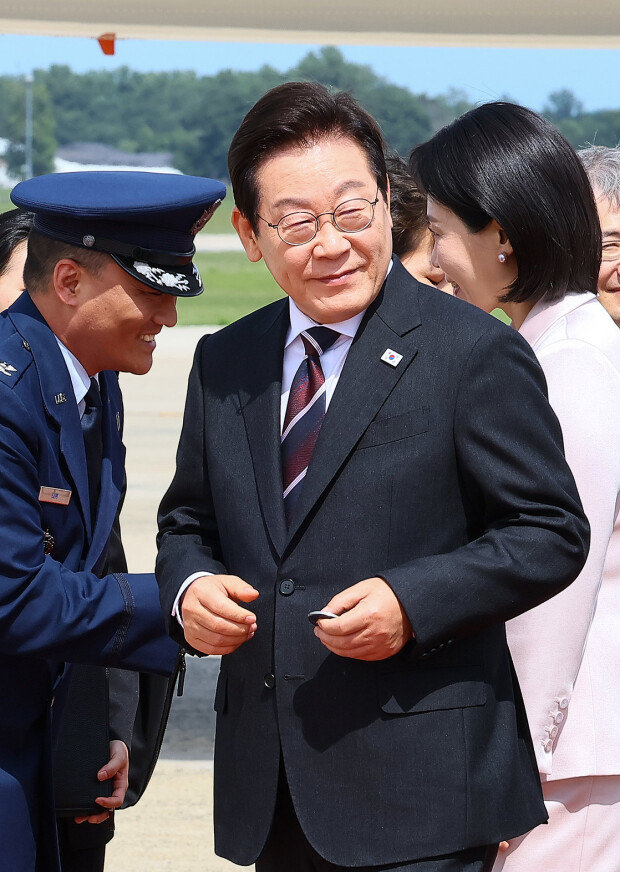
President Lee Jae-myung and U.S. President Donald Trump held their first summit at the White House on Aug. 25 local time, 83 days after Lee took office.
Trump welcomed Lee with a ceremony at noon, followed by a bilateral summit in the Oval Office at 12:15 p.m. The two leaders continued their discussions over a working lunch.
The talks focused on follow-up measures to last month’s tariff agreement, including a $350 billion investment fund for the United States, as well as security and technology cooperation, including South Korea’s planned increase in defense spending.
Trump emphasized expanded South Korean investment in the United States and greater access to its agricultural and livestock markets. He also underscored burden sharing through higher defense spending.
Ahead of the summit, Washington reportedly pressed Seoul to submit detailed plans for the investment fund, increase direct investment, and further open its agricultural and livestock markets, including rice and beef. U.S. officials reportedly warned that the talks could be disrupted if these demands were not met.
Trump has repeatedly said that South Korea pays almost nothing for U.S. forces stationed in the country and should cover the costs itself, insisting that Seoul raise its contribution to $10 billion.
During a press conference on Air Force One en route to Washington on Aug. 24, Lee pushed back, saying, “The U.S. president himself already announced a major agreement. How could we simply accept a unilateral change just because it is now being requested?” He drew a line against demands for increased direct investment and further openings in agriculture and livestock markets.
“The U.S. clearly views the tariff deal as favorable to South Korea, which is why different departments are raising calls for changes," Lee added. "I believe we will reach a realistic and reasonable conclusion.”
On the issue of strategic flexibility for U.S. forces in Korea, he said, “It is not something we can easily agree to. Instead, discussions on transforming U.S. forces in Korea into a future-oriented strategic presence are necessary for us as well.” While expressing concern that changes aimed at countering China could draw Seoul into a cross-strait conflict, Lee made clear a positive stance on restructuring the U.S. military presence to address threats from North Korea and China.
Hoon-Sang Park tigermask@donga.com

![‘반쯤 열린 노트북’ 곳곳에…웃픈 현실인가 유행인가[트렌디깅]](https://dimg.donga.com/c/138/175/90/1/wps/NEWS/IMAGE/2026/05/13/133913539.3.jpg)
![[단독]의원 만찬 잦아진 金총리…‘5월말 사퇴하고 당권 도전’ 관측도](https://dimg.donga.com/c/138/175/90/1/wps/NEWS/IMAGE/2026/05/13/133916813.1.jpg)



 About Dong-A Ilbo