

China sheltered Koreans after Hongkou Park bombing
China sheltered Koreans after Hongkou Park bombing
Posted August. 16, 2025 07:59,
Updated August. 16, 2025 07:59
Japanese poet Tsuru Akira (1909-1938) denounced his country’s wars of aggression until his death. Little known in South Korea, he released a series of poems in 1937 condemning Japan’s full-scale invasion of China and urging an end to the fighting. He was arrested under the Public Security Preservation Law and died the following year.
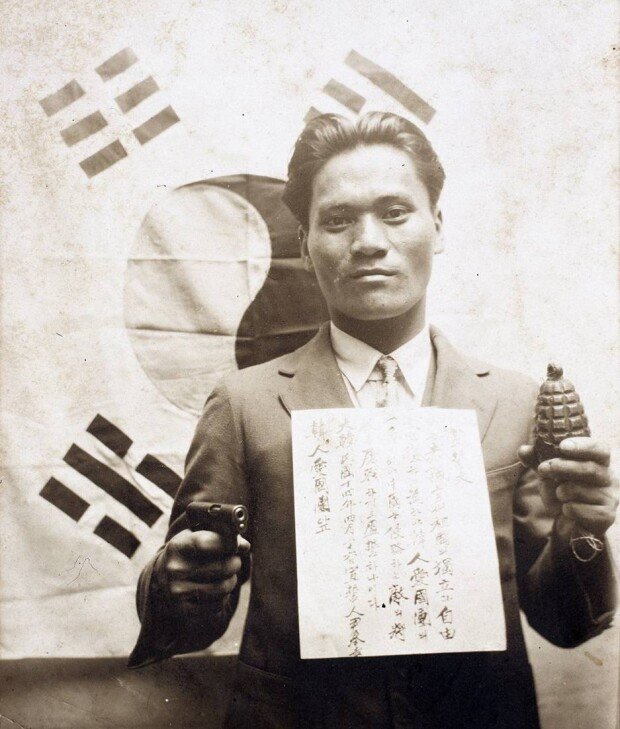
As Korean independence fighter Yoon Bong-gil carried out the Hongkou Park bombing in 1932, the Chinese Nationalist government secretly sheltered leaders of the Korean Provisional Government, including Kim Gu, and provided for their daily needs while cooperating in the anti-Japanese movement.
“History That Opens Peace” is the third joint history textbook created by historians, teachers, and civic groups from three countries to share a common understanding of East Asia’s past. Spanning the period from the 19th century, when the region opened its ports under Western pressure, to the present day, the book was produced over 10 years starting in 2015 by 39 authors and 24 translators. Contributors include scholars from Seoul National University, the University of Tokyo, the Chinese Academy of Social Sciences, and the Asia Peace and History Education Network.
Although it could have been a dry historical account, the book reads in an engaging and accessible way. Divided into three parts, nine chapters, and 36 questions, each section begins with detailed background explanations and timelines that make it easy to follow. Written with young readers in mind, it poses questions that also challenge adults, such as “What language was used in diplomatic negotiations?” and “What role did people with disabilities have under a total war regime?”
One example is the signing of the 1882 Joseon-U.S. Treaty of Peace, Amity, Commerce, and Navigation, Joseon’s first treaty with a Western nation. The language used was neither English nor Korean, but Chinese. At the time, Joseon had no interpreters fluent in English, and the talks were conducted through Qing intermediaries. The book explains, “The plenipotentiary representative Shin Heon’s remarks were translated into Chinese by a Joseon interpreter, then rendered into English by a Chinese interpreter for the U.S. envoy.”
The text also stands out for presenting balanced accounts of the same events from the perspectives of South Korea, China, and Japan. In South Korea, Aug. 15 is celebrated as Liberation Day, marking the end of Japanese colonial rule. In North Korea, it is called the Day of Liberation of the Fatherland. Japan, as the defeated nation, refers to it as the End of the War Day, avoiding terms such as “defeat” or “surrender.” Taiwan’s Liberation Day, however, is Oct. 25, the date the Japanese Governor-General of Taiwan signed the surrender document with the Chinese Nationalist government.
Closing the book leaves readers with a broader view of the alternating conflicts and cooperation among the three East Asian nations. The authors write, “Hostility comes from not knowing each other. Dialogue, discussion, and solidarity toward the future will open the door to a new history.” The subtitle reads, “The future of East Asia as envisioned by Korea, China, and Japan together.”
이지윤 leemail@donga.com




 About Dong-A Ilbo