

Births in April see largest rise in 34 years
Births in April see largest rise in 34 years
Posted June. 26, 2025 08:00,
Updated June. 26, 2025 08:00
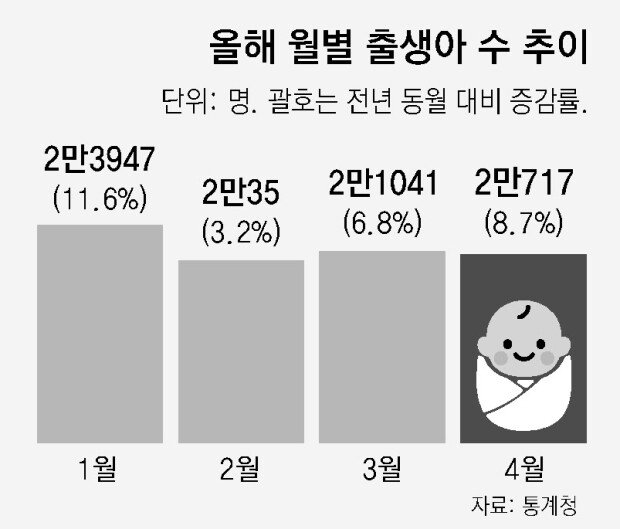
The number of babies born in April rose 8.7 percent year-on-year, marking the sharpest increase in 34 years. Whether the upward trend in births, which began in July of last year, can continue will likely be determined in the second half of this year.
According to Statistics Korea’s “April Population Trends,” released on Tuesday, a total of 20,717 babies were born in April, up 1,658 from the same month last year. This 8.7 percent jump is the highest April increase since 1991. The total fertility rate, which refers to the average number of children a woman is expected to have in her lifetime, also climbed to 0.79 in April, up 0.06 from a year earlier.
By birth order, firstborns accounted for 62.0 percent of all births, up 1.2 percentage points from a year earlier. In contrast, the share of second-borns and third-borns or higher fell by 0.6 percentage points each, to 31.8 percent and 6.2 percent, respectively. This reflects a trend of delayed marriage and childbirth, resulting in smaller family sizes.
The increase in births has now continued for 10 consecutive months since July 2023. A Statistics Korea official explained that those born during Korea’s "echo boom" period (1991 to 1996), who are now in their early to mid-30s and at prime marrying age, are driving the rise in marriages and, consequently, births. The official also cited the resumption of delayed weddings due to the COVID-19 pandemic and various childbirth support policies from the central and local governments as contributing factors.
Most members of the echo boom generation, born during a temporary rebound in birth rates after they fell to the 600,000s in the late 1980s, are now in their 30s. Between 1991 and 1995, the number of annual births in Korea returned to the 700,000s before declining again.
The number of marriages in April was 18,921, up 884 cases, or 4.9 percent, from the same month last year. The increase marks a continued year-on-year rise since April 2023, when marriage numbers jumped by 24.6 percent.
Experts say the second half of this year will be a critical turning point in determining whether the rise in birth rates will persist. “It remains uncertain whether the current pace of growth will be sustained through the end of the year,” said a Statistics Korea official.
Soon-Gu Jeong soon9@donga.com







 About Dong-A Ilbo