

Mt. Naeyeon
The paths leading to a mountain temple in the midwinter are as desolate as can be, with leaves fallen and without signs of man. The sun is hidden by the clouds in the grey sky. The obscure circle around the sun looks beautiful. Frozen leaves make crispy and pleasing sounds at each step of the foot. On this winter day, with no one to badger me, Im allowed to stroll about as much as I please. The scenery I encounter there amuses me. Why not take a winter trip to the Bogyeong Temple valley on Naeyeon Mountain in Pohang, North Gyeongsang Province?
The valley of Mt. Naeyeon is featured in the background of the beautiful mountains and waters in Gyeomjae Jeong Seons paintings
It is not just the journalist who is surprised. Everyone is. Why, I never knew such a beautiful place existed, they say regarding the Bogyeong Temple valley (in Bogyeong Temple National Park, Mountain Naeyeon). From the car park to the temple, one is greeted by an array of disappointments. Restaurants and souvenir shops are lined up one after another. But once one passes the iljumun (entrance with many wooden polls lined up on each side), takes a look around the temple and steps to the paths to the valley, and your thoughts will be entirely different. There they are in a completely new world. One cannot restrain from expressing surprise.
Even when Pohang people referred to this place as little Geumgang I thought they were embellishing their stories. But the sceneries of the valley that only become more and more beautiful awaken me of the limits of my ability to express in words. Would it have been any different for Gyeomjae, a painter in the mid Joseon Dynasty who shaded the beautiful Korean mountains and rivers in the frame of paper? Gyeomjae was given a position as an inspector here in 1733. He must have painted his pictures inebriated by the mountains and waters in this valley while lamenting his limited ability to express, like me. The scenery of the mountains and waters projected into his eyes at that time remains in the painting named Samyongchu, Mountain Naeyeon.
The extraordinarily beautiful valley spreads out above white rocks. Even in the depths of winter, the water still flows. Deep ravines of huge mountains never run dry. The ridge of the mountain is revealed over rocks. There it makes a stage for tall and exuberant pine trees. An old pine tree stands aloof clutching fast to a large rock. The scenery itself is a rich eastern painting.
The paths, leading parallel to the edge of a ravine, are narrow but just right for a person to walk on. Not too steep, rough, or boring. One passes by rocks and walks on muddy paths, circumventing obstacles this way and that. Walking the paths with the children would also be favorable. On the left, the great scenery of the valley spreads. Not too big, not too small, the scale is just right to be observed by two eyes. But a thirty-minute walk over a ridge leads to an enormously enlarged valley. There, the geography of the waterfall begins. In this valley of twelve waterfalls, the Ssangsaeng (or Twin) Waterfall reveals itself first. It is a rare unexplored sight where two streams of water fall into one pond. It is another 40-minute walk from here to Gwaneum Waterfall, said to be the leader in waterfall scenery. To this point the visitors only need to stroll.
Bogyeong Temple, which was built in the Shilla era, is an old temple set in an ideal spot of the valley of Mt. Naeyeon. Even in the deep gorge of the high and steep Taebaek peaks, it is placed so that it looks enveloped by the range of Mt. Naeyeon in the shape of a half moon. There are 14 houses in the temple, including Jeokgwangjeon and Daeungjeon. The allocation of the buildings makes them seem amicable, as if they are chatting with one another. The wooden unicorn-lion sculpture at the foot of the door of Jeokgwangjeon and the jade plate are valuable artifacts that cannot be seen at any other temple. Budo and Wonjinguksabi are also worthy remains that are registered as national treasures. A water basin made of granite lies at the entrance of the temple. Try not to miss the sight of the temple reflected on the surface of the sweet water.
Jusanji, where the King Willows froze in ice to make beautiful scenery-
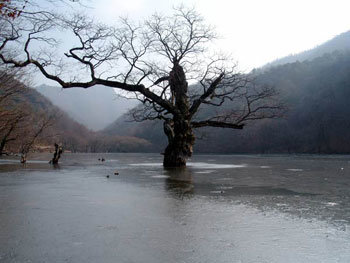
Jusanji in winter is frozen in ice. The glass-like water surface maintains the beauty all through the three previous seasons, reflecting king willows half sunk in water. Finally succumbing to the cold winter, they turn grey and frozen. They look somewhat lacking with all their leaves fallen off, but their gracefulness is not altered.
Now Jusanji is full of ice instead of water. The shadows of the naked trees, darkening the surface of ice forms a unique taste. This figure of nature is outlined without any ostentation. It is graceful and worthy because it is a transcendental existence that cannot be deliberated or expected from the ephemeral thoughts of human beings.
The lakeside paths that circumscribe Jusanji are also worth exploring. It feels good to walk on the frozen lake, but a stroll through the paths up and down Jusanji is another experience. The serene mountain path can be conquered in only ten minutes. But it is so lovely it makes the walkers feel like walking for an hour. It is even more so in the winter morning when the sun shines with warmth, probably due to the 100% pure sunshine shower that falls through the stripped branches. Jusanji is the lake that appeared in the Kim Ki-deok film Spring Summer Fall Winter and Spring.
summer@donga.com


![[단독]조선업도 중동 쇼크… “선박 철판 절단용 에틸렌 부족” SOS](https://dimg.donga.com/c/138/175/90/1/wps/NEWS/IMAGE/2026/03/16/133535690.1.jpg)
![[김승련 칼럼]호르무즈 파병은 ‘무서운 고양이’ 목에 방울 달기](https://dimg.donga.com/c/138/175/90/1/wps/NEWS/IMAGE/2026/03/15/133535385.1.jpg)




 About Dong-A Ilbo