

Election watchdog resists accountability
Election watchdog resists accountability
Posted June. 24, 2026 08:39,
Updated June. 24, 2026 08:39
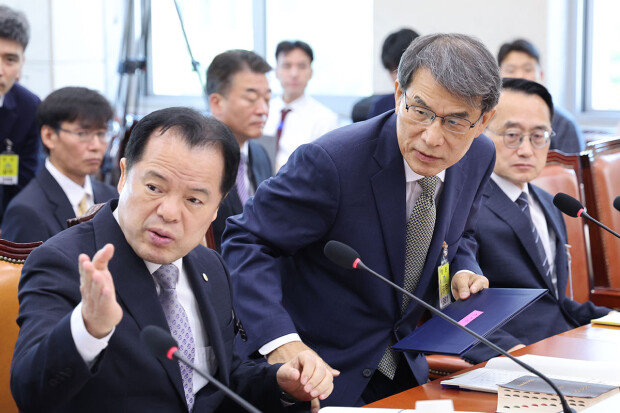
Election officials skipped the opening session of a parliamentary investigation into the ballot shortage fiasco and appeared only after facing fierce criticism for what lawmakers described as a collective refusal to answer to the public. On June 23, one day before the inquiry began, rival parties agreed to summon all nine members of the National Election Commission, along with 19 current and former election officials, including former heads of the Seoul and Songpa election commissions. Yet when the hearing opened, only three witnesses, including former commission chairman Roh Tae-ak, were present. Of the eight sitting commissioners, only standing commissioner Wi Cheol-hwan attended.
The seven non-standing commissioners had initially informed the National Assembly that they would not appear. After lawmakers from both parties condemned their absence, five arrived later in the day, while two never appeared. Even then, commissioners gave conflicting answers about whether they had been informed of a directive issued last November lowering the minimum ballot-printing threshold to 50 percent of registered voters. Of the seven commissioners questioned, including Roh, only two said they knew the guideline had been included in a report prepared by the commission secretariat. The measure was approved a month later solely under the authority of the secretary-general, without any discussion among commissioners. In doing so, the commissioners effectively acknowledged that they had failed to exercise even basic oversight.
Oh Min-seok, former head of the Seoul election commission, and Min So-young, former head of the Songpa election commission, both of whom bear direct responsibility for the incident, also failed to appear until the afternoon session. Requests for additional ballot papers poured in from polling stations across Songpa District beginning on the afternoon of Election Day on June 3. Yet neither the Seoul nor Songpa election commission took meaningful action, and the matter was never reported to the National Election Commission. Even those best positioned to explain what happened and why appeared unwilling to do so.
The episode highlights the extent to which the election commission, shielded from meaningful oversight by its status as a constitutional institution, has drifted from accountability. During the hearing, the commission acknowledged that earlier explanations regarding the number of polling stations that received additional ballot papers and the timing of the Songpa commission's initial awareness of the problem were inaccurate. More than 20 days after the incident, even the most basic facts remain in dispute. After exposing serious shortcomings in competence and management, the commission is now raising questions about its willingness to take responsibility. The public is left wondering how much of its account can still be trusted.

![[오늘의 운세/6월 24일]](https://dimg.donga.com/c/138/175/90/1/wps/NEWS/IMAGE/2026/06/24/134170359.1.jpg)
![금태섭 “李정부 지탱한 ‘내란 프레임’ 이제 깨졌다”[황형준의 법정모독]](https://dimg.donga.com/c/138/175/90/1/wps/NEWS/IMAGE/2026/06/23/134167619.1.jpg)
![[단독]선관위, 사전투표 용지는 실제 투표자 2배 넘게 준비](https://dimg.donga.com/c/138/175/90/1/wps/NEWS/IMAGE/2026/06/13/134105323.3.jpg)


 About Dong-A Ilbo