

Kim Jong Un orders stronger nuclear forces
Kim Jong Un orders stronger nuclear forces
Posted June. 24, 2026 08:39,
Updated June. 24, 2026 08:39
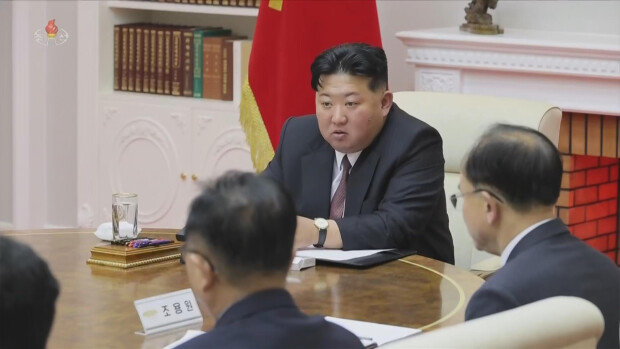
North Korean leader Kim Jong Un has ordered an accelerated buildup of the country's military capabilities, including its nuclear forces, while accusing South Korea's pursuit of nuclear-powered submarines of heightening tensions on the Korean Peninsula. The remarks appeared intended to justify Pyongyang's continued military expansion by shifting responsibility for regional instability onto Seoul.
According to the Korean Central News Agency, the second plenary meeting of the Central Committee of the ninth term of the Workers' Party of Korea was held from June 20 to 22 under Kim's chairmanship. As the party's highest decision-making body between congresses, the meeting addressed key political and military priorities. Kim claimed that the United States and South Korea were becoming increasingly aggressive in expanding and modernizing their military capabilities and were now seeking to acquire nuclear-powered submarines. He said such moves were pushing tensions on the Korean Peninsula to dangerous levels. Kim also accused the allies of conducting another round of military planning through the Nuclear Consultative Group, or NCG, which he described as a mechanism for preparing a nuclear war against North Korea by integrating nuclear and conventional forces. He pointed to South Korea's submarine initiative and the latest NCG meeting as major sources of regional tension. South Korea and the United States held the sixth NCG meeting in Seoul on June 11 and reaffirmed their shared goal of North Korea's denuclearization in a joint statement.
The meeting also reaffirmed North Korea's hard-line stance toward Seoul. Participants stressed the need to uphold the party's principle of struggle against what it calls its "most hostile state," a reference to South Korea. Kim further instructed officials to advance construction of a 10,000-ton strategic guided-missile cruiser and complete fortification projects along the inter-Korean border, which Pyongyang refers to as its "southern border."
Kim also underscored his commitment to expanding North Korea's nuclear arsenal. KCNA reported that participants agreed that strengthening nuclear forces and fully asserting the country's status as a nuclear-armed state was the only effective way to respond confidently to an increasingly unpredictable international security environment. Kim directed officials to press ahead without interruption with efforts to expand strategic military assets, pursuing a level of capability that could "overwhelm the world."
Lim Eul-chul, a professor at Kyungnam University's Institute for Far Eastern Studies, said North Korea was using South Korea's push for nuclear-powered submarines to justify its own military initiatives, including construction of a 10,000-ton guided-missile cruiser, development of naval bases and efforts to seal off the inter-Korean border. He described the move as a carefully calculated political and military strategy.
South Korea's Foreign Ministry said Tuesday that the country's pursuit of nuclear-powered submarines is intended to bolster national security amid a rapidly changing security environment, particularly as North Korea continues to advance its nuclear and missile capabilities.
Oh-Hyuk Kwon hyuk@donga.com

![[오늘의 운세/6월 24일]](https://dimg.donga.com/c/138/175/90/1/wps/NEWS/IMAGE/2026/06/24/134170359.1.jpg)
![금태섭 “李정부 지탱한 ‘내란 프레임’ 이제 깨졌다”[황형준의 법정모독]](https://dimg.donga.com/c/138/175/90/1/wps/NEWS/IMAGE/2026/06/23/134167619.1.jpg)
![[단독]선관위, 사전투표 용지는 실제 투표자 2배 넘게 준비](https://dimg.donga.com/c/138/175/90/1/wps/NEWS/IMAGE/2026/06/13/134105323.3.jpg)



 About Dong-A Ilbo