

AI Collaboration Era, WEVEN’s Zaemit “Changing Web Production with Multi-Agent Orchestration”
AI Collaboration Era, WEVEN’s Zaemit “Changing Web Production with Multi-Agent Orchestration”
Posted June. 08, 2026 13:55,
Updated June. 08, 2026 13:56
- WEVEN’s "Zaemit" platform replaces fragmented tools with a unified system where specialized AI agents (design, code, operations) collaborate to manage the entire web production lifecycle.
- By offering an integrated environment that works within VS Code and connects with external AI models, Zaemit eliminates tool-switching, enabling high-quality, full-stack "vibe coding."
- Building on strong domestic growth (30k+ MAU), WEVEN is targeting the US and European markets to position Zaemit as the "Next Figma" for AI-orchestrated web development.
-
AI agents are advancing beyond the level of content generation to a stage where they can enable actual services. Recently, as the limitations of relying on a single Large Language Model (LLM) for all tasks have been exposed, "Multi-Agent Orchestration," where AI agents specialized in each field collaborate organically, is emerging as a trend.
Global big tech companies are also paying attention to multi-agent orchestration. The global market research firm Gartner projected that by 2028, agentic AI will drive $450 billion (approximately 600 trillion won) in revenue, amounting to about 30% of enterprise application revenue. Anthropic announced on its company blog last June that its research function, operating in a multi-agent structure, recorded an evaluation score of 90.2%, showing superior performance compared to a single agent. OpenAI unveiled "AgentKit," which allows developers to visually design and deploy complex agent workflows, at DevDay last October.
The open-source framework LangChain introduced "LangGraph 1.0" last year and began supporting a multi-agent collaboration environment. Microsoft(MS) released an agent framework that integrates the open-source AI software development kit "Semantic Kernel" with "AutoGen," which coordinated conversations between multiple agents. The paradigm of the AI market is shifting from a competition of AI performance to a competition of building systems where multiple AIs collaborate.
Limitations of existing web builders and vibe coding... Why multi-agent?
This trend is changing the topography of the web production field. The existing web production market was divided into "web builders" such as Wix or Webflow, and "vibe coding tools" such as Lovable or Cursor. However, while web builders introduced AI functions and operational support functions, they automated only the editor functions within the platform, making customization difficult. On the other hand, while vibe coding tools excelled at initial code generation, there was the inconvenience of the user having to solve complex infrastructure such as hosting, database (DB) connection, and real-time deployment.
The domestic AI startup WEVEN presents a blueprint to solve the limitations of existing vibe coding tools through a multi-agent structure using "Zaemit," a vibe coding platform that creates high-quality design-based websites through AI conversation. It is structurally difficult for a single AI agent to perfectly perform design sense, code quality, image generation, and operational judgment. On the other hand, the explanation is that if agents specialized in each area collaborate, they can bundle areas of operation and personalization that existing tools could not reach into a single flow.
Accordingly, Zaemit claims to be a "Full-Lifecycle platform" for web production, not an AI web builder or a vibe coding tool. It pursues an integrated structure that bundles all stages of web production and operation, such as site generation, image generation, code development, and operation automation, into a single flow and processes them with natural language commands.
Organic collaboration drawn by domain-specific agents
The differentiation points of Zaemit that WEVEN puts forward are largely three: high-quality post-AI-level design through its own learning model; versatility compatible with the results of external AI or design tools; and the construction of an ecosystem (scalability) where experts can monetize templates and extended functions through a plugin market.
Currently, it supports WebGen.Agent, which is in charge of web generation. This is driven by a web-specialized AI model that WEVEN tuned itself with data by industry. Users create the site they want while having a natural language conversation with the AI. Following this, ImgGen.Agent, which is specialized in image generation, is scheduled to be updated within the first half of the year. Dev.Agent, which handles code and functions, and Ops.Agent, which is responsible for operations, are also ahead of release within the year.
In particular, WEVEN plans to expand its territory beyond B2C services to the professional B2B market that supports real-time collaboration and full-stack vibe coding. To this end, it is supported separately as an extension program for Microsoft Visual Studio Code(VS Code). HTML created with external AI such as ChatGPT, Claude, or Gemini can be immediately modified in the Zaemit editor, and through Model Context Protocol(MCP) linkage, you can also perform vibe coding by directly connecting to the AI you were using.
The strength of this multi-agent structure is that it connects the entire life cycle of a website into a single workflow. Although different capabilities are required at each stage from site generation to images, code, and deployment/operation, in the existing environment, the stages were cut off, so it was necessary to parallelize multiple tools or rely on collaboration by field. Zaemit supports the entire process to be performed without interruption by having specialized agents take charge of each stage and connect them into a single flow. The fact that the work gap due to tool switching is reduced and the introduction burden is low because it does not significantly change the existing work method is also a differentiation point that Zaemit puts forward.
Starting global expansion beyond the domestic stage
WEVEN, established in 2024, announced that it exceeded 3 billion won in cumulative sales. After the beta launch in May 2025, the Zaemit service, which began official service in October of the same year, exceeded 30,000 MAU(Monthly Active Users) and 300,000 cumulative users as of April 2026. It also solidified its technical foundation by holding 3 registered patents related to AI web technology and 7 PCT international patents under application.
WEVEN's ultimate goal is to integrate the tools that were fragmented by web production stage and become a global standard for overall web production, just like Figma, which became the global standard for design tools.
The biggest battleground is the US market, which accounts for about 38% of total web builder demand. WEVEN plans to build infrastructure based on global cloud regions and provide the same environment to users all over the world. Junghwan Kim, CEO of WEVEN, added, "As soon as we finish localization work such as English UI application, payment and domain linkage, we plan to enter the US and European markets in earnest," and "The multi-agent orchestration area is a market that has just begun to form even in the US. WEVEN will verify its value as an integrated platform in the US market."
He continued, "The question the market is throwing now is not 'which AI is the smartest,' but 'which system collaborates most effectively,'" and " WEVEN's Zaemit will prove the answer most quickly in the professional field of web and establish itself as a 'Next Figma' platform."
By Ye-ji Kim (yj@itdonga.com)
- By offering an integrated environment that works within VS Code and connects with external AI models, Zaemit eliminates tool-switching, enabling high-quality, full-stack "vibe coding."
- Building on strong domestic growth (30k+ MAU), WEVEN is targeting the US and European markets to position Zaemit as the "Next Figma" for AI-orchestrated web development.
-
AI agents are advancing beyond the level of content generation to a stage where they can enable actual services. Recently, as the limitations of relying on a single Large Language Model (LLM) for all tasks have been exposed, "Multi-Agent Orchestration," where AI agents specialized in each field collaborate organically, is emerging as a trend.
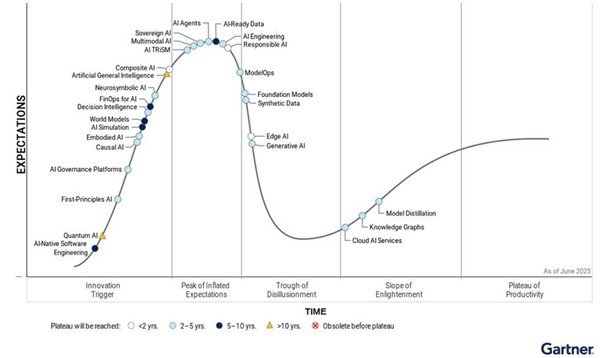
Gartner data highlighting AI agents as a key technology trend / Source=Gartner
Global big tech companies are also paying attention to multi-agent orchestration. The global market research firm Gartner projected that by 2028, agentic AI will drive $450 billion (approximately 600 trillion won) in revenue, amounting to about 30% of enterprise application revenue. Anthropic announced on its company blog last June that its research function, operating in a multi-agent structure, recorded an evaluation score of 90.2%, showing superior performance compared to a single agent. OpenAI unveiled "AgentKit," which allows developers to visually design and deploy complex agent workflows, at DevDay last October.
The open-source framework LangChain introduced "LangGraph 1.0" last year and began supporting a multi-agent collaboration environment. Microsoft(MS) released an agent framework that integrates the open-source AI software development kit "Semantic Kernel" with "AutoGen," which coordinated conversations between multiple agents. The paradigm of the AI market is shifting from a competition of AI performance to a competition of building systems where multiple AIs collaborate.
Limitations of existing web builders and vibe coding... Why multi-agent?
This trend is changing the topography of the web production field. The existing web production market was divided into "web builders" such as Wix or Webflow, and "vibe coding tools" such as Lovable or Cursor. However, while web builders introduced AI functions and operational support functions, they automated only the editor functions within the platform, making customization difficult. On the other hand, while vibe coding tools excelled at initial code generation, there was the inconvenience of the user having to solve complex infrastructure such as hosting, database (DB) connection, and real-time deployment.
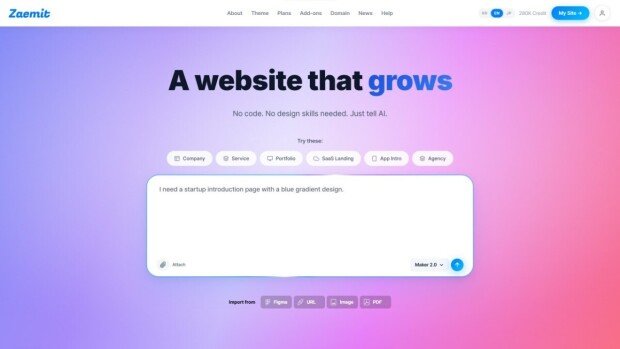
Zaemit service page / Source=WEVEN
The domestic AI startup WEVEN presents a blueprint to solve the limitations of existing vibe coding tools through a multi-agent structure using "Zaemit," a vibe coding platform that creates high-quality design-based websites through AI conversation. It is structurally difficult for a single AI agent to perfectly perform design sense, code quality, image generation, and operational judgment. On the other hand, the explanation is that if agents specialized in each area collaborate, they can bundle areas of operation and personalization that existing tools could not reach into a single flow.
Accordingly, Zaemit claims to be a "Full-Lifecycle platform" for web production, not an AI web builder or a vibe coding tool. It pursues an integrated structure that bundles all stages of web production and operation, such as site generation, image generation, code development, and operation automation, into a single flow and processes them with natural language commands.
Organic collaboration drawn by domain-specific agents
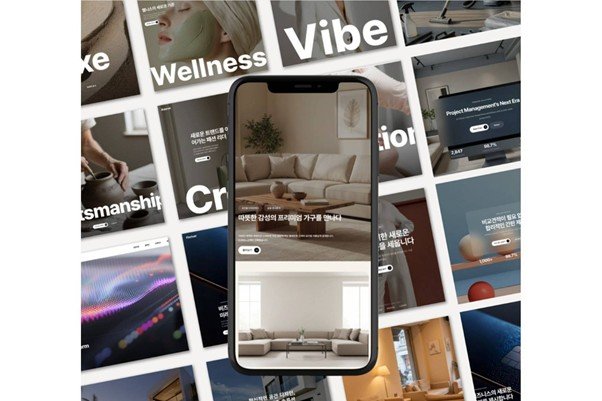
WebGen.Agent applied Maker 3.0 model update / Source=WEVEN
The differentiation points of Zaemit that WEVEN puts forward are largely three: high-quality post-AI-level design through its own learning model; versatility compatible with the results of external AI or design tools; and the construction of an ecosystem (scalability) where experts can monetize templates and extended functions through a plugin market.
Currently, it supports WebGen.Agent, which is in charge of web generation. This is driven by a web-specialized AI model that WEVEN tuned itself with data by industry. Users create the site they want while having a natural language conversation with the AI. Following this, ImgGen.Agent, which is specialized in image generation, is scheduled to be updated within the first half of the year. Dev.Agent, which handles code and functions, and Ops.Agent, which is responsible for operations, are also ahead of release within the year.
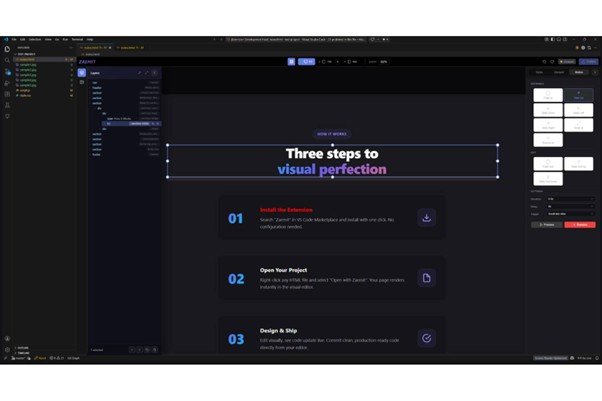
In particular, WEVEN plans to expand its territory beyond B2C services to the professional B2B market that supports real-time collaboration and full-stack vibe coding. To this end, it is supported separately as an extension program for Microsoft Visual Studio Code(VS Code). HTML created with external AI such as ChatGPT, Claude, or Gemini can be immediately modified in the Zaemit editor, and through Model Context Protocol(MCP) linkage, you can also perform vibe coding by directly connecting to the AI you were using.
The strength of this multi-agent structure is that it connects the entire life cycle of a website into a single workflow. Although different capabilities are required at each stage from site generation to images, code, and deployment/operation, in the existing environment, the stages were cut off, so it was necessary to parallelize multiple tools or rely on collaboration by field. Zaemit supports the entire process to be performed without interruption by having specialized agents take charge of each stage and connect them into a single flow. The fact that the work gap due to tool switching is reduced and the introduction burden is low because it does not significantly change the existing work method is also a differentiation point that Zaemit puts forward.
Starting global expansion beyond the domestic stage
Zaemit extension program where any HTML can be edited in VS Code / Source=WEVEN
WEVEN, established in 2024, announced that it exceeded 3 billion won in cumulative sales. After the beta launch in May 2025, the Zaemit service, which began official service in October of the same year, exceeded 30,000 MAU(Monthly Active Users) and 300,000 cumulative users as of April 2026. It also solidified its technical foundation by holding 3 registered patents related to AI web technology and 7 PCT international patents under application.
WEVEN's ultimate goal is to integrate the tools that were fragmented by web production stage and become a global standard for overall web production, just like Figma, which became the global standard for design tools.
The biggest battleground is the US market, which accounts for about 38% of total web builder demand. WEVEN plans to build infrastructure based on global cloud regions and provide the same environment to users all over the world. Junghwan Kim, CEO of WEVEN, added, "As soon as we finish localization work such as English UI application, payment and domain linkage, we plan to enter the US and European markets in earnest," and "The multi-agent orchestration area is a market that has just begun to form even in the US. WEVEN will verify its value as an integrated platform in the US market."
He continued, "The question the market is throwing now is not 'which AI is the smartest,' but 'which system collaborates most effectively,'" and " WEVEN's Zaemit will prove the answer most quickly in the professional field of web and establish itself as a 'Next Figma' platform."
By Ye-ji Kim (yj@itdonga.com)








 About Dong-A Ilbo