

Won reaches 17-year low against dollar
Won reaches 17-year low against dollar
Posted June. 08, 2026 08:34,
Updated June. 08, 2026 08:34
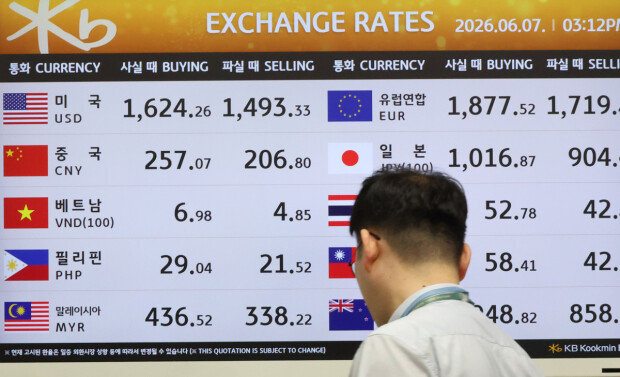
The South Korean won fell past 1,560 per U.S. dollar on June 6, sliding to its weakest level in 17 years. The average exchange rate for the second quarter, covering April through June, is on track to reach its highest level since the first quarter of 1998 during the Asian financial crisis. Despite repeated verbal intervention from authorities, the won has remained under pressure as expectations of higher U.S. interest rates strengthen the dollar, foreign investors continue to sell South Korean stocks and exporters hold on to their dollar earnings. The prolonged currency weakness is expected to weigh heavily on the South Korean economy.
According to the Ministry of Economy and Finance and the Bank of Korea, the won-dollar exchange rate rose as high as 1,561.5 during overnight trading in Seoul on June 6. That was its highest level since March 6, 2009, when it reached 1,597.0 won. In New York trading, the exchange rate later closed at 1,560.2 won at 6 a.m. Korea time on June 7.
On a quarterly basis, the won is headed for its weakest showing since the Asian financial crisis. Based on settlement prices, the average won-dollar exchange rate from April 1 through June 5 stood at 1,491.0 won, up 25.8 won from the first-quarter average of 1,465.2 won. The first-quarter figure had already marked the highest quarterly average since the first quarter of 1998.
The factors behind the won’s decline are more complex than those seen during either the 1998 financial crisis or the 2009 global financial crisis. Expectations of further U.S. rate hikes have accelerated a global shift toward dollar assets. Meanwhile, foreign investors have posted net sales on the benchmark KOSPI for 20 consecutive trading sessions, taking profits after the market’s sharp gains earlier this year.
A weaker won pushes up the cost of imported goods, including food and raw materials, creating broad-based pressure on households and businesses alike. While a lower currency can help exporters by improving price competitiveness overseas, the benefits are likely to be limited if companies continue to keep their export earnings in dollars rather than converting them into won.
After the exchange rate jumped sharply over the weekend, the Ministry of Economy and Finance, the Bank of Korea and other agencies held an emergency meeting on June 7 to assess market conditions. Officials agreed to examine suspected market manipulation in the foreign exchange market and investigate potential illegal dollar transactions involving importers and exporters. Chairing the meeting, Deputy Prime Minister and Finance Minister Koo Yun-cheol said authorities would monitor market developments around the clock and take necessary steps as volatility remains elevated.
Kang Sung-jin, a professor of economics at Korea University, said there are few signs of fresh dollar inflows into Seoul’s foreign exchange market. He added that policymakers should also prepare for the possibility of the won-dollar exchange rate climbing above 1,600.
지민구 기자 warum@donga.com








 About Dong-A Ilbo