

KOSPI slides as Broadcom rattles AI bets
KOSPI slides as Broadcom rattles AI bets
Posted June. 06, 2026 08:04,
Updated June. 06, 2026 08:04
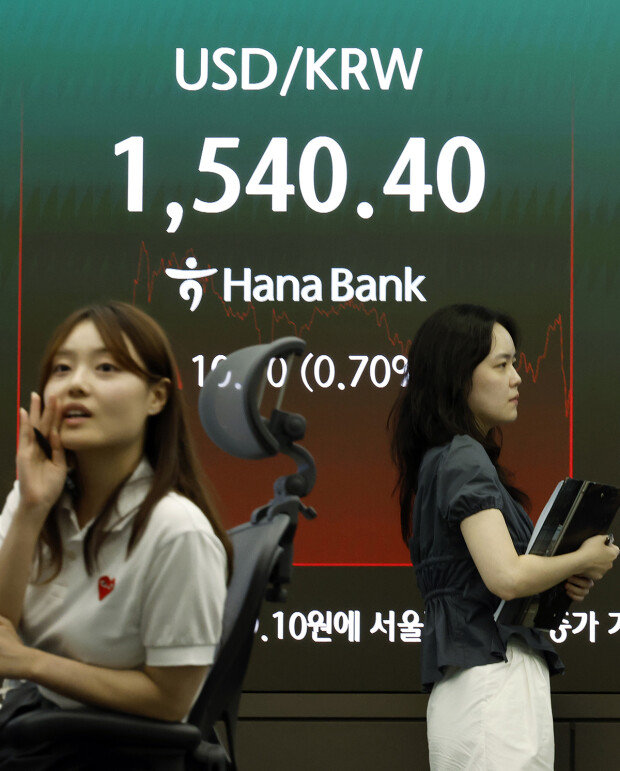
South Korea’s benchmark KOSPI fell more than 5% on Friday after concerns about the artificial intelligence trade spread through global semiconductor stocks following a disappointing outlook from U.S. chipmaker Broadcom. Foreign investors extended their selloff of South Korean equities, sending the won to its weakest level against the U.S. dollar since the global financial crisis. At currency exchange counters at Incheon International Airport, the dollar traded above 1,600 won.
The KOSPI closed at 8,160.59, down 478.82 points, or 5.54%, from the previous session. Foreign investors rushed to sell from the opening bell, prompting the Korea Exchange to activate a sell-side sidecar, a temporary suspension of program sell orders, at 9:08 a.m. It was the 10th such measure triggered this year.
The sharp decline followed what investors dubbed the “Broadcom shock.” Although Broadcom reported strong fiscal second-quarter earnings for the February-April period, its AI semiconductor revenue and outlook fell short of market expectations. The company’s shares plunged 12.6% in New York trading on Thursday, wiping out $285 billion in market value. It marked the fourth-largest one-day market capitalization loss in U.S. corporate history.
The disappointment quickly spread to memory chipmakers, which had been among the biggest beneficiaries of the AI boom. Investors were also unsettled by speculation that Nvidia’s next-generation AI accelerator, Vera Rubin, could require less memory than previously expected. After Micron Technology fell 7.74% and SanDisk lost 3.92%, shares of Samsung Electronics and SK hynix dropped 6.40% and 9.92%, respectively. A broader retreat from risk assets pushed the KOSDAQ down 4.5% to 1,002.44. The index briefly fell to 992.8 during the session, dropping below 1,000 for the first time since March 4.
“Concerns have grown that the semiconductor industry could peak sooner than expected, and that led to a sharp market reaction,” said Lee Hyo-seop, a senior research fellow at the Korea Capital Market Institute. “As the won weakened, foreign investors sold South Korean stocks to avoid currency losses. That selling then added further pressure on the exchange rate.”
Foreign investors sold a net 3.5 trillion won worth of KOSPI-listed shares on Friday. They have been net sellers for 20 consecutive trading sessions since May 7, unloading a combined 70.11 trillion won over that period.
The foreign selloff also hit the currency market. The won closed the daytime session at 1,539.1 per dollar, down 9.4 won from the previous trading day. It weakened to as low as 1,549.1 during the session, its lowest level since March 10, 2009, when the exchange rate reached 1,561 won amid the aftermath of the global financial crisis. On Friday afternoon, travelers buying dollars at bank exchange counters at Incheon International Airport were quoted rates above 1,600 won per dollar.
Analysts expect pressure on the won to persist in the near term. Park Hyeong-jung, an economist at Woori Bank, cited tight supply and demand conditions in the foreign exchange market, prolonged instability in the Middle East and uncertainty surrounding the U.S. Federal Reserve as key risks.
“With foreign exchange market conditions already tight, those factors are likely to keep the dollar supported,” Park said. “There also appear to be few effective options available to authorities seeking to stabilize the exchange rate.”
홍석호 기자 will@donga.com


![[단독]양정원 남편에 룸살롱 접대받은 강남서 수사팀장 “자네 부인 잘 끝날거야”](https://dimg.donga.com/c/138/175/90/1/wps/NEWS/IMAGE/2026/06/05/134060265.1.jpg)





 About Dong-A Ilbo