

Lee criticizes prosecutorial power expansion
Lee criticizes prosecutorial power expansion
Posted April. 15, 2026 09:27,
Updated April. 15, 2026 09:27
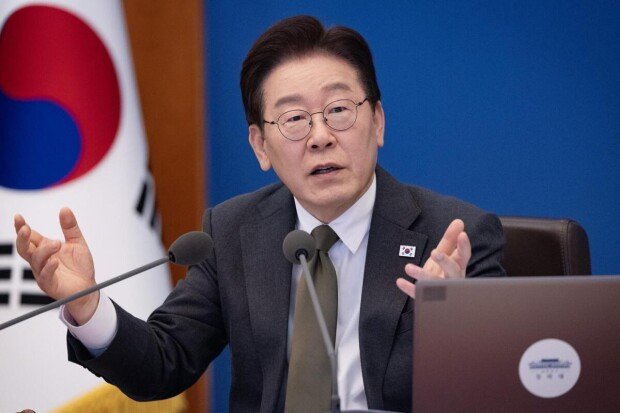
President Lee Jae-myung said Tuesday that South Koreans may carry more criminal records than people in any other country, warning that the heavy reliance on criminal penalties has distorted the legal system and concentrated power in prosecutors.
Speaking at a Cabinet meeting, Lee made the remarks after receiving a report on measures to rationalize criminal penalties from the Ministry of Justice and the Ministry of Economy and Finance. “It may be that South Korean citizens have the most criminal records in the world. Almost everyone seems to have one,” he said, underscoring what he described as excessive criminalization.
Lee said the broad application of criminal punishment has weakened the principle of legality, which requires that crimes and penalties be clearly defined by law. “When criminal penalties are applied so widely, almost anything can be punished,” he said. “That has given prosecutors and investigative agencies too much power, drawing criticism that the country has become a prosecutorial state. In some cases, judicial authority is even being used for political ends.”
He called for a shift toward financial penalties, arguing that fines and surcharges are now more effective than in the past. “When economic capacity was limited, fines may not have carried much weight, which led to greater reliance on criminal punishment,” he said. “Today, economic penalties can have a stronger impact.” He indicated that the penalty system should be redesigned to center on fines and administrative charges.
Turning to global developments, Lee said ceasefire talks over the recent Middle East conflict appear unlikely to yield a clear agreement. He warned that disruptions to global energy and raw materials supply chains, along with high oil prices, are likely to continue for the time being.
“We should treat this as a given and further reinforce our emergency response system,” he said, urging swift implementation of the recently approved supplementary budget to support livelihoods.
Lee also called for faster efforts to address structural weaknesses in the economy exposed during the conflict. He urged the government to prioritize diversifying supply chains, pursuing mid- to long-term industrial restructuring and advancing a transition to a plastic-free economy as key national strategic projects.
After receiving a briefing on inflation, Lee pointed to the fuel price cap, saying it may have made South Korea one of the lowest-cost countries for fuel. He urged continued efforts to curb fuel consumption as much as possible.
Kyu-Jin Shin newjin@donga.com

![[김순덕 칼럼]황당 X에 잡힌 李, 대통령 주변이 단단히 고장났다](https://dimg.donga.com/c/138/175/90/1/wps/NEWS/IMAGE/2026/04/15/133748626.1.jpg)


 About Dong-A Ilbo