

China’s humanoid robot rentals shift from novelty to service
China’s humanoid robot rentals shift from novelty to service
Posted January. 28, 2026 09:24,
Updated January. 28, 2026 09:24
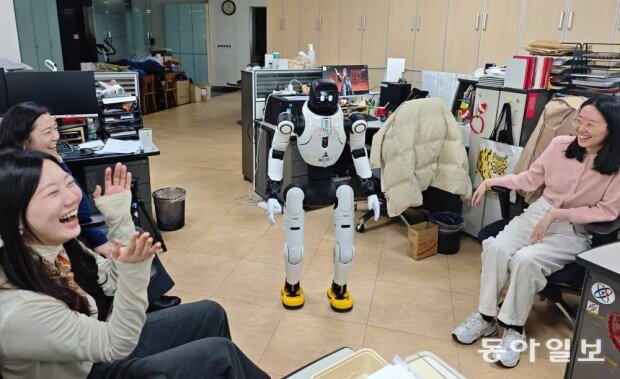
The robot was rented through a China-based platform specializing in robot rentals. Using the company’s smartphone application, users can choose from a wide range of models, including robot dogs, panda-shaped robots and humanoid robots. After selecting a rental date and delivery address and completing payment, the robot can be delivered in within two days. A professional technician accompanies the delivery to explain basic operation and assist with any unexpected issues during use, highlighting how quickly humanoid robots are becoming accessible consumer services.
The unit rented that day was the Lingxi X2, produced by Chinese robotics firm Zhiyuan Robotics. The robot is capable of simple gestures such as waving, shaking hands and forming a heart shape above its head. It also comes with four preset routines that involve dancing to music for about one minute. Basic operation can be handled through a joystick or a smartphone app.
One notable advantage of renting a robot is that users can directly control it and experiment with various movements, rather than merely watching it operate. After a brief tutorial, even first-time users were able to issue simple commands without difficulty. The robot also navigated office spaces smoothly, handling tasks such as riding elevators and moving between floors with ease.
Powered by artificial intelligence, the robot can interact with people through voice communication. It introduced itself as a “next-generation AI star made of silicon.” When asked whether it was male or female, it replied simply, “I am a robot.”
When asked who South Korea’s current president is, the robot answered accurately, “President Lee Jae-myung, the 21st president, who took office in June 2025.” When prompted for a hug, it formed smiling eyes and opened its arms, offering a glimpse into the potential future of companion robots.
The daily rental fee is 3,599 yuan, or about 750,000 won. For a 30-day rental, the price drops to 1,499 yuan per day, or roughly 310,000 won. While this is relatively affordable compared with the robot’s retail price of 98,000 yuan, or about 20 million won, it remains a substantial expense for individual consumers. Robot dog models are priced lower, at 399 to 499 yuan per day, or approximately 83,000 to 104,000 won.
● Orders surge ahead of Lunar New Year
Qingtianzu, a Shanghai-based robot rental platform, launched its service in late December last year. The company was jointly established by robotics startup Zhiyuan Robotics and Paiqu Technology. While individuals and small businesses had previously sold or rented robots through general e-commerce platforms, this marks the first platform created exclusively for robot rentals. “China has seen a robot boom since early last year, but relatively few people have actually had hands-on experience,” said Li Kewei, the company’s chief marketing officer, explaining the motivation behind the service.
Most customers so far have been corporate clients, typically renting robots for internal events or promotional activities at shopping malls. Orders have surged ahead of the Lunar New Year, as companies plan to deploy robots for kickoff ceremonies or employee appreciation events. Li said the platform has received an average of more than 100 orders per day since its launch, adding that it provides not only robot rentals but also event concepts built around the machines.
Robot rentals are also available through offline stores in China. A “6S robot store” that opened last year in Shenzhen, Guangdong province, offers one-stop services that include sales and rentals. The 6S model expands on the traditional automotive industry’s 4S framework by adding leasing and customization. According to Chinese media reports, the store carries more than 20 robot brands, with humanoid robots renting for about 8,000 yuan, or roughly 1.7 million won. Four-legged robot dogs are also offered with customized designs, including dinosaur, pony and lion shapes.
● China’s humanoid robot rental market seen reaching 10 billion yuan this year
China’s humanoid robot rental market was valued at about 1 billion yuan, or roughly 210 billion won, last year. Experts expect rapid expansion this year, projecting the market to reach at least 10 billion yuan, or about 2.1 trillion won. Wu Zewei, a researcher at Jiangsu Commercial Bank, said the industry is undergoing a clear transition. “If the early robot market centered on curiosity-driven exhibitions, it is now swiftly moving into a phase focused on practical services,” he said.
Robot prices are also trending downward. Last year, Chinese robotics firm Songyan Dynamics introduced a humanoid robot called Bumi priced in the 10,000-yuan range. Even so, robots remain difficult for ordinary households to purchase and operate, given their limited applications and high maintenance costs. Li said the rental market is likely to outpace direct sales for the foreseeable future. “Until robots are capable of handling household chores and childcare, which could take three to five years, rentals will grow much faster than outright purchases,” he said.
According to China’s Ministry of Industry and Information Technology, 140 companies produced complete humanoid robots in China last year, releasing about 330 different models. Public interest surged after Unitree’s H1 performed a synchronized group dance at last year’s Lunar New Year Gala. Since then, robots have showcased increasingly advanced capabilities through events such as robot marathons, combat competitions and Olympic-style demonstrations. The ministry said rapid advances in artificial intelligence have propelled the industry’s growth beyond initial expectations.
● Morgan Stanley calls China humanoid robots a key commercialization turning point
Morgan Stanley said in a recent report that this year will mark a pivotal moment for China’s humanoid robot industry as it enters the commercialization phase and begins forming a full-fledged industrial ecosystem, according to Taiwan’s United Daily News. The investment bank doubled its forecast for humanoid robot sales in China this year to 28,000 units, up from an earlier estimate of 14,000. It also projected that manufacturing costs would fall by an average of 16% annually, a trend expected to accelerate commercialization and broader adoption.
At the same time, some analysts urged caution, noting that large-scale production and industrial deployment may still be premature. Wang Feili, an analyst at UBS Securities, said the development of humanoid robots’ cognitive capabilities remains a major hurdle because of insufficient training data. UBTECH, one of China’s largest robot manufacturers, said its latest industrial humanoid robot, Walker S2, currently achieves about 30% to 50% of human productivity in tasks such as box stacking and quality inspection, with the company aiming to raise that level to 80% by 2028.


![이름-주소 다 다른 유령회사들, 31세 男 한명이 굴리고 있었다[히어로콘텐츠/히든①-下]](https://dimg.donga.com/c/138/175/90/1/wps/NEWS/IMAGE/2026/06/22/134153535.1.jpg)

![팔순 노인 전세금까지 빨아먹은 ‘악마의 통장’[히어로콘텐츠/히든①-上]](https://dimg.donga.com/c/138/175/90/1/wps/NEWS/IMAGE/2026/06/22/134153615.1.jpg)



 About Dong-A Ilbo