

Lee vows to curb real estate distortions, enforce tax policy
Lee vows to curb real estate distortions, enforce tax policy
Posted January. 28, 2026 09:24,
Updated January. 28, 2026 09:24
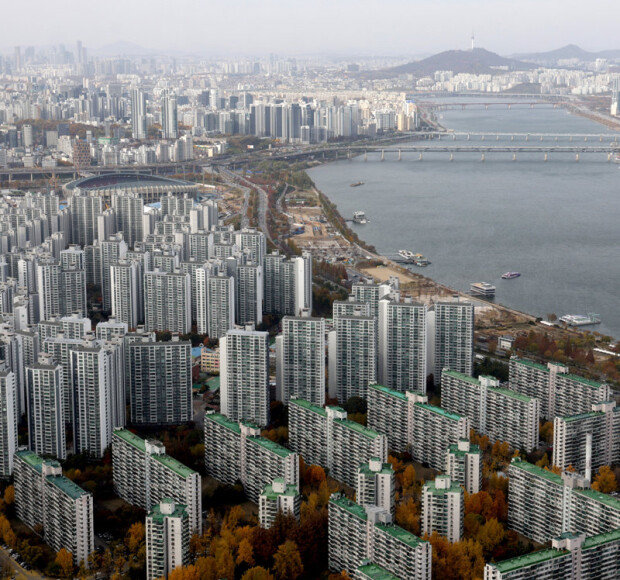
President Lee Jae-myung said on Jan. 27 that South Korea must correct distortions in resource allocation stemming from the country’s excessive focus on real estate, warning that unchecked property concentration could undermine broader economic stability. Referring to Japan’s experience during its so-called lost 30 years, Lee reiterated concerns over real estate bubbles and reaffirmed his resolve to normalize the housing market, including through stricter capital gains taxes on owners of multiple homes.
● ‘Unfairness and abnormal practices must never be tolerated’
Speaking at a Cabinet meeting at the presidential office, Lee said that the excessive expansion of nonproductive real estate inevitably breeds asset bubbles. He emphasized that fears of short-term pain or political resistance must never serve as an excuse for tolerating unfairness or abnormal practices.
Lee added that distorted expectations fueled by the pursuit of unjust profits must be firmly curbed, again highlighting the government’s plan to end the grace period for heavier capital gains taxes on multiple-home owners on May 9. He noted that the surcharge had already been extended by just one year last year and that its expiration date had been clearly announced in advance. Lee also rejected claims portraying the measure as a newly imposed tax hike, warning that the government should not be swayed by what he described as groundless attacks on its policies.
Referring again to Japan’s experience, Lee said South Korea should heed the painful lessons of a neighboring country that endured prolonged economic turmoil after failing to rein in a real estate bubble. He called for the implementation of effective policies supported by firm resolve.
Emphasizing policy consistency, Lee said that once a direction is set, the government must not be swayed by minor fluctuations or short-term reactions and should secure policy stability without overreacting. He reiterated that misguided expectations driven by the pursuit of unjust profits must be decisively curbed. Lee added that when society commits to a certain course, policies should proceed as planned, criticizing a recurring pattern in which opposition emerges whenever laws are set to expire. He also warned against altering rules for those with influence while rigidly enforcing them on those without power.
At the same time, Lee said the government must pursue proactive measures in response to market demand. He said new housing supply measures, with a focus on the Seoul area, would be announced in the near future.
A presidential office official said Lee’s remarks came amid a backlash against real estate taxation in conservative online communities following the president’s weekend social media post on housing issues. The official said it was necessary for Lee to reaffirm his commitment to normalizing the real estate market in clear and direct terms.
● 'Economic conditions improving, shift to productive finance to accelerate'
Lee said economic conditions are gradually improving, noting that capital and stock markets, including the KOSPI and KOSDAQ, appear to be steadily moving toward normalization. He added that the capital market, long neglected, is being rebuilt as a solid foundation for expanding household wealth.
Calling for the swift reform of irrational systems that hinder capital market normalization, Lee urged the government to further accelerate the shift toward productive finance. He also instructed officials to strengthen the basis for shared growth between large corporations and small and midsized firms and to focus on building an institutional ecosystem that supports venture startups and entrepreneurship.
Lee also publicly questioned restrictions that require approval from prosecutors before the Financial Supervisory Service’s special judicial police can launch investigations. He said it was unreasonable to bar the FSS special judicial police from independently identifying and pursuing cases, asking whether investigations should proceed only after reporting to prosecutors and receiving their instructions. Lee further questioned whether it made sense for investigative authority over quasi-public institutions tasked with correcting illegal conduct to rest exclusively with prosecutors.
Justice Minister Jung Sung-ho expressed reservations, saying that granting investigative authority inevitably entails the use of coercive measures. He noted that the Financial Supervisory Service already wields substantial powers, including the ability to trace bank accounts without warrants, and cautioned that the public disclosure of FSS-initiated investigations could have serious repercussions for capital markets.
윤다빈 empty@donga.com



![[단독]“非육사라 무시” “징계 운운 XX에 반항”… 계급장 없는 ‘軍톡방’](https://dimg.donga.com/c/138/175/90/1/wps/NEWS/IMAGE/2026/04/30/133839353.1.png)
![[송평인 칼럼]‘주권 AI’ 먹튀 하정우](https://dimg.donga.com/c/138/175/90/1/wps/NEWS/IMAGE/2026/04/29/133838999.1.jpg)



 About Dong-A Ilbo