

Kospi tops 5,000 for the first time
Kospi tops 5,000 for the first time
Posted January. 23, 2026 09:36,
Updated January. 23, 2026 09:36
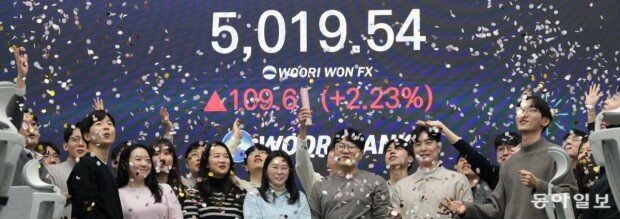
The KOSPI index climbed past 5,000 intraday on Jan. 22, reaching the landmark for the first time 70 years after South Korea’s stock market began trading with just 12 listed companies. The rally was driven by robust earnings growth at major corporations, led by semiconductor firms. Analysts say the breakthrough could help erode the so-called Korea discount, a long-standing perception that South Korean equities are undervalued in global markets.
The benchmark index closed at 4,952.53, up 0.87% from the previous session. Gains accelerated during morning trading, briefly pushing the KOSPI to an intraday record of 5,019.54. The milestone comes seven decades after the Korea Securities Exchange opened in March 1956, marking the start of organized stock trading in the country. Profit-taking by foreign investors and institutions, who sold a net USD 228 million and USD 79 million respectively, pulled the index back below 5,000 by the close.
The KOSPI’s ascent follows a sharp downturn last year, when it fell to 2,293.7 on April 9 amid a state of emergency and the announcement of U.S. tariff measures. Since the start of this year, the index has risen for 12 consecutive trading sessions, more than doubling in nine months to break above the 5,000 level.
The rally was led by blue-chip conglomerates that have proven their global competitiveness in semiconductors, automobiles, defense and shipbuilding. Samsung Electronics briefly surpassed KRW 1,000 trillion in market capitalization during trading, overtaking China’s Tencent to rank third among Asian companies. SK hynix’s projected annual operating profit stands at KRW 148 trillion, according to Morgan Stanley. Hyundai Motor, which has showcased advances in humanoid robot technology, has seen its share price climb 78.4% so far this year.
Major international media attributed the KOSPI milestone to the artificial intelligence boom, strong demand for semiconductors and sustained efforts to improve corporate governance. The Financial Times, citing interviews with Asia market experts, said South Korea’s market remains undervalued and that the move past 5,000 helps address key drivers of the Korea discount.
Still, the widening gap between the KOSPI’s surge and the pace of South Korea’s economic growth remains a concern. The Bank of Korea said on Jan. 22 that the country’s annual real gross domestic product grew 1.0% last year, the weakest performance since the 0.7% contraction recorded in 2020 during the COVID-19 pandemic.
“The KOSPI is rising on expectations of a semiconductor supercycle, while overall economic growth remains stuck in the low 1% range,” said Ahn Dong-hyun, a professor of economics at Seoul National University. “Once the boom fades, both stock prices and growth could fall sharply.”
지민구 기자 warum@donga.com






 About Dong-A Ilbo