

Ground One: Scaling Autonomous Building Energy AI to City and National Levels
Ground One: Scaling Autonomous Building Energy AI to City and National Levels
Posted December. 05, 2025 10:26,
- Ground One, founded by Yoon-jung Hong, is pioneering AI-powered building energy management with its platform Archflow, which enables real-time adaptive control and achieves significant energy savings while maintaining occupant comfort.
- The company overcame challenges related to incomplete facility data by integrating existing infrastructure with high-precision simulation, allowing autonomous operation even in imperfect environments.
- Ground One is expanding internationally, participating in energy incubation programs and pilot projects, with a vision to scale its technology from individual buildings to city and national levels for enhanced energy efficiency.
The building energy management market is rapidly being reshaped by the integration of Artificial Intelligence (AI) technology. As the global emphasis on sustainable energy use grows, so does the critical importance of effective building energy management. The efficacy of AI-powered building energy solutions is already being demonstrated in countries like the United States and Germany.
Amidst this trend, Ground One, a startup founded in 2022, is gaining significant attention. We met with Yoon-jung Hong, CEO of Ground One, who envisions an era of autonomous and optimized building energy operation driven by AI technology. We discussed the company's proprietary technology, vision, and overseas expansion strategy.

Overseas Experience Fueled the Confidence to Launch
What led to the founding of Ground One? Hong has been involved in the building sector since her twenties. She gained practical real estate experience while living abroad throughout her 20s and 30s. It was during this time that she directly witnessed the profound impact of "space" on people's lives.
"Experiencing the cities and residential environments of various countries, I realized that 'people's expressions, lifestyles, and even their energy usage change depending on the space they inhabit,'" said Hong. "Our daily lives fundamentally unfold within spaces. I felt that the quality of that space significantly influences the quality of life, energy consumption, and, by extension, the environment. I wanted to help accurately understand real-world spaces through data and technology, and enable their operation in a better way."
The company name, Ground One, encapsulates the meaning: 'placing the real-world land and buildings (Ground) onto a single standard (One).' Hong introduces herself as 'A small Giant in capturing real spaces with Machines,' explaining that this statement best encapsulates Ground One's ultimate goal.
Her past international experience provided her with more than mere observation—it provided an unwavering conviction. She gained a clear understanding that space is not just a physical container but a force capable of transforming people, cities, and the environment simultaneously. Hong recalled, "The question, 'How can people utilize space more efficiently and sustainably?' became the direct driving force behind the decision to launch the company."
Archflow Tackles Fundamental Flaws in Existing BMS
Ground One's core solution is Archflow, a building operation automation platform. Archflow utilizes AI to analyze real-time energy consumption, comfort levels, and environmental changes, automatically controlling linked Building Management Systems (BMS) and major equipment like HVAC (Heating, Ventilation, and Air Conditioning). This process enables the reduction of operating costs and carbon emissions while maintaining occupant comfort.
According to Hong, Archflow is designed to address the fundamental problems inherent in conventional BMS. Most buildings operate HVAC based on fixed schedules, which inevitably leads to energy waste because it fails to reflect real-time environmental changes. For example, systems might run on a weekday schedule even when a building is largely empty on a weekend, or fail to adapt to sudden shifts in weather. Archflow, in contrast, rectifies this through AI-based real-time adaptive control.
By learning and applying patterns in real time, it achieves energy savings and automatically responds to environmental shifts such as weather or indoor occupancy counts. It also features environment-aware control, which comprehensively analyzes internal and external signals to automatically adjust HVAC settings while maintaining comfort.
Archflow's effectiveness is proven with tangible metrics. It achieves a 15-30% reduction in energy consumption while maintaining a 98% comfort level. Hong emphasized, "Archflow's greatest strength is that it doesn't just cut energy and costs; it finds practical, applicable reduction strategies by simultaneously considering comfort and the safe operating range of the equipment. Furthermore, the ease of integration with existing operating systems is another major advantage, allowing adoption without large-scale equipment replacement."
Ground One achieves differentiation through the combination of AI and on-device technology for automation, and an AI Agent-based simulation engine. This approach enables lower installation costs for equipment while significantly boosting efficiency compared to conventional systems.
Development Challenges and the Pivotal Breakthrough
The path to developing Ground One's technology was anything but smooth. The most significant obstacle was the lack of complete digitization in building facilities. Most building equipment operates individually. Furthermore, central collection and analysis of data is often not structurally possible, or data, even when measured, is inconsistently recorded and stored.
\"AI requires continuous operational data to learn and optimize. In the beginning, we spent considerable time and resources simply collecting and refining incomplete data," lamented Hong. "From both a technical and service design perspective, developing a rational control strategy under conditions of 'incomplete observation' was a massive challenge."
Ground One tackled this issue with a dual approach. First, they decided to start with the existing facilities and data on-site, rather than assuming new equipment from the outset. They focused on integrating the maximum amount of measurement values and operational history from various facilities to establish the minimal foundation necessary for generating meaningful insights. Second, they prioritized achieving highly accurate simulations. For periods where facility data was lacking or missing, they utilized a combination of simulation and actual measurement data to enhance the reliability of the results.
"This two-pronged approach allowed us to, to a certain extent, offset the limitation of 'incomplete observation,' leading to more stable control and consistent reduction effects," Hong explained. She added, "Ultimately, we found a way to apply autonomous operation even to buildings with imperfect data and facility conditions, by integrating existing infrastructure with high-precision simulation."
These numerous trials and errors provided a crucial springboard for Ground One's advancement. By operating through a structure that combines simulation with real-world data, rather than solely relying on historical data, the company has established a foundation for scaling its solution to new projects and buildings with insufficient historical data. Hong noted, "While many solutions require collecting facility data for at least a year before an application strategy can be found, Ground One's system is designed to efficiently apply improvement directions and operations from the initial stages."
Expanding Collaboration Focused on the International Market
Ground One is achieving meaningful results, particularly in the international market. They have been selected for and are actively participating in building energy incubation programs in Europe and the Middle East. Proof-of-Concept (PoC) results in actual public and commercial buildings indicate a potential 20% to 30% reduction in energy consumption. They are currently leveraging these findings to refine their service. Domestically, they are collaborating with public institutions on pilot projects focused on cultural and public buildings.
"We set and manage key metrics such as annual energy consumption, peak load, and operating costs for each project," stated Hong. "Even after a project concludes, we focus on continuously tracking metric changes to demonstrate tangible results. To this end, steadily accumulating diverse case studies both domestically and internationally is our utmost priority right now."
Ground One's growth potential was specifically recognized when it was selected as a supported company by the Seoul Center for Creative Economy & Innovation (CCEI) in September. Hong shared, "Through Seoul CCEI, we were able to expand our overseas networking, which subsequently led to a PoC agreement with a public institution in the Middle East. We are currently conducting an energy autonomous operation pilot project in a real building with that partner." She added, "It is not easy for a startup to reach this level of cooperation with regional public institutions or companies. Seoul CCEI played a critical role in moving beyond simple connection to actual business development."
Ground One is continually expanding its global partnership opportunities by participating in international exhibitions and conferences. Hong stated, "We are in the stage of applying our technology to diverse sites to confirm the effects in various climates and operational environments. We plan to incorporate the insights gained into our product to build a foundation for full-scale overseas market entry and investment attraction in the future."
Finally, Hong projected that Ground One's vision will extend beyond single buildings. "A building does not end as just a building; it is part of a flow that connects to smart cities, city-to-city transactions, and grid-level connections. In the case of energy, it's a resource even traded between nations," she concluded. "I believe Ground One's technology can be integrated and utilized not just for equipment and buildings, but also at the city level. We are drawing a day when the energy optimization of individual buildings collectively enhances the energy efficiency of an entire city and connects to overall power grid management."
Ground One is receiving even better reviews in the international market. Its journey is noteworthy as it steadily moves forward to spearhead innovation in autonomous and optimized building energy operation with its practical AI solution, which functions effectively even in incomplete data environments.
By Kui-im Park (luckyim@itdonga.com)
- The company overcame challenges related to incomplete facility data by integrating existing infrastructure with high-precision simulation, allowing autonomous operation even in imperfect environments.
- Ground One is expanding internationally, participating in energy incubation programs and pilot projects, with a vision to scale its technology from individual buildings to city and national levels for enhanced energy efficiency.
The building energy management market is rapidly being reshaped by the integration of Artificial Intelligence (AI) technology. As the global emphasis on sustainable energy use grows, so does the critical importance of effective building energy management. The efficacy of AI-powered building energy solutions is already being demonstrated in countries like the United States and Germany.
Amidst this trend, Ground One, a startup founded in 2022, is gaining significant attention. We met with Yoon-jung Hong, CEO of Ground One, who envisions an era of autonomous and optimized building energy operation driven by AI technology. We discussed the company's proprietary technology, vision, and overseas expansion strategy.
Yoon-jung Hong, CEO of Ground One / source=Ground One
Overseas Experience Fueled the Confidence to Launch
What led to the founding of Ground One? Hong has been involved in the building sector since her twenties. She gained practical real estate experience while living abroad throughout her 20s and 30s. It was during this time that she directly witnessed the profound impact of "space" on people's lives.
"Experiencing the cities and residential environments of various countries, I realized that 'people's expressions, lifestyles, and even their energy usage change depending on the space they inhabit,'" said Hong. "Our daily lives fundamentally unfold within spaces. I felt that the quality of that space significantly influences the quality of life, energy consumption, and, by extension, the environment. I wanted to help accurately understand real-world spaces through data and technology, and enable their operation in a better way."
The company name, Ground One, encapsulates the meaning: 'placing the real-world land and buildings (Ground) onto a single standard (One).' Hong introduces herself as 'A small Giant in capturing real spaces with Machines,' explaining that this statement best encapsulates Ground One's ultimate goal.
Her past international experience provided her with more than mere observation—it provided an unwavering conviction. She gained a clear understanding that space is not just a physical container but a force capable of transforming people, cities, and the environment simultaneously. Hong recalled, "The question, 'How can people utilize space more efficiently and sustainably?' became the direct driving force behind the decision to launch the company."
Archflow Tackles Fundamental Flaws in Existing BMS
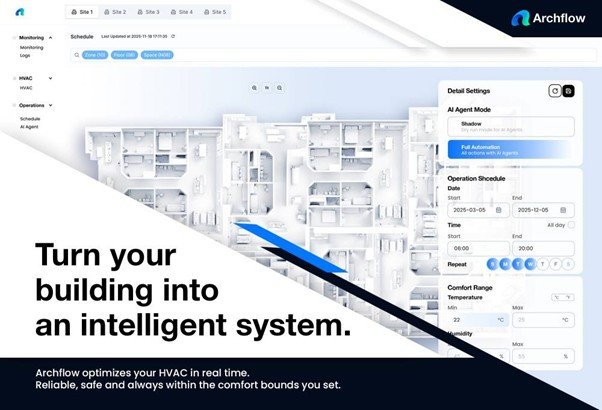
Ground One's core solution is Archflow, a building operation automation platform. Archflow utilizes AI to analyze real-time energy consumption, comfort levels, and environmental changes, automatically controlling linked Building Management Systems (BMS) and major equipment like HVAC (Heating, Ventilation, and Air Conditioning). This process enables the reduction of operating costs and carbon emissions while maintaining occupant comfort.
Ground One's Archflow, a building operation automation platform / source=IT dongA
According to Hong, Archflow is designed to address the fundamental problems inherent in conventional BMS. Most buildings operate HVAC based on fixed schedules, which inevitably leads to energy waste because it fails to reflect real-time environmental changes. For example, systems might run on a weekday schedule even when a building is largely empty on a weekend, or fail to adapt to sudden shifts in weather. Archflow, in contrast, rectifies this through AI-based real-time adaptive control.
By learning and applying patterns in real time, it achieves energy savings and automatically responds to environmental shifts such as weather or indoor occupancy counts. It also features environment-aware control, which comprehensively analyzes internal and external signals to automatically adjust HVAC settings while maintaining comfort.
Archflow's effectiveness is proven with tangible metrics. It achieves a 15-30% reduction in energy consumption while maintaining a 98% comfort level. Hong emphasized, "Archflow's greatest strength is that it doesn't just cut energy and costs; it finds practical, applicable reduction strategies by simultaneously considering comfort and the safe operating range of the equipment. Furthermore, the ease of integration with existing operating systems is another major advantage, allowing adoption without large-scale equipment replacement."
Ground One achieves differentiation through the combination of AI and on-device technology for automation, and an AI Agent-based simulation engine. This approach enables lower installation costs for equipment while significantly boosting efficiency compared to conventional systems.
Development Challenges and the Pivotal Breakthrough
The path to developing Ground One's technology was anything but smooth. The most significant obstacle was the lack of complete digitization in building facilities. Most building equipment operates individually. Furthermore, central collection and analysis of data is often not structurally possible, or data, even when measured, is inconsistently recorded and stored.
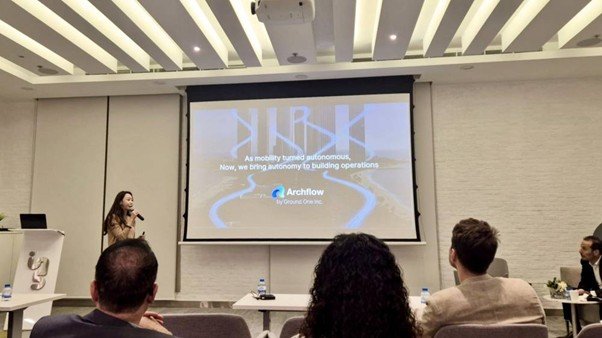
Hong is explaining about Archflow / source=Ground One
\"AI requires continuous operational data to learn and optimize. In the beginning, we spent considerable time and resources simply collecting and refining incomplete data," lamented Hong. "From both a technical and service design perspective, developing a rational control strategy under conditions of 'incomplete observation' was a massive challenge."
Ground One tackled this issue with a dual approach. First, they decided to start with the existing facilities and data on-site, rather than assuming new equipment from the outset. They focused on integrating the maximum amount of measurement values and operational history from various facilities to establish the minimal foundation necessary for generating meaningful insights. Second, they prioritized achieving highly accurate simulations. For periods where facility data was lacking or missing, they utilized a combination of simulation and actual measurement data to enhance the reliability of the results.
"This two-pronged approach allowed us to, to a certain extent, offset the limitation of 'incomplete observation,' leading to more stable control and consistent reduction effects," Hong explained. She added, "Ultimately, we found a way to apply autonomous operation even to buildings with imperfect data and facility conditions, by integrating existing infrastructure with high-precision simulation."
These numerous trials and errors provided a crucial springboard for Ground One's advancement. By operating through a structure that combines simulation with real-world data, rather than solely relying on historical data, the company has established a foundation for scaling its solution to new projects and buildings with insufficient historical data. Hong noted, "While many solutions require collecting facility data for at least a year before an application strategy can be found, Ground One's system is designed to efficiently apply improvement directions and operations from the initial stages."
Expanding Collaboration Focused on the International Market
Ground One is achieving meaningful results, particularly in the international market. They have been selected for and are actively participating in building energy incubation programs in Europe and the Middle East. Proof-of-Concept (PoC) results in actual public and commercial buildings indicate a potential 20% to 30% reduction in energy consumption. They are currently leveraging these findings to refine their service. Domestically, they are collaborating with public institutions on pilot projects focused on cultural and public buildings.
"We set and manage key metrics such as annual energy consumption, peak load, and operating costs for each project," stated Hong. "Even after a project concludes, we focus on continuously tracking metric changes to demonstrate tangible results. To this end, steadily accumulating diverse case studies both domestically and internationally is our utmost priority right now."
Ground One's growth potential was specifically recognized when it was selected as a supported company by the Seoul Center for Creative Economy & Innovation (CCEI) in September. Hong shared, "Through Seoul CCEI, we were able to expand our overseas networking, which subsequently led to a PoC agreement with a public institution in the Middle East. We are currently conducting an energy autonomous operation pilot project in a real building with that partner." She added, "It is not easy for a startup to reach this level of cooperation with regional public institutions or companies. Seoul CCEI played a critical role in moving beyond simple connection to actual business development."
Ground One is continually expanding its global partnership opportunities by participating in international exhibitions and conferences. Hong stated, "We are in the stage of applying our technology to diverse sites to confirm the effects in various climates and operational environments. We plan to incorporate the insights gained into our product to build a foundation for full-scale overseas market entry and investment attraction in the future."
Finally, Hong projected that Ground One's vision will extend beyond single buildings. "A building does not end as just a building; it is part of a flow that connects to smart cities, city-to-city transactions, and grid-level connections. In the case of energy, it's a resource even traded between nations," she concluded. "I believe Ground One's technology can be integrated and utilized not just for equipment and buildings, but also at the city level. We are drawing a day when the energy optimization of individual buildings collectively enhances the energy efficiency of an entire city and connects to overall power grid management."
Ground One is receiving even better reviews in the international market. Its journey is noteworthy as it steadily moves forward to spearhead innovation in autonomous and optimized building energy operation with its practical AI solution, which functions effectively even in incomplete data environments.
By Kui-im Park (luckyim@itdonga.com)



![레이더 비웃는 ‘하늘의 암살자’… 스텔스기가 바꾼 현대戰 양상[글로벌 포커스]](https://dimg.donga.com/c/138/175/90/1/wps/NEWS/IMAGE/2026/04/03/133673453.1.jpg)




 About Dong-A Ilbo