

“The Power of Water Cooling Hot GPUs”: H3 Solution Targets AI Market with ‘Nautilus’ Liquid-Cooled Server
“The Power of Water Cooling Hot GPUs”: H3 Solution Targets AI Market with ‘Nautilus’ Liquid-Cooled Server
Posted November. 27, 2025 13:53,
Updated November. 27, 2025 13:55
- H3 Solution, a Korean startup, has launched the ‘Nautilus’ liquid-cooled server lineup to address the growing demand for efficient cooling in high-performance AI GPU data centers, offering significant reductions in power consumption and noise compared to traditional air-cooled systems.
- Their competitive edge lies in vertical integration, with about 50% of core liquid cooling components designed and manufactured in-house, resulting in improved cooling efficiency, stability, and faster delivery times.
- The company aims to become a global leader in the liquid-cooled server market by expanding its product lineup, advancing technology, and strengthening industry partnerships.
With the rapid proliferation of generative AI, the demand for high-performance computing has surged. As massive Graphics Processing Units (GPUs) become essential for running AI models, the market for AI-dedicated data centers and servers is expanding at a breakneck pace.
AI servers are high-performance computers specialized for AI operations. AI data centers are massive facilities that aggregate these servers to facilitate AI training and inference. To meet the immense power, thermal, and high-speed network requirements of these servers, AI data centers are equipped with infrastructure far more robust than that of general-purpose data centers. Global big tech companies like Google, Microsoft, and Amazon, as well as major Korean conglomerates, have embarked on constructing large-scale AI data centers and deploying GPU servers.
The Rapid Growth of AI Servers and the Thermal Challenge
The critical issue facing this growth is the tremendous heat emitted by high-performance GPUs. As high-density environments stacking tens or hundreds of GPUs become more common, server heat generation has increased geometrically. Since server heat poses a severe threat to system stability, performance, and lifespan, establishing a cooling system to maintain optimal temperatures is paramount.
The traditional method for cooling servers has been "Air Cooling." This method, which uses fans to dissipate heat into the air, has been widely used due to its simple structure and ease of installation. However, its limitations are evident in high-density GPU environments. Air has low thermal conductivity, making it difficult to cool high temperatures quickly, and the power consumption required to run the fans is significant.
Amidst this challenge, "Liquid Cooling" systems using water have emerged as the next-generation solution. By utilizing water (coolant) to absorb heat directly, this method leverages a liquid that transfers heat faster than air, reducing data center power consumption by up to 40% compared to air cooling. Due to superior cooling efficiency, fans can operate at lower speeds, resulting in lower noise levels compared to air-cooled servers. Recently, "Immersion Cooling," a method where the entire server is submerged in dielectric fluid to cool it, has also emerged.
Indeed, liquid cooling systems are shifting from a choice to a necessity. According to global market research firm Research Nester, the global data center liquid cooling market is projected to grow from $4.58 billion (approx. KRW 6.7 trillion) in 2025 to approximately $44.39 billion (approx. KRW 65.3 trillion) by 2035, expanding at an annual average growth rate (CAGR) of 25.5%. NVIDIA’s latest GPU, Blackwell, is predicted to require liquid cooling exclusively, and KT Cloud opened its Gasan AI Data Center equipped with a liquid cooling system on November 6. As such, domestic and international companies are concretizing their next-generation liquid cooling technology roadmaps and positioning them as a core competitive edge.
Competing with Homegrown Tech: H3 Solution’s Liquid-Cooled Server ‘Nautilus’
H3 Solution, a Korean startup specializing in liquid-cooled servers, has launched its proprietary liquid-cooled server brand, "Nautilus," to target this rapidly changing market. The Nautilus lineup consists of seven models optimized for specific environments and uses, covering a wide range of demands from small research environments to large-scale data centers and extreme computing conditions.
Key products include:
• 6U: Suitable for small offices where silence and stability are critical.
• 4U: Designed for data centers with a focus on maximizing performance.
• T: A tower-type high-performance server for environments where rack
installation is difficult.
• HFT: Suitable for high-frequency trading environments such as securities firms.
• M-1: A general desktop-sized tower for individual research.
• M-2: A high-end workstation supporting multi-GPU and high-performance
computing.
"While air-cooled servers maintain an average GPU temperature of 85°C, H3 Solution’s liquid-cooled servers maintain an average of 60°C," Choi stated.
Power consumption is also lower; including air conditioning units, air cooling consumes 373.7W, whereas liquid cooling consumes 339.6W. Noise levels are significantly reduced as well, dropping from 80dB for air cooling under load to 45–50dB for liquid cooling—a reduction of over 30dB—making it suitable for various work environments.
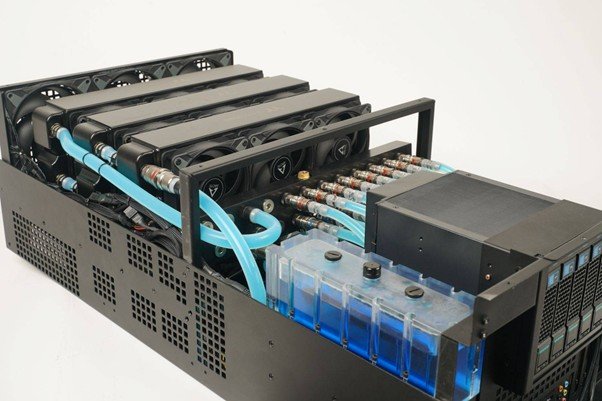
Particular attention is being paid to the "5U" and "3U" models, which have been under development since August. The Nautilus 5U is a hybrid high-performance server that can be operated without a dedicated server room while also being mountable in a standard 19-inch rack. It is suitable for university labs and early-stage startup clients requiring flexible space utilization. It maintains a low noise level of 54dB under load, allowing operation in quiet environments without soundproofing facilities.
"It offers high flexibility as it can be used without a separate rack mount, making it widely applicable from space-constrained environments like labs to large-scale centers," said Choi.
The Nautilus 3U is an external Coolant Distribution Unit (CDU) that easily converts existing air-cooled servers to liquid-cooled ones. The CDU is a core device that reprocesses hot coolant, cooling it down before re-supplying it. To address the high initial setup cost of liquid cooling systems, the 3U offers an efficient method to switch to a liquid cooling system by attaching it externally without completely replacing existing facilities.
Key Competitiveness: Vertical Integration and In-House Development
H3 Solution’s most significant differentiator is the vertical integration (in-house production) of key components. While competitors often assemble general-purpose parts from external vendors, H3 Solution designs and manufactures approximately 50% of the core components of its liquid cooling system in-house. These include the chassis (server exterior), cold plates (metal plates that directly absorb heat), manifolds (passages for distributing coolant), water blocks (core parts transferring component heat to the coolant), and reservoirs.
"Vertical integration through the in-house design of key components, which determine cooling performance, has boosted cooling efficiency and stability. It is designed to maintain consistent performance even in high-density GPU environments. Furthermore, clients can shorten the product acquisition period from the existing 8 weeks to just 2–3 weeks," Choi explained.
Additionally, Nautilus incorporates various technologies from H3 Solution. A parallel cooling structure is applied to cool all components simultaneously, increasing efficiency. To prepare for pump failure—a major cause of breakdowns in liquid cooling systems—a proprietary pump top design ensures the system continues to operate normally even if some pumps fail, while also facilitating easy maintenance. Real-time verification of reserve coolant levels from the outside further supports operational convenience.
H3 Solution plans to add "NautiVision," a real-time monitoring platform, to support the stable operation of the cooling system. NautiVision monitors server temperature, flow rate, and coolant status in real-time and provides immediate alerts in case of issues. The company explains that it guarantees high operational efficiency by providing an integrated solution that manages the entire lifecycle of the cooling system, going beyond simple server sales.
Completing the Lineup: Aiming to Become a Global Server Powerhouse
Established in 2024, H3 Solution is accelerating product development. While focusing on the development of new products like the upcoming 5U and 3U models, the company is striving for continuous technological advancement, such as designing new water blocks for GPUs/CPUs and internalizing additional key components.
The company sees potential clients in diverse industries including AI, 3D content, biotechnology, robotics, and automotive, and is pursuing technology verification and partnership expansion. It has signed a Memorandum of Understanding (MOU) with Professor Oh Jun-ho’s lab at the Department of Mechanical Engineering, Hanyang University ERICA, and has been selected as a business partner by HP.
H3 Solution laid the foundation for its growth through support programs at Seoul National University of Science and Technology (SeoulTech).
"We received practical support for R&D to improve prototype completeness, such as Nautilus design improvements and cooling structure optimization, as well as for component internalization. Additionally, participating in demo days and IR events provided opportunities for investor networking and follow-up support programs. We are simultaneously solidifying our technology and commercialization through market channel development and branding consulting," Choi noted.
"We will complete the entire Nautilus liquid-cooled server lineup and expand commercialization. By strengthening industry-academic-research cooperation, we will solidify our brand awareness in the domestic High-Performance Computing (HPC) and AI server markets. Ultimately, our goal is to become a proper noun—a company synonymous with manufacturing computers and servers, just like Dell or HP."
The liquid-cooled server market is in its nascent stage and is expected to explode alongside the AI boom. With liquid cooling systems gaining attention for their advantages in cooling efficiency and energy savings, the moves of H3 Solution, which has internalized key components with domestic technology, are worth watching.
By Ye-ji Kim (yj@itdonga.com)
- Their competitive edge lies in vertical integration, with about 50% of core liquid cooling components designed and manufactured in-house, resulting in improved cooling efficiency, stability, and faster delivery times.
- The company aims to become a global leader in the liquid-cooled server market by expanding its product lineup, advancing technology, and strengthening industry partnerships.
With the rapid proliferation of generative AI, the demand for high-performance computing has surged. As massive Graphics Processing Units (GPUs) become essential for running AI models, the market for AI-dedicated data centers and servers is expanding at a breakneck pace.
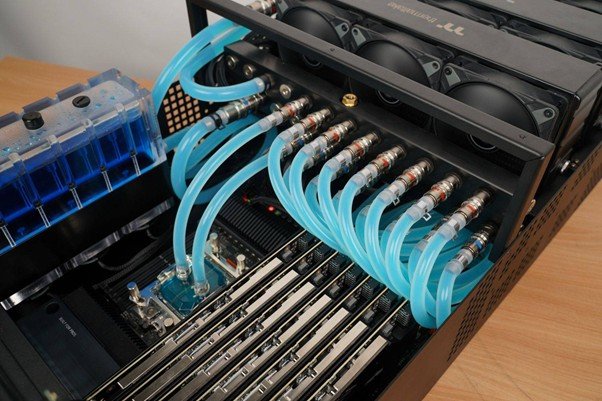
Liquid cooling systems reduce data center power consumption by up to 40% compared to conventional air cooling / source=H3 Solution
AI servers are high-performance computers specialized for AI operations. AI data centers are massive facilities that aggregate these servers to facilitate AI training and inference. To meet the immense power, thermal, and high-speed network requirements of these servers, AI data centers are equipped with infrastructure far more robust than that of general-purpose data centers. Global big tech companies like Google, Microsoft, and Amazon, as well as major Korean conglomerates, have embarked on constructing large-scale AI data centers and deploying GPU servers.
The Rapid Growth of AI Servers and the Thermal Challenge
The critical issue facing this growth is the tremendous heat emitted by high-performance GPUs. As high-density environments stacking tens or hundreds of GPUs become more common, server heat generation has increased geometrically. Since server heat poses a severe threat to system stability, performance, and lifespan, establishing a cooling system to maintain optimal temperatures is paramount.
The traditional method for cooling servers has been "Air Cooling." This method, which uses fans to dissipate heat into the air, has been widely used due to its simple structure and ease of installation. However, its limitations are evident in high-density GPU environments. Air has low thermal conductivity, making it difficult to cool high temperatures quickly, and the power consumption required to run the fans is significant.
Amidst this challenge, "Liquid Cooling" systems using water have emerged as the next-generation solution. By utilizing water (coolant) to absorb heat directly, this method leverages a liquid that transfers heat faster than air, reducing data center power consumption by up to 40% compared to air cooling. Due to superior cooling efficiency, fans can operate at lower speeds, resulting in lower noise levels compared to air-cooled servers. Recently, "Immersion Cooling," a method where the entire server is submerged in dielectric fluid to cool it, has also emerged.
Indeed, liquid cooling systems are shifting from a choice to a necessity. According to global market research firm Research Nester, the global data center liquid cooling market is projected to grow from $4.58 billion (approx. KRW 6.7 trillion) in 2025 to approximately $44.39 billion (approx. KRW 65.3 trillion) by 2035, expanding at an annual average growth rate (CAGR) of 25.5%. NVIDIA’s latest GPU, Blackwell, is predicted to require liquid cooling exclusively, and KT Cloud opened its Gasan AI Data Center equipped with a liquid cooling system on November 6. As such, domestic and international companies are concretizing their next-generation liquid cooling technology roadmaps and positioning them as a core competitive edge.
Competing with Homegrown Tech: H3 Solution’s Liquid-Cooled Server ‘Nautilus’
H3 Solution, a Korean startup specializing in liquid-cooled servers, has launched its proprietary liquid-cooled server brand, "Nautilus," to target this rapidly changing market. The Nautilus lineup consists of seven models optimized for specific environments and uses, covering a wide range of demands from small research environments to large-scale data centers and extreme computing conditions.
Key products include:
• 6U: Suitable for small offices where silence and stability are critical.
• 4U: Designed for data centers with a focus on maximizing performance.
• T: A tower-type high-performance server for environments where rack
installation is difficult.
• HFT: Suitable for high-frequency trading environments such as securities firms.
• M-1: A general desktop-sized tower for individual research.
• M-2: A high-end workstation supporting multi-GPU and high-performance
computing.
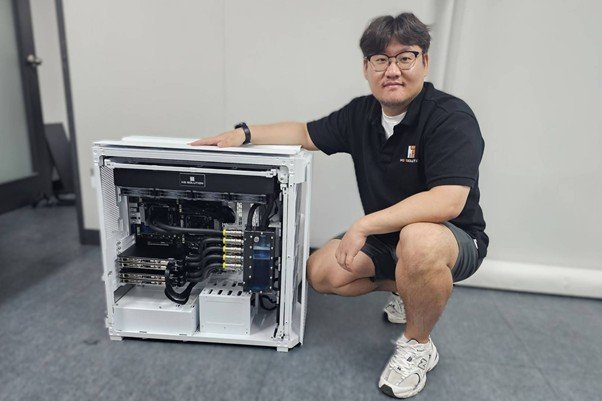
Hyung-seok Choi, CEO of H3 Solution emphasized the cooling efficiency of Nautilus / source=IT dongA
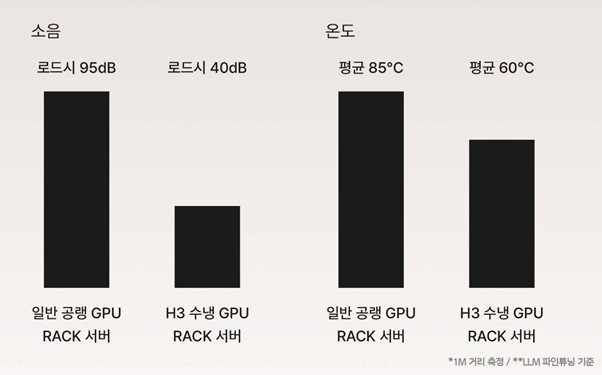
"While air-cooled servers maintain an average GPU temperature of 85°C, H3 Solution’s liquid-cooled servers maintain an average of 60°C," Choi stated.
Power consumption is also lower; including air conditioning units, air cooling consumes 373.7W, whereas liquid cooling consumes 339.6W. Noise levels are significantly reduced as well, dropping from 80dB for air cooling under load to 45–50dB for liquid cooling—a reduction of over 30dB—making it suitable for various work environments.
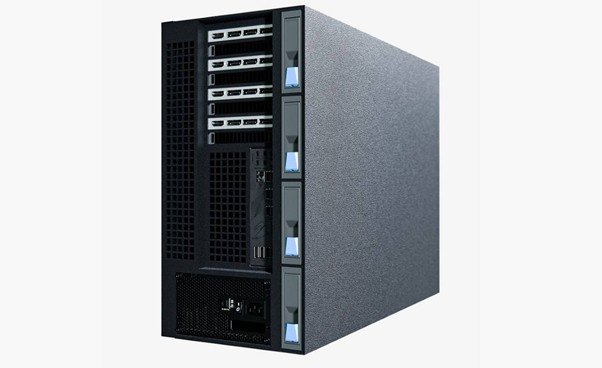
Particular attention is being paid to the "5U" and "3U" models, which have been under development since August. The Nautilus 5U is a hybrid high-performance server that can be operated without a dedicated server room while also being mountable in a standard 19-inch rack. It is suitable for university labs and early-stage startup clients requiring flexible space utilization. It maintains a low noise level of 54dB under load, allowing operation in quiet environments without soundproofing facilities.
5U model of H3 Solution / source=H3 Solution
"It offers high flexibility as it can be used without a separate rack mount, making it widely applicable from space-constrained environments like labs to large-scale centers," said Choi.
The Nautilus 3U is an external Coolant Distribution Unit (CDU) that easily converts existing air-cooled servers to liquid-cooled ones. The CDU is a core device that reprocesses hot coolant, cooling it down before re-supplying it. To address the high initial setup cost of liquid cooling systems, the 3U offers an efficient method to switch to a liquid cooling system by attaching it externally without completely replacing existing facilities.
Key Competitiveness: Vertical Integration and In-House Development
H3 Solution’s most significant differentiator is the vertical integration (in-house production) of key components. While competitors often assemble general-purpose parts from external vendors, H3 Solution designs and manufactures approximately 50% of the core components of its liquid cooling system in-house. These include the chassis (server exterior), cold plates (metal plates that directly absorb heat), manifolds (passages for distributing coolant), water blocks (core parts transferring component heat to the coolant), and reservoirs.
Performance of 5U model / source=H3 Solution
"Vertical integration through the in-house design of key components, which determine cooling performance, has boosted cooling efficiency and stability. It is designed to maintain consistent performance even in high-density GPU environments. Furthermore, clients can shorten the product acquisition period from the existing 8 weeks to just 2–3 weeks," Choi explained.
Additionally, Nautilus incorporates various technologies from H3 Solution. A parallel cooling structure is applied to cool all components simultaneously, increasing efficiency. To prepare for pump failure—a major cause of breakdowns in liquid cooling systems—a proprietary pump top design ensures the system continues to operate normally even if some pumps fail, while also facilitating easy maintenance. Real-time verification of reserve coolant levels from the outside further supports operational convenience.
H3 Solution plans to add "NautiVision," a real-time monitoring platform, to support the stable operation of the cooling system. NautiVision monitors server temperature, flow rate, and coolant status in real-time and provides immediate alerts in case of issues. The company explains that it guarantees high operational efficiency by providing an integrated solution that manages the entire lifecycle of the cooling system, going beyond simple server sales.
Completing the Lineup: Aiming to Become a Global Server Powerhouse
Established in 2024, H3 Solution is accelerating product development. While focusing on the development of new products like the upcoming 5U and 3U models, the company is striving for continuous technological advancement, such as designing new water blocks for GPUs/CPUs and internalizing additional key components.
6U model of H3 Solution / source=H3 Solution
The company sees potential clients in diverse industries including AI, 3D content, biotechnology, robotics, and automotive, and is pursuing technology verification and partnership expansion. It has signed a Memorandum of Understanding (MOU) with Professor Oh Jun-ho’s lab at the Department of Mechanical Engineering, Hanyang University ERICA, and has been selected as a business partner by HP.
H3 Solution laid the foundation for its growth through support programs at Seoul National University of Science and Technology (SeoulTech).
"We received practical support for R&D to improve prototype completeness, such as Nautilus design improvements and cooling structure optimization, as well as for component internalization. Additionally, participating in demo days and IR events provided opportunities for investor networking and follow-up support programs. We are simultaneously solidifying our technology and commercialization through market channel development and branding consulting," Choi noted.
"We will complete the entire Nautilus liquid-cooled server lineup and expand commercialization. By strengthening industry-academic-research cooperation, we will solidify our brand awareness in the domestic High-Performance Computing (HPC) and AI server markets. Ultimately, our goal is to become a proper noun—a company synonymous with manufacturing computers and servers, just like Dell or HP."
The liquid-cooled server market is in its nascent stage and is expected to explode alongside the AI boom. With liquid cooling systems gaining attention for their advantages in cooling efficiency and energy savings, the moves of H3 Solution, which has internalized key components with domestic technology, are worth watching.
By Ye-ji Kim (yj@itdonga.com)

![[오늘의 운세/7월 8일]](https://dimg.donga.com/c/138/175/90/1/wps/NEWS/IMAGE/2026/07/07/134255552.1.jpg)
![매년 30억 쓰며 노화 막던 억만장자, 완치법 없는 자가면역질환 진단 [노화설계]](https://dimg.donga.com/c/138/175/90/1/wps/NEWS/IMAGE/2026/07/07/134249064.3.jpg)





 About Dong-A Ilbo