

Elysian, “We want to become a leader in virtual world experiences.”
Elysian, “We want to become a leader in virtual world experiences.”
Posted November. 21, 2025 09:53,
Updated November. 21, 2025 09:55
- Elysian is a hardware startup aiming to revolutionize virtual reality experiences by innovating haptic technology and human interface devices, such as full-body haptic suits and glove-type controllers that deliver realistic tactile sensations.
- Despite advancements in visual and auditory VR hardware, the lack of immersive tactile feedback has limited market growth, and seeks to bridge this gap with their technology.
- Supported by Seoul National University of Science and Technology’s Preliminary Startup Package, is expanding applications to robotics and AI, envisioning a future where users can fully immerse themselves in virtual worlds.
Extended Reality (XR), encompassing Virtual Reality (VR), Augmented Reality (AR), and Mixed Reality (MR), has become a key industrial buzzword alongside the Metaverse. However, the hype faces a cold reality: according to market researcher Counterpoint Research, the global metaverse market in 2024 contracted by 12% compared to 2023. Despite the launch of cutting-edge XR devices like the Apple Vision Pro and Meta Quest 3, they were insufficient to expand the overall market pie.
Industry experts cite the limitations of experience as a primary reason for the sluggish growth of the XR market. The core of the virtual experience is immersion. Users need to physically feel sensations, such as picking up an object or feeling raindrops on their skin within the virtual world. The problem is that while Head-Mounted Displays (HMDs) satisfying visual and auditory senses have reached a high level of perfection, the development speed of tactile sensation (haptics)—the final puzzle piece to complete immersion—remains slow.
Innovating the Human Interface
Elysian is a hardware startup dedicated to innovating haptic technology for VR devices. Rather than simply manufacturing peripherals tailored to the existing virtual ecosystem, the company plans to seek new technological directions through the innovation of "human interfaces" (experiential equipment). What is the direction for improving in-world experiences that Elysian pursues? We met with Jun Jeong, CEO of Elysian, to discuss his vision.
"I felt a disconnect between the VR technology I saw in media and reality," Jeong said. "I was frustrated, wondering when experiences like those in the movie ‘Ready Player One’ would be possible. I concluded the cause was the stagnation of hardware technology. While headsets that allow us to view flat surfaces three-dimensionally have evolved, innovation in the tactile realm has stalled. Current haptic technology amounts to little more than mobile phone vibrations. I founded Elysian with the idea of innovating the VR experience."
Jeong’s entrepreneurial journey began with frustration over the stagnant VR device market. Having worked in robotics development, he questioned why operation methods remained unchanged from years ago, even with the latest VR devices. While they offer crisp image and sound quality, control is still centered around handheld controllers. The sensory feedback is limited to weak vibrations delivered by these controllers.
Jeong attributed the slow progress of the XR market to the degradation of experience caused by controller-based manipulation. Valve introduced the Index controllers, designed to recognize the movement of five fingers, but they failed to achieve mass adoption.
Beyond the Vibration
Elysian is currently focusing on developing hardware to revolutionize virtual world experiences. The direction is twofold. The first is a controller capable of immediate linkage with content. Their flagship product is a gun-type controller for VR. While gun-shaped controllers are common, Elysian differentiates itself by enhancing the perfection of details such as handling and weight to approximate actual experience.
"Military enthusiasts show more interest the more detailed the firearm structure is implemented," Jeong explained. "While VR gun controllers exist in the market, most only mimic the act of shooting. Elysian has crafted ours meticulously, allowing users to feel the heavy weight of loading and operating the selector switch just like a real firearm. I believe this helps reduce the disparity between the controller and the in-game experience."
Elysian emphasizes the necessity of developing human interfaces that connect people with the virtual world. This is why they are pouring efforts into developing a full-body haptic suit capable of interacting with VR. The goal is to implement a tactile display that allows users to feel not just vibration, but various sensations such as temperature, texture, and fluids. Currently, Jeong is developing a glove-type VR controller prototype. It utilizes Force Feedback technology, which uses wires and motors to deliver resistance in fine detail.
The glove-type controller has expandability beyond XR into robotics and humanoid sectors. As tele-operation (remote control) becomes more active, recognizing movements via force feedback reduces error rates. The key is data training. While tactile sensors applied to robot hands are implemented, tactile-action data is needed for training. Jeong explains that the glove-type VR controller, incorporating tactile display technology, will serve as essential equipment for collecting this tactile-action data in the future.
Balancing Future Value and Market Reality
When asked what is needed for growth, Jeong identified partners who align with Elysian’s values. VR is a medium that realizes experiences impossible in reality. He pointed out a lack of partners who understand the future value of developing tools for such experiences.
Excessive market expectations also pose a burden to Elysian. Jeong noted that many investors believe future VR input technologies will be solved through Neuralink or Brain-Computer Interfaces (BCI). However, he emphasized that these views overlook technological and ethical issues.
"Reading brain signals and writing them are different matters," Jeong said. "Even if we try to recreate sensations with AI, we need sensory data for training. My view is that human interfaces must be commercialized before BCI to make data collection possible."
Jeong’s next challenge is proving the technology's promise to investors. "Haptic technology has clear future value, but it is difficult to present an immediate revenue model," he admitted. "The VR market itself has not yet reached maturity, and haptic technology requires further development. To persuade investors, we are in a situation where we must emphasize not only technical prowess but also business strategy and market insights."
To foster growth, Elysian is expanding the scope of its technology application. This involves applying human interface technology to robotics and AI training fields, beyond just VR. For example, when remotely controlling a humanoid robot, the system learns movements and tactile sensations. Currently, humanoid robot learning relies solely on visual information. Through Elysian’s human interface equipment, the operator and the robot exchange the tactile sensations and force intensity felt by the robot in real-time. Jeong posits that applying a mutually reactive human interface can lower task error rates.
Aiming for "Full Dive"
Elysian has co-developed a gun-type controller in cooperation with HIG VR, a VR company. In November 2025, they plan to operate a VR booth with Aims Media. Additionally, they are proceeding with virtual content collaboration projects. They plan to fuse web novel Intellectual Property (IP) with VR controller technology to help users experience the worlds within novels.
Elysian is growing with the support of the "Preliminary Startup Package" from Seoul National University of Science and Technology (SeoulTech) in 2025. Elysian received support for development space as well as funding necessary for prototype production and equipment acquisition. Mentoring for Minimum Viable Product (MVP) development was also provided. Business planning consulting required for product development and strategy formulation essential for hardware startups was also part of the package.
"What hardware startups need are funds and space," Jeong said. "Thanks to the support from Seoul National University of Science and Technology, we secured the equipment and materials needed for human interface prototype production and started R&D. I am confident that this support from SeoulTech will serve as the foundation for Elysian's growth."
Expanding the possibilities of software through hardware innovation and guiding users to a new world of immersion through the new sensory channel of touch—this is the future Elysian envisions.
"I want to create a future where people can 'Full Dive' (fully immerse) into virtual reality," Jeong concluded. "For that to be possible, hardware must show the possibilities first. Elysian wants to play that role."
By Hyung-seok Kang (redbk@itdonga.com)
- Despite advancements in visual and auditory VR hardware, the lack of immersive tactile feedback has limited market growth, and seeks to bridge this gap with their technology.
- Supported by Seoul National University of Science and Technology’s Preliminary Startup Package, is expanding applications to robotics and AI, envisioning a future where users can fully immerse themselves in virtual worlds.
Extended Reality (XR), encompassing Virtual Reality (VR), Augmented Reality (AR), and Mixed Reality (MR), has become a key industrial buzzword alongside the Metaverse. However, the hype faces a cold reality: according to market researcher Counterpoint Research, the global metaverse market in 2024 contracted by 12% compared to 2023. Despite the launch of cutting-edge XR devices like the Apple Vision Pro and Meta Quest 3, they were insufficient to expand the overall market pie.
Industry experts cite the limitations of experience as a primary reason for the sluggish growth of the XR market. The core of the virtual experience is immersion. Users need to physically feel sensations, such as picking up an object or feeling raindrops on their skin within the virtual world. The problem is that while Head-Mounted Displays (HMDs) satisfying visual and auditory senses have reached a high level of perfection, the development speed of tactile sensation (haptics)—the final puzzle piece to complete immersion—remains slow.
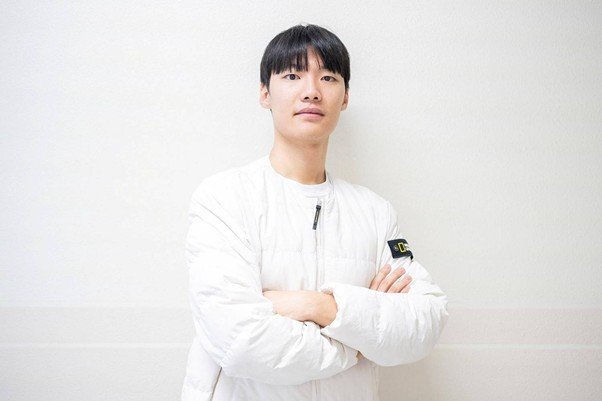
Jun Jeong, CEO of Elysian / source=IT dongA
Innovating the Human Interface
Elysian is a hardware startup dedicated to innovating haptic technology for VR devices. Rather than simply manufacturing peripherals tailored to the existing virtual ecosystem, the company plans to seek new technological directions through the innovation of "human interfaces" (experiential equipment). What is the direction for improving in-world experiences that Elysian pursues? We met with Jun Jeong, CEO of Elysian, to discuss his vision.
"I felt a disconnect between the VR technology I saw in media and reality," Jeong said. "I was frustrated, wondering when experiences like those in the movie ‘Ready Player One’ would be possible. I concluded the cause was the stagnation of hardware technology. While headsets that allow us to view flat surfaces three-dimensionally have evolved, innovation in the tactile realm has stalled. Current haptic technology amounts to little more than mobile phone vibrations. I founded Elysian with the idea of innovating the VR experience."
Jeong’s entrepreneurial journey began with frustration over the stagnant VR device market. Having worked in robotics development, he questioned why operation methods remained unchanged from years ago, even with the latest VR devices. While they offer crisp image and sound quality, control is still centered around handheld controllers. The sensory feedback is limited to weak vibrations delivered by these controllers.
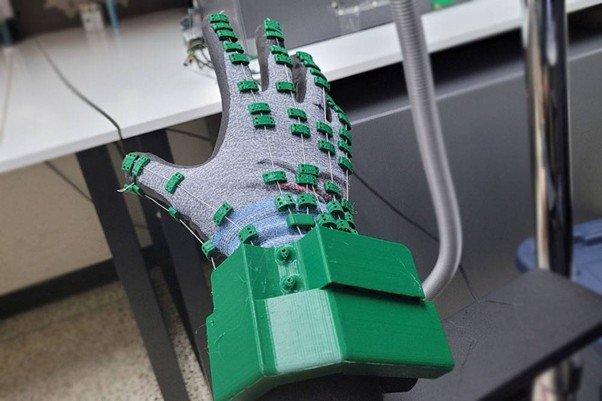
Elysian developing a glove-type VR controller prototype / source=Elysian
Jeong attributed the slow progress of the XR market to the degradation of experience caused by controller-based manipulation. Valve introduced the Index controllers, designed to recognize the movement of five fingers, but they failed to achieve mass adoption.
Beyond the Vibration
Elysian is currently focusing on developing hardware to revolutionize virtual world experiences. The direction is twofold. The first is a controller capable of immediate linkage with content. Their flagship product is a gun-type controller for VR. While gun-shaped controllers are common, Elysian differentiates itself by enhancing the perfection of details such as handling and weight to approximate actual experience.
"Military enthusiasts show more interest the more detailed the firearm structure is implemented," Jeong explained. "While VR gun controllers exist in the market, most only mimic the act of shooting. Elysian has crafted ours meticulously, allowing users to feel the heavy weight of loading and operating the selector switch just like a real firearm. I believe this helps reduce the disparity between the controller and the in-game experience."
Elysian emphasizes the necessity of developing human interfaces that connect people with the virtual world. This is why they are pouring efforts into developing a full-body haptic suit capable of interacting with VR. The goal is to implement a tactile display that allows users to feel not just vibration, but various sensations such as temperature, texture, and fluids. Currently, Jeong is developing a glove-type VR controller prototype. It utilizes Force Feedback technology, which uses wires and motors to deliver resistance in fine detail.
The glove-type controller has expandability beyond XR into robotics and humanoid sectors. As tele-operation (remote control) becomes more active, recognizing movements via force feedback reduces error rates. The key is data training. While tactile sensors applied to robot hands are implemented, tactile-action data is needed for training. Jeong explains that the glove-type VR controller, incorporating tactile display technology, will serve as essential equipment for collecting this tactile-action data in the future.
Balancing Future Value and Market Reality
When asked what is needed for growth, Jeong identified partners who align with Elysian’s values. VR is a medium that realizes experiences impossible in reality. He pointed out a lack of partners who understand the future value of developing tools for such experiences.
Excessive market expectations also pose a burden to Elysian. Jeong noted that many investors believe future VR input technologies will be solved through Neuralink or Brain-Computer Interfaces (BCI). However, he emphasized that these views overlook technological and ethical issues.
"Reading brain signals and writing them are different matters," Jeong said. "Even if we try to recreate sensations with AI, we need sensory data for training. My view is that human interfaces must be commercialized before BCI to make data collection possible."
Jeong’s next challenge is proving the technology's promise to investors. "Haptic technology has clear future value, but it is difficult to present an immediate revenue model," he admitted. "The VR market itself has not yet reached maturity, and haptic technology requires further development. To persuade investors, we are in a situation where we must emphasize not only technical prowess but also business strategy and market insights."
To foster growth, Elysian is expanding the scope of its technology application. This involves applying human interface technology to robotics and AI training fields, beyond just VR. For example, when remotely controlling a humanoid robot, the system learns movements and tactile sensations. Currently, humanoid robot learning relies solely on visual information. Through Elysian’s human interface equipment, the operator and the robot exchange the tactile sensations and force intensity felt by the robot in real-time. Jeong posits that applying a mutually reactive human interface can lower task error rates.
Aiming for "Full Dive"
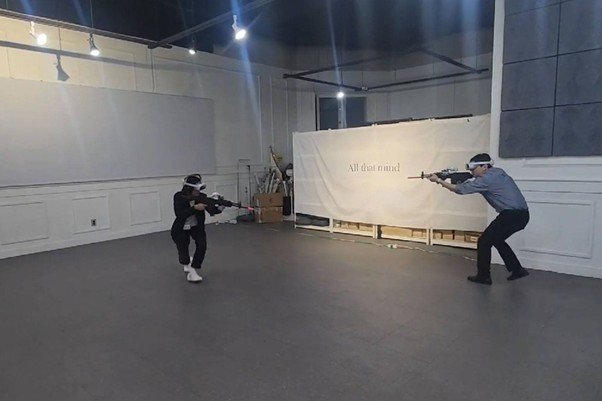
Elysian has co-developed a gun-type controller in cooperation with HIG VR, a VR company. In November 2025, they plan to operate a VR booth with Aims Media. Additionally, they are proceeding with virtual content collaboration projects. They plan to fuse web novel Intellectual Property (IP) with VR controller technology to help users experience the worlds within novels.
Elysian is working on converging virtual content and controller technology / source=Elysian
Elysian is growing with the support of the "Preliminary Startup Package" from Seoul National University of Science and Technology (SeoulTech) in 2025. Elysian received support for development space as well as funding necessary for prototype production and equipment acquisition. Mentoring for Minimum Viable Product (MVP) development was also provided. Business planning consulting required for product development and strategy formulation essential for hardware startups was also part of the package.
"What hardware startups need are funds and space," Jeong said. "Thanks to the support from Seoul National University of Science and Technology, we secured the equipment and materials needed for human interface prototype production and started R&D. I am confident that this support from SeoulTech will serve as the foundation for Elysian's growth."
Expanding the possibilities of software through hardware innovation and guiding users to a new world of immersion through the new sensory channel of touch—this is the future Elysian envisions.
"I want to create a future where people can 'Full Dive' (fully immerse) into virtual reality," Jeong concluded. "For that to be possible, hardware must show the possibilities first. Elysian wants to play that role."
By Hyung-seok Kang (redbk@itdonga.com)

![[오늘의 운세/7월 8일]](https://dimg.donga.com/c/138/175/90/1/wps/NEWS/IMAGE/2026/07/07/134255552.1.jpg)

![매년 30억 쓰며 노화 막던 억만장자, 완치법 없는 자가면역질환 진단 [노화설계]](https://dimg.donga.com/c/138/175/90/1/wps/NEWS/IMAGE/2026/07/07/134249064.3.jpg)




 About Dong-A Ilbo