

Wi Sung-rak warns alliance must secure Korea peace
Wi Sung-rak warns alliance must secure Korea peace
Posted December. 08, 2025 08:05,
Updated December. 08, 2025 08:05
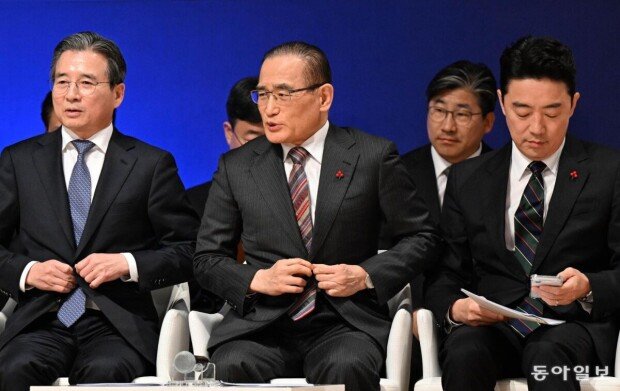
National Security Adviser Wi Sung-rak said on Dec. 7 that the government will seek to resume dialogue with North Korea next year to launch a full-scale process for peaceful coexistence on the Korean Peninsula. He suggested that talks between the United States and North Korea could take place before inter-Korean discussions, emphasizing that North Korea's willingness to engage will be the decisive factor. Wi also drew a firm line, saying that reducing joint South Korea–U.S. military exercises is not being considered as a direct negotiating tool in the peace process.
During a performance briefing by the three senior presidential secretaries that day, Wi said 2026 must become a year of progress rather than mere recovery. He added that although the Korean Peninsula peace process may appear stalled due to North Korea's lack of response, the administration hopes to leverage the momentum from stabilizing U.S. relations and restoring ties with China to advance peace on the peninsula.
He avoided giving a direct answer on the timing of inter-Korean dialogue but predicted that U.S.–North Korea talks would likely take place first. He said whichever talks occur first, the government intends to use the outcome to create a positive cycle. His remarks suggested a strategy that prioritizes coordination with the United States while remaining flexible in responding to future developments, given the uncertainty surrounding North Korea's willingness to engage in diplomacy.
Wi said that over the past six months, the administration has opened what he described as a renaissance of the South Korea–U.S. alliance. He explained that the two countries have coordinated their positions more successfully than expected and have resolved key security issues. Building on that progress, he emphasized that the government will maintain close communication with the United States as a peacemaker while actively implementing confidence-building measures between the two Koreas.
However, when asked whether joint South Korea–U.S. military exercises could be scaled back, he responded cautiously, saying that while many options are under consideration, the exercises are not being reviewed as a direct bargaining tool. He added that various other alternatives remain under review. His response indicated that the government does not intend to use the joint drills, a core element of defense cooperation with the United States, as a negotiating instrument in the Korean Peninsula peace process. It also appeared aimed at preventing friction after reports that U.S. diplomatic officials had expressed concern over proposals from political figures, including Unification Minister Chung Dong-young, to adjust the exercises.
Following the results of the South Korea and U.S. summit held in Gyeongju in North Gyeongsang Province in October, working-level consultations with Washington are now underway. First Deputy National Security Adviser Kim Hyun-jong said the National Security Office has formed three task forces. The first concerns discussions related to uranium enrichment. The second focuses on nuclear-powered submarines. The third involves the defense budget sector, including increases in defense spending. He said visible results could emerge in the first half of next year.
Wi also addressed criticism from former Unification Minister Jeong Se-hyun and other senior figures in the so-called self-reliance faction, who had raised concerns about structural issues within the National Security Council. He countered that the current system strictly follows the structure and practices established during the Kim Dae-jung administration, and noted that participation in the NSC by officials at the deputy director level has been standard since the Park Geun-hye administration.
Na-Ri Shin journari@donga.com

![[속보]시진핑 “적수 아닌 파트너 돼야” 트럼프 “당신의 친구 돼 영광”](https://dimg.donga.com/c/138/175/90/1/wps/NEWS/IMAGE/2026/05/14/133921352.1.jpg)
![[단독]“이익 좀 났다고 나눠 갖자고 하면 미래 없어… 한때 반도체 강국 獨, 순식간에 주도권 뺏겨”](https://dimg.donga.com/c/138/175/90/1/wps/NEWS/IMAGE/2026/05/14/133919193.1.jpg)


 About Dong-A Ilbo