

U.S. approves Nvidia AI chip exports to Gulf
U.S. approves Nvidia AI chip exports to Gulf
Posted November. 21, 2025 07:25,
Updated November. 21, 2025 07:25
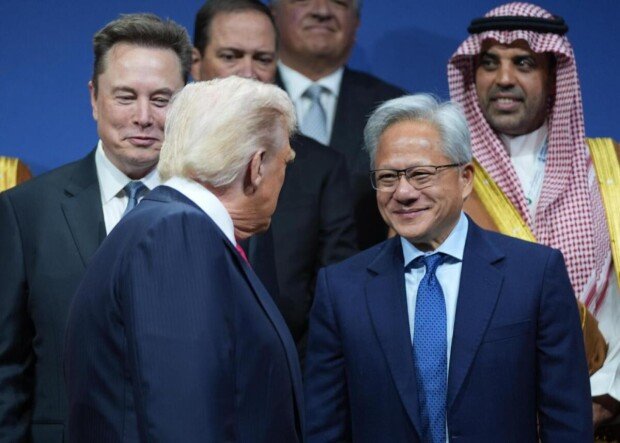
The Trump administration has authorized exports of Nvidia’s latest artificial intelligence chips to key Middle Eastern allies, including Saudi Arabia.
Although U.S. President Donald Trump earlier raised the possibility of restricting exports of advanced AI chips, the move is seen as a signal that the United States is willing to provide the technology to allies as long as it poses no security risk and offers economic benefits.
According to The Wall Street Journal, the U.S. Department of Commerce on Nov. 19 approved exports of Nvidia’s latest chips to Saudi AI firm Humane and the United Arab Emirates’ G42. The authorized shipment totals 70,000 units, with 35,000 chips allocated to each company. The shipment includes Nvidia’s GB300 server-grade graphics processing units and chips of equivalent performance. The GB300 uses Blackwell, currently the world’s most powerful AI chip architecture. The approval indicates that the Trump administration has lifted export restrictions the previous Biden administration had imposed in the Middle East to prevent the technology from reaching China through third countries.
The Trump administration appears to have made the decision with U.S. companies’ commercial interests in mind. The Journal reported that Commerce Secretary Howard Lutnick insisted Middle Eastern allies fulfill previously pledged investments in the United States before receiving approval to import AI chips. The negotiations were reportedly delayed until the final stage as a result. Authorization was granted only after Saudi Crown Prince Mohammed bin Salman visited the White House on Nov. 18 for talks with President Trump. During the visit, the two sides agreed that Saudi Humane would build a 500-megawatt data center in partnership with Elon Musk’s xAI and Nvidia.
In exchange for easing export controls, the Trump administration required stringent security safeguards. The Commerce Department’s Bureau of Industry and Security plans to apply strict protocols to ensure the exported chips do not end up at sanctioned firms, including China’s Huawei. The bureau also will continuously monitor compliance with the rules.
There is growing speculation that the approval could benefit South Korea. Analysts say the decision raises the likelihood that the supply of AI chips pledged for the country will proceed as scheduled, particularly after Nvidia CEO Jensen Huang said during his visit to Seoul last month that he would supply 260,000 of the latest GPUs to major Korean companies.
Hyun-Seok Lim lhs@donga.com



![샤워는 매일 하는데… 수건도 한 번 쓰고 빨아야 할까?[건강팩트체크]](https://dimg.donga.com/c/138/175/90/1/wps/NEWS/IMAGE/2026/05/07/133878335.3.jpg)



 About Dong-A Ilbo