

China Displays Advanced ICBMs and Hypersonic Missiles
China Displays Advanced ICBMs and Hypersonic Missiles
Posted September. 04, 2025 07:38,
Updated September. 04, 2025 07:38
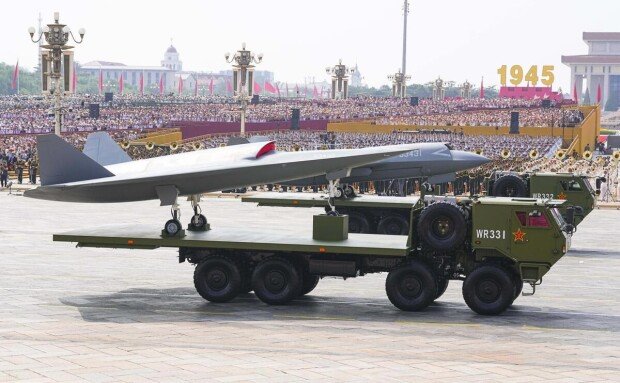
On Sept. 3, at Tiananmen Square in Beijing, China showcased new strategic weapons for the first time during the 80th anniversary Victory Day parade, including next-generation intercontinental ballistic missiles (ICBMs) and hypersonic missiles aimed at the U.S. mainland and regional U.S. forces as part of its so-called “nuclear triad.” The parade featured cutting-edge forces across land, sea, air, and even space, creating an unprecedented weapons display. According to a military official, China is demonstrating its formidable nuclear strike capabilities not only to the United States but also to neighboring countries, including South Korea and Japan, while openly challenging the U.S.-led security order.
The new DF-61 ICBM, capable of striking the U.S. mainland, was unveiled for the first time. It is believed to be an upgraded version of the DF-41, which was first displayed during China’s 70th National Day parade in 2015. With an estimated range of 12,000 to 15,000 kilometers and equipped with multiple independently targetable reentry vehicles (MIRVs), it could simultaneously strike multiple major U.S. cities.
The DF-5C ICBM, capable of reaching anywhere on Earth, also appeared. An upgraded liquid-fueled version of the DF-5B, Chinese media described it as “a critical component of China’s strategic retaliatory system, with a strike range spanning the globe.”
Several JL-class submarine-launched ballistic missiles (SLBMs) were displayed. The JL-class SLBMs, which are multiple-warhead ICBMs, have a maximum range of 8,000 kilometers and are launched from strategic nuclear submarines (SSBNs). Fired from China’s near seas, they could reach Alaska, while launches into the Indian and Pacific Oceans could strike the entire U.S. mainland. This demonstrates a “second-strike” nuclear capability comparable to that of the United States. The Washington Post reported that “the submarine-launched JL-3 ICBM is believed capable of reaching the North American continent.”
The DF-26D, nicknamed the “Guam killer,” also drew attention. With improved precision over the previous DF-26 and a maximum range of 5,000 kilometers, it could directly target Guam, a key U.S. strategic hub, from the Chinese mainland. U.S. military bases in Japan and the Philippines, as well as U.S. aircraft carriers in the Taiwan Strait, would also fall within its reach. The National Interest, a U.S. foreign policy and security publication, warned that “due to the DF-26D, U.S. aircraft carriers would have to remain at least 1,000 kilometers from the Taiwan Strait in a contingency.”
Numerous hypersonic missiles capable of evading missile defense systems were also displayed. The DF-17 is considered difficult to intercept with the U.S. THAAD system in South Korea or the SM-3 interceptors of the U.S.-Japan alliance. Several new hypersonic anti-ship missiles, including the YJ-17 and YJ-21, were also showcased. The YJ-17, with a top speed of Mach 8 and a range of 1,200 kilometers, can be launched from ships or aircraft to strike distant naval targets, using evasive maneuvers in its final flight phase. This makes interception difficult and positions it as a new threat to U.S. carriers in the event of a Taiwan conflict.
Sang-Ho Yun ysh1005@donga.com








 About Dong-A Ilbo