

Poised for Strategic Global Expansion, ‘Gmission’ Gains Attention for its AX Solutions.
Poised for Strategic Global Expansion, ‘Gmission’ Gains Attention for its AX Solutions.
Posted August. 26, 2025 09:52,
Updated August. 26, 2025 10:02
- Gmission is gaining attention for its AI transformation solutions, which combine
analog robustness with digital innovation.
- The company has developed industry-optimized generative AI solutions,
including AI Fax and Retriever, to process unstructured documents for public
and financial institutions.
- Gmission is actively expanding its business globally, targeting markets in
Canada, the United States, and several Asian countries.
“We combine analog robustness and digital innovation with AI technology.”
As AI-powered solutions flood the market, corporations are shifting their focus from digital transformation (DX) to AI transformation (AX). For public and financial institutions, a critical challenge has emerged: converting decades of vast, unstructured documents into digital assets to apply and leverage AI. In this landscape, one startup is gaining attention for its generative AI-based solutions for intelligent video, document, and data processing: Gmission Corp. We met with CEO Jun-sup Han to discuss the company's growth strategy and international expansion.
Refining Solutions by Applying AI to Customer Problems
Gmission began as a general service provider before reinventing itself as an AI solutions specialist. Guided by its on-the-ground experience of ‘connecting the robust stability of analog with digital innovation through AI,’ the company developed industry-optimized generative AI solutions that emphasize security and convenience.
"AI has brought inventive innovation to the world," said Han. "My interest grew as I learned more about it. Despite majoring in business, I was so compelled that I enrolled at Yonsei University Graduate School of Engineering to study AI. The more I studied, the more I felt that the pace of AI-driven change would be faster than we think, much like 'The Third Wave' that futurist Alvin Toffler predicted would follow the agricultural and industrial eras."
While working at Gmission, Han foresaw in 2017 that AI innovation would drive positive change for businesses and dedicated himself to acquiring knowledge. He went on to acquire a stake in the company in 2019 and, upon becoming CEO in January 2020, pivoted the business to specialize in AI.
From its early stages, Gmission actively integrated AI technology, achieving significant milestones such as developing facial recognition and vehicle detection technologies through CCTV video analysis in collaboration with government agencies. Through continuous R&D and government-funded projects, the company secured its own unique technology stack. This is represented by 9 patents, 4 trademarks, and 3 copyrights, including a system and method for providing customized content services using video information, for which a PCT (Patent Cooperation Treaty) application has been filed.
"As a startup, securing expert talent and R&D was not easy," Han noted. "Our client base was diverse, ranging from financial and public institutions to large corporations, and we committed all our energy to meeting their top-tier demands. As a result, by solving the needs of about 300 clients, Gmission's technology also advanced rapidly."
Unstructured Document Processing as a Core Competency
Gmission targets public agencies, local governments, financial institutions, and large enterprises with its AI-based data processing technology. Its flagship solutions include: ▲ AI Fax, an AI-based web fax solution; ▲ Retriever, an intelligent data processing solution; ▲ DXHUND, an intelligent document processing solution; ▲ BodoCollie (tentative title), an intelligent press release generation platform; and ▲ DEXMA, a video analysis solution commercialized through government R&D.
"When you think about business operations, everything begins and ends with 'data.' It's what we use to analyze and derive insights," Han explained. "This data accumulates in unstructured documents. Even today, countless documents move between departments and companies. Gmission's AI Fax is utilized throughout this entire process of handling document data. We determined that fax was the optimal service for applying technology that can understand, summarize, and generate documents in the era of generative AI. The AI Fax we launched has since become our flagship product."
Gmission's AI Fax solution applies AI OCR (Optical Character Recognition) to go beyond simply sending faxes, maximizing efficiency by automatically analyzing and processing text and images within documents. As fax is a globally used standard, the solution holds a strong competitive edge for overseas expansion. More recently, the company developed the BodoCollie solution to help public agencies ensure journalistic integrity and assist departments in generating press releases, which is currently undergoing a proof-of-concept at the Seoul Gangnam-gu Office.
Furthermore, while the generative AI boom following the launch of OpenAI's ChatGPT has prompted many companies to adopt AI, they often get stuck at the stage of converting internal unstructured documents into digital assets. It is precisely at this point that Gmission has secured its growth engine by targeting a niche market with its differentiated technology. Han himself emphasized that Gmission's core competency is its ‘unstructured document processing technology.’
Gmission has leveraged its AI Fax technology to develop a variety of solutions. The company has secured the technology to extract text from unstructured documents using its proprietary deep-learning-based AI OCR solution and natural language processing algorithms, and to build datasets for training AI models. As a result, it is growing rapidly by building a track record of successful unstructured document processing in the public and financial sectors.
"With most corporate tasks mediated by documents, converting unstructured documents into digital assets has become a key challenge for AI adoption," Han pointed out. "We built a foundation model to integrate AI as a customized solution into clients' legacy environments. We then achieved rapid growth by providing an optimized solution that included building a fine-tuned small language model (sLM) based on the client's internal data."
He added, "Our quadrilateral business model, which combines Information, Communication, and AI with the recently highlighted ESG, also provides stability, which will have a positive impact on our overseas expansion. Even our solution names, which bring to mind breeds of dogs, were created to be easily understood by anyone, with global markets in mind."
Gmission is actively targeting the Vertical AI market, which is specialized for each industry. It is developing a service that facilitates the easy construction of sLM models based on its proprietary AI document extraction technology for unstructured documents in specialized fields such as public administration, finance, law, and medicine. The company also plans to pioneer a new market by launching a contract analysis solution that compares key items and official seals from various types of documents like contracts, operational directives, and purchase orders.
People: The Most Important Factor in Business
Having started with 10 employees, Gmission now has a team of about 50. The company shows remarkable growth over five years, with revenue projected to increase from KRW 6.55 billion in 2024 to a target of KRW 10 billion this year.
"A company's growth ultimately comes down to its people," Han said, stressing the importance of both employees and clients. "An entrepreneur is connected to various stakeholders, including investors, customers, and employees. Without trust, a company's sustainability is threatened. At Gmission, we have chosen the path of building trust with our clients, even if it means taking a loss on some projects in the short term."
Gmission places a particular emphasis on employee welfare. "When employees grow happily, that energy is projected externally," Han said. "We hold the 'Gmission Awards' at the end of the year to provide substantial rewards. I'm delighted that our employees are so passionate about their work."
The company is also proactive in strengthening employee capabilities. It actively supports the use of necessary AI tools for work and encourages employee growth by operating internal patents and education programs. It also runs an in-house employee welfare corporation. "We've faced many difficult collaborative projects, but I believe we were able to overcome them because of our employees who poured their efforts in together," Han stated. "Our people are the most important, so we strive to provide them with many benefits. The organization can only grow quickly when each individual employee becomes stronger."
Full-Scale Overseas Expansion with a BPO Policy
Gmission is developing SaaS solutions and conducting local market research to expand its business globally. Starting with Canada and the United States, the company has signed MOUs with software channel partners in Indonesia, Malaysia, Vietnam, and Japan. In the second half of this year, it will participate in "Japan IT Week Autumn 2025" to officially launch its entry into the local market.
"I believe the method of entry is crucial for pioneering overseas markets," Han said. "Gmission plans to expand abroad through a Business Partner Ownership (BPO) policy. It is vital to meet local business partners who can strategically sell Gmission's AI solutions tailored to each country. And with the current high interest in K-content, the opportunities are more open than ever."
Gmission also has a strong interest in the medical and legal fields. "Law and medicine are sectors where an AX transformation is just as urgently needed as in public and financial institutions," Han noted. "In the U.S., 70% of all healthcare organizations use fax to transmit patient information because it is perceived as a secure option. In the legal field as well, documents exchanged by fax are recognized as written records with the same legal force as the original. However, in terms of AX innovation, these sectors have not yet grown to the scale of finance or public administration. We will expand the market with Gmission's generative AI technology and customer-centric sales approach."
Recently, Gmission was selected as one of the companies for the ‘Innovation Premier 1000,’ a national strategic project promoted by the Korea government. "Gmission has redefined the traditional fax from a simple transmission tool into an integrated platform for intelligent document processing through AX innovation," Han said. "I believe our approach of innovating a legacy industry by combining it with AI transformation and generative AI technologies resonated with the core of this national strategic project. We will continue to drive AX innovation for unstructured documents in public and financial institutions."
Finally, Han shared his vision: "Gmission's goal is to grow into a fully integrated data AI platform company possessing top-tier, frontier AI technology. We aim to achieve a revenue of KRW 100 billion by 2030."
On a final note, Gmission participated in a global corporate collaboration program hosted by Seoul National University of Science and Technology (SeoulTech). "Thanks to the program, we had the opportunity to collaborate with Oracle and introduce our solutions to their SaaS services," Han said with satisfaction. "The various other support programs that provided mentoring and networking with global experts were also very helpful."
By Kui-im Park (luckyim@itdonga.com)
* This article was written with support from Seoul National University of Science and Technology.
analog robustness with digital innovation.
- The company has developed industry-optimized generative AI solutions,
including AI Fax and Retriever, to process unstructured documents for public
and financial institutions.
- Gmission is actively expanding its business globally, targeting markets in
Canada, the United States, and several Asian countries.
“We combine analog robustness and digital innovation with AI technology.”
As AI-powered solutions flood the market, corporations are shifting their focus from digital transformation (DX) to AI transformation (AX). For public and financial institutions, a critical challenge has emerged: converting decades of vast, unstructured documents into digital assets to apply and leverage AI. In this landscape, one startup is gaining attention for its generative AI-based solutions for intelligent video, document, and data processing: Gmission Corp. We met with CEO Jun-sup Han to discuss the company's growth strategy and international expansion.
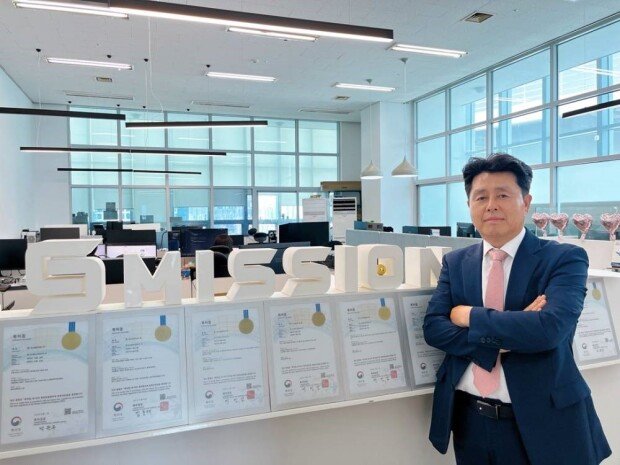
Jun-sup Han, CEO of Gmission / source=Gmission
Refining Solutions by Applying AI to Customer Problems
Gmission began as a general service provider before reinventing itself as an AI solutions specialist. Guided by its on-the-ground experience of ‘connecting the robust stability of analog with digital innovation through AI,’ the company developed industry-optimized generative AI solutions that emphasize security and convenience.
"AI has brought inventive innovation to the world," said Han. "My interest grew as I learned more about it. Despite majoring in business, I was so compelled that I enrolled at Yonsei University Graduate School of Engineering to study AI. The more I studied, the more I felt that the pace of AI-driven change would be faster than we think, much like 'The Third Wave' that futurist Alvin Toffler predicted would follow the agricultural and industrial eras."
While working at Gmission, Han foresaw in 2017 that AI innovation would drive positive change for businesses and dedicated himself to acquiring knowledge. He went on to acquire a stake in the company in 2019 and, upon becoming CEO in January 2020, pivoted the business to specialize in AI.
From its early stages, Gmission actively integrated AI technology, achieving significant milestones such as developing facial recognition and vehicle detection technologies through CCTV video analysis in collaboration with government agencies. Through continuous R&D and government-funded projects, the company secured its own unique technology stack. This is represented by 9 patents, 4 trademarks, and 3 copyrights, including a system and method for providing customized content services using video information, for which a PCT (Patent Cooperation Treaty) application has been filed.
"As a startup, securing expert talent and R&D was not easy," Han noted. "Our client base was diverse, ranging from financial and public institutions to large corporations, and we committed all our energy to meeting their top-tier demands. As a result, by solving the needs of about 300 clients, Gmission's technology also advanced rapidly."
Unstructured Document Processing as a Core Competency
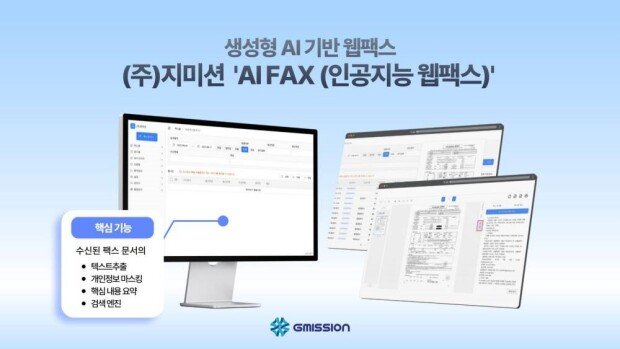
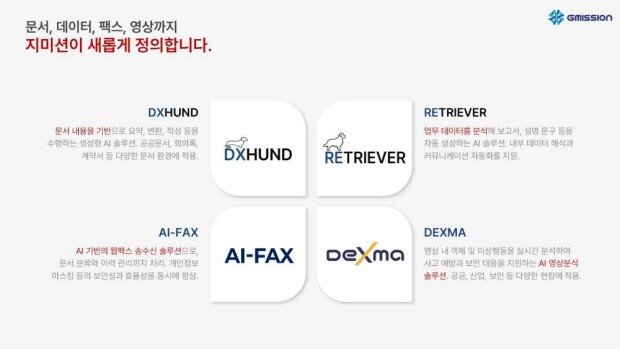
Gmission targets public agencies, local governments, financial institutions, and large enterprises with its AI-based data processing technology. Its flagship solutions include: ▲ AI Fax, an AI-based web fax solution; ▲ Retriever, an intelligent data processing solution; ▲ DXHUND, an intelligent document processing solution; ▲ BodoCollie (tentative title), an intelligent press release generation platform; and ▲ DEXMA, a video analysis solution commercialized through government R&D.
"When you think about business operations, everything begins and ends with 'data.' It's what we use to analyze and derive insights," Han explained. "This data accumulates in unstructured documents. Even today, countless documents move between departments and companies. Gmission's AI Fax is utilized throughout this entire process of handling document data. We determined that fax was the optimal service for applying technology that can understand, summarize, and generate documents in the era of generative AI. The AI Fax we launched has since become our flagship product."
Gmission is rapidly growing by expanding AI fax to develop various solutions in the public and financial sectors / source=Gmission
Gmission's AI Fax solution applies AI OCR (Optical Character Recognition) to go beyond simply sending faxes, maximizing efficiency by automatically analyzing and processing text and images within documents. As fax is a globally used standard, the solution holds a strong competitive edge for overseas expansion. More recently, the company developed the BodoCollie solution to help public agencies ensure journalistic integrity and assist departments in generating press releases, which is currently undergoing a proof-of-concept at the Seoul Gangnam-gu Office.
Furthermore, while the generative AI boom following the launch of OpenAI's ChatGPT has prompted many companies to adopt AI, they often get stuck at the stage of converting internal unstructured documents into digital assets. It is precisely at this point that Gmission has secured its growth engine by targeting a niche market with its differentiated technology. Han himself emphasized that Gmission's core competency is its ‘unstructured document processing technology.’
Gmission has leveraged its AI Fax technology to develop a variety of solutions. The company has secured the technology to extract text from unstructured documents using its proprietary deep-learning-based AI OCR solution and natural language processing algorithms, and to build datasets for training AI models. As a result, it is growing rapidly by building a track record of successful unstructured document processing in the public and financial sectors.
"With most corporate tasks mediated by documents, converting unstructured documents into digital assets has become a key challenge for AI adoption," Han pointed out. "We built a foundation model to integrate AI as a customized solution into clients' legacy environments. We then achieved rapid growth by providing an optimized solution that included building a fine-tuned small language model (sLM) based on the client's internal data."
He added, "Our quadrilateral business model, which combines Information, Communication, and AI with the recently highlighted ESG, also provides stability, which will have a positive impact on our overseas expansion. Even our solution names, which bring to mind breeds of dogs, were created to be easily understood by anyone, with global markets in mind."
Gmission is actively targeting the Vertical AI market, which is specialized for each industry. It is developing a service that facilitates the easy construction of sLM models based on its proprietary AI document extraction technology for unstructured documents in specialized fields such as public administration, finance, law, and medicine. The company also plans to pioneer a new market by launching a contract analysis solution that compares key items and official seals from various types of documents like contracts, operational directives, and purchase orders.
People: The Most Important Factor in Business
Having started with 10 employees, Gmission now has a team of about 50. The company shows remarkable growth over five years, with revenue projected to increase from KRW 6.55 billion in 2024 to a target of KRW 10 billion this year.
"A company's growth ultimately comes down to its people," Han said, stressing the importance of both employees and clients. "An entrepreneur is connected to various stakeholders, including investors, customers, and employees. Without trust, a company's sustainability is threatened. At Gmission, we have chosen the path of building trust with our clients, even if it means taking a loss on some projects in the short term."
Gmission places a particular emphasis on employee welfare. "When employees grow happily, that energy is projected externally," Han said. "We hold the 'Gmission Awards' at the end of the year to provide substantial rewards. I'm delighted that our employees are so passionate about their work."
The company is also proactive in strengthening employee capabilities. It actively supports the use of necessary AI tools for work and encourages employee growth by operating internal patents and education programs. It also runs an in-house employee welfare corporation. "We've faced many difficult collaborative projects, but I believe we were able to overcome them because of our employees who poured their efforts in together," Han stated. "Our people are the most important, so we strive to provide them with many benefits. The organization can only grow quickly when each individual employee becomes stronger."
Full-Scale Overseas Expansion with a BPO Policy
Gmission is developing SaaS solutions and conducting local market research to expand its business globally. Starting with Canada and the United States, the company has signed MOUs with software channel partners in Indonesia, Malaysia, Vietnam, and Japan. In the second half of this year, it will participate in "Japan IT Week Autumn 2025" to officially launch its entry into the local market.
"I believe the method of entry is crucial for pioneering overseas markets," Han said. "Gmission plans to expand abroad through a Business Partner Ownership (BPO) policy. It is vital to meet local business partners who can strategically sell Gmission's AI solutions tailored to each country. And with the current high interest in K-content, the opportunities are more open than ever."
Gmission also has a strong interest in the medical and legal fields. "Law and medicine are sectors where an AX transformation is just as urgently needed as in public and financial institutions," Han noted. "In the U.S., 70% of all healthcare organizations use fax to transmit patient information because it is perceived as a secure option. In the legal field as well, documents exchanged by fax are recognized as written records with the same legal force as the original. However, in terms of AX innovation, these sectors have not yet grown to the scale of finance or public administration. We will expand the market with Gmission's generative AI technology and customer-centric sales approach."
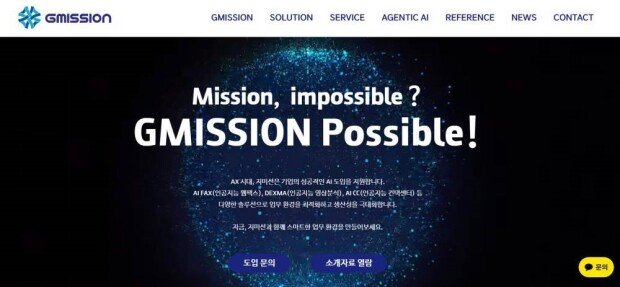
"From Good to Great Global, Go Gmission," Gmission plans to advance internationally with its BPO policy / source=Gmission
Recently, Gmission was selected as one of the companies for the ‘Innovation Premier 1000,’ a national strategic project promoted by the Korea government. "Gmission has redefined the traditional fax from a simple transmission tool into an integrated platform for intelligent document processing through AX innovation," Han said. "I believe our approach of innovating a legacy industry by combining it with AI transformation and generative AI technologies resonated with the core of this national strategic project. We will continue to drive AX innovation for unstructured documents in public and financial institutions."
Finally, Han shared his vision: "Gmission's goal is to grow into a fully integrated data AI platform company possessing top-tier, frontier AI technology. We aim to achieve a revenue of KRW 100 billion by 2030."
On a final note, Gmission participated in a global corporate collaboration program hosted by Seoul National University of Science and Technology (SeoulTech). "Thanks to the program, we had the opportunity to collaborate with Oracle and introduce our solutions to their SaaS services," Han said with satisfaction. "The various other support programs that provided mentoring and networking with global experts were also very helpful."
By Kui-im Park (luckyim@itdonga.com)
* This article was written with support from Seoul National University of Science and Technology.








 About Dong-A Ilbo