

Temple dispute fuels deadly Thai-Cambodian skirmish
Temple dispute fuels deadly Thai-Cambodian skirmish
Posted July. 25, 2025 07:23,
Updated July. 25, 2025 07:23
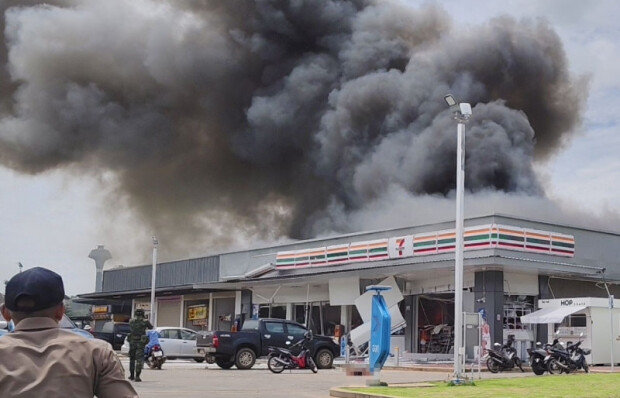
At least nine Thai civilians were killed and 14 others wounded when Thai and Cambodian troops exchanged fire near the border on Wednesday, according to the BBC and other media reports. The clash occurred just one day after Thailand expelled Cambodia’s ambassador, alleging that a landmine planted by Cambodian forces had injured Thai soldiers.
The two countries have long contested ownership of the 11th-century Khmer temple complex Preah Vihear, whose name means “sacred sanctuary” in Sanskrit. The crisis is further complicated by political turmoil in Thailand, where Thai Prime Minister Paetongtarn Shinawatra has been suspended following the leak of a phone call in which she made conciliatory remarks to Cambodian Senate President Hun Sen, the country’s de facto leader.
● Both sides blame each other for attack
The clash erupted around 8:20 a.m. near the border between Thailand’s Surin Province and Cambodia’s Oddar Meanchey Province, with both sides accusing the other of firing first.
Thai officials said the fighting began when six armed Cambodian soldiers opened fire after a drone was heard circling near a Thai military post. They also accused Cambodia of intentionally launching a BM-21 multiple rocket system into a densely populated area, resulting in heavy civilian casualties. About 40,000 residents were evacuated from the region, and the Thai Air Force deployed F-16 fighter jets in response.
Thailand also accused Cambodia of deliberately planting landmines along the border in recent weeks, leading to additional injuries among Thai troops. On Tuesday, Deputy Prime Minister and Interior Minister Phumtham Wechayachai, who is serving as acting prime minister, announced the expulsion of Cambodia’s ambassador and recalled Thailand’s envoy from Phnom Penh.
Cambodia has denied the landmine allegations and maintains that Thai forces initiated the clash. On Wednesday, its Ministry of Defense said, “We only responded in self-defense after a preemptive attack by Thai forces.” Senate President Hun Sen added, “Although our forces were shelled by Thai troops, I urge calm and trust in our military.”
● Disputed temple remains a flashpoint in border tensions
The long-running dispute over the Preah Vihear temple remains a central source of friction between Thailand and Cambodia. Tensions intensified after France withdrew from Cambodia in 1953, and Thai forces moved to occupy the temple grounds.
Cambodia took the case to the International Court of Justice, which ruled in 1962 and reaffirmed in 2013 that the temple belongs to Cambodia. Thailand has never fully accepted the ruling. In 2011, a separate clash near the site resulted in more than 20 deaths.
Anti-Cambodian sentiment has been growing in Thailand following the June 15 leak of a phone call between Prime Minister Paetongtarn Shinawatra and Hun Sen. In the conversation, Shinawatra referred to Hun Sen as “uncle” and criticized Thailand’s military leadership for its handling of border tensions. Her deferential tone and remark that she would “give you anything you want” sparked public outrage and ultimately led to her suspension from office.
Despite the escalation, analysts widely believe a full-scale war is unlikely. Cambodia is struggling with economic hardship, while Thailand remains deeply divided by political turmoil. “Given the instability in both nations, few expect the current tension to escalate into a wider conflict,” the BBC reported.
Thailand’s military and economic superiority over Cambodia also makes war less likely. Still, political gridlock in Bangkok may hinder Thailand’s ability to respond effectively to international disputes.
Seong-Mo Kim mo@donga.com






 About Dong-A Ilbo