

Korea launches rare earth exploration in Pacific
Korea launches rare earth exploration in Pacific
Posted July. 15, 2025 08:05,
Updated July. 15, 2025 08:05
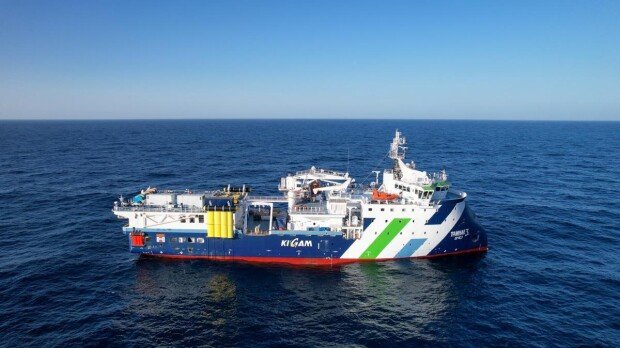
The Tamhae 3, known as a “high-tech research lab on the sea,” has set sail for the western Pacific. It will conduct an exploration mission for rare earth elements, which are considered key minerals.
The Korea Institute of Geoscience and Mineral Resources (KIGAM) announced that the Tamhae 3 departed from Jinhae Port in Changwon at 5 p.m. Monday for international waters in the western Pacific, launching the Seabed Rare Earth Element Exclusive Exploration Project. After beginning its first mission in June 2024 and conducting research in domestic waters, the Tamhae 3 is entering the western Pacific high seas for the first time in about a year.
The Tamhae 3 is a 6,000-ton geophysical exploration vessel capable of conducting seabed exploration in global waters, including continental shelves, oceans, and polar regions. It uses marine seismic waves to perform not only 3D physical surveys but also 4D surveys that detect geological changes over time. It can identify the presence and location of seafloor resources such as underwater topography, oil, gas, and rare earth elements.
The current mission aims to locate areas on the western Pacific seafloor with high concentrations of rare earth elements. Rare earths, which became a key issue during the U.S.-China trade conflict, are classified into light and heavy rare earths based on their weight and properties. Heavy rare earths are considered essential minerals used in specialized industries such as high-performance magnets and catalysts.
Global competition for seafloor rare earth elements is already intense. With China having secured many land-based mining sites, Japan has moved quickly by anchoring a deep-sea scientific drilling vessel in nearby waters and conducting a pilot project to extract rare earths at a depth of 5,500 meters. China has also taken an early lead, having signed a contract with the International Seabed Authority (ISA) several years ago to explore seabed mineral resources in international waters of the western Pacific.
KIGAM plans to use this mission as a starting point to conduct three-dimensional assessments of rare earth deposits in the western Pacific over the next six years and evaluate their development potential.
Kim Yoon-mi, head of KIGAM’s Marine Geology Research Center, said, “This mission is significant because Korea is operating the Tamhae 3 independently and using purely domestic research technology to confirm the distribution of seafloor rare earth resources.” She added, “With China and Japan already moving to secure early access, this mission is strategically important.”
최지원 기자 jwchoi@donga.com

![[속보]李, 국무총리에 한성숙 지명…여성·非서울대·기업인](https://dimg.donga.com/c/138/175/90/1/wps/NEWS/IMAGE/2026/06/07/134062963.1.jpg)


![6월 3일 잠실에서 본 광경…선관위 존재 이유를 묻다[청계천 옆 사진관]](https://dimg.donga.com/c/138/175/90/1/wps/NEWS/IMAGE/2026/06/06/134043363.1.jpg)



 About Dong-A Ilbo