

KOSPI tops 2,900 as foreign investors fuel rally
KOSPI tops 2,900 as foreign investors fuel rally
Posted June. 12, 2025 07:33,
Updated June. 12, 2025 07:33
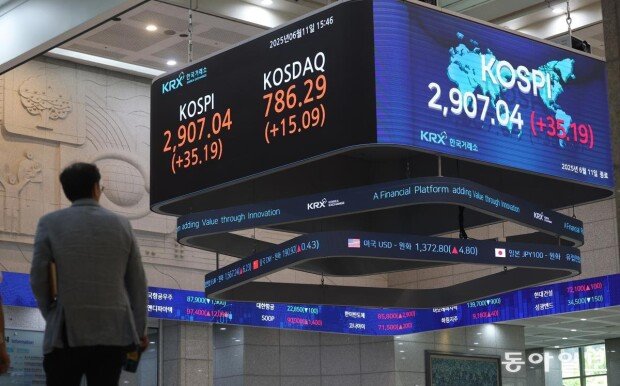
The KOSPI broke through the 2,900 mark for the first time in three years and five months, driven by strong buying from foreign investors and easing political uncertainty under the new administration.
On Wednesday, the index closed at 2,907.04, up 35.19 points, or 1.23 percent, from the previous trading day. It was the first time the KOSPI surpassed 2,900 since Jan. 14, 2022, when it closed at 2,921.92. Foreign and institutional investors were key drivers, with net purchases of 165.6 billion won and 228.7 billion won worth of stocks, respectively. The KOSDAQ also gained, closing at 786.29, up 15.09 points, or 1.96 percent, supported by continued net buying from foreign and institutional investors.
Investor sentiment was lifted by news of smooth progress in high-level U.S.-China trade talks. On Tuesday, all three major New York stock indexes rose, boosting the domestic market. The PHLX Semiconductor Sector Index, which includes companies such as Nvidia and Broadcom, gained 2.1 percent.
President Lee Jae-myung, who has pledged to raise the KOSPI to 5,000, visited the Korea Exchange in Yeouido on Wednesday, fueling expectations that the administration will take active steps to support the stock market. The government plans to stimulate domestic demand through measures such as executing supplementary budgets and making large-scale investments in strategic industries including artificial intelligence, defense, and biotechnology. Efforts to improve corporate governance through amendments to the Commercial Act are also expected to support the market.
Returning foreign investors have played a key role in the rally. After selling stocks from August last year through April this year, they have shifted to net buying. The KOSPI has risen more than 7 percent this month, with foreigners purchasing nearly 4 trillion won worth of shares. Semiconductor stocks attracted significant investments, including SK hynix with net purchases of 975.8 billion won and Samsung Electronics with 842 billion won. Other notable buys included Hanwha Aerospace at 219.7 billion won and HD Hyundai Electric at 184.4 billion won.
Some analysts attribute the recent gains to stable exchange rates. From December through April, the monthly average USD/KRW exchange rate hovered in the low to mid-1,400 won range but declined to 1,390.7 won in May. A continued strengthening of the won against the dollar could offer additional foreign exchange gains for investors holding Korean stocks.
“Foreign investors have sold a net total of 40 trillion won through April, so there is still room for additional purchases, and the KOSPI could potentially exceed 3,000," said Jeong Yong-taek, senior researcher at IBK Securities Co. "We expect the strong market trend to persist, driven by a shift in leading stocks from export-oriented companies to sectors such as semiconductor materials, parts and equipment, and entertainment.”
홍석호 기자 will@donga.com






 About Dong-A Ilbo