

Opposition parties pass amendment to Commercial Act
Opposition parties pass amendment to Commercial Act
Posted March. 14, 2025 07:31,
Updated March. 14, 2025 07:31
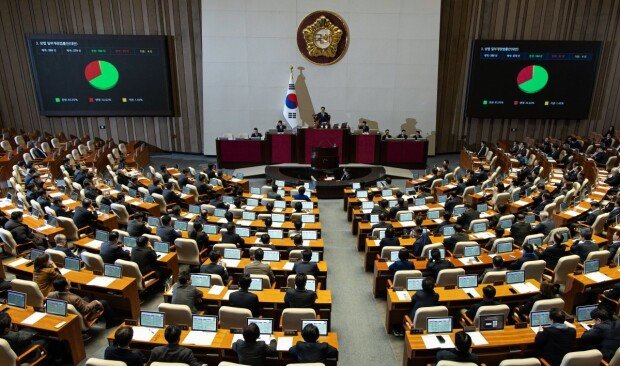
Despite strong opposition from the business sector, the National Assembly passed an amendment to the Commercial Act on Thursday, with the Democratic Party of Korea (DPK) and other opposition parties leading the vote. Economic institutions swiftly condemned the decision, arguing that the amendment would leave businesses vulnerable to speculative capital, while the ruling People Power Party (PPP) called on the government to veto the bill.
Of the 279 lawmakers present, the amendment was approved by 185 lawmakers, with 91 opposed and three abstaining. All opposition lawmakers voted in favor of the bill, except for Jeong Hye-kyung of the Progressive Party, who abstained. The PPP had declared its opposition before the session, yet lawmakers Kwon Young-jin and Kim Jae-seob abstained.
The amendment expands the fiduciary duty of company directors beyond just the company itself, extending it to shareholders. It also mandates the electronic general shareholders’ meeting system. The DPK argued that the bill would enhance protections for retail investors and help correct the persistent undervaluation of Korean stocks. The bill was advanced solely by opposition parties through the Legislation and Judiciary Committee and the plenary session, without bipartisan agreement. A senior DPK official noted that the bill had been previously endorsed by President Yoon Suk Yeol, former PPP leader Han Dong-hoon, and Financial Supervisory Service Commissioner Lee Bok-hyun.
In contrast, PPP Emergency Response Committee Chairman Kwon Young-se strongly criticized the bill, stating, "While DPK leader Lee Jae-myung speaks of his vision for a ‘Korean Nvidia,’ such economic aspirations are impossible under the regulatory environment shaped by the DPK." Major economic groups, including the Federation of Korean Industries (FKI) and the Korea Chamber of Commerce and Industry (KCCI), also voiced strong opposition. The FKI called for a presidential veto, stating, "This amendment to the Commercial Act will have a devastating impact on the economy and businesses, and it is unconstitutional."
National Assembly Speaker Woo Won-shik, who had previously postponed putting the bill to a vote on February 27 in an effort to encourage bipartisan negotiations, ultimately brought it forward, remarking, "Over the past three weeks, there has been little meaningful negotiation between the ruling and opposition parties. If both sides remain entrenched in their positions, that is not governance."
Meanwhile, opposition parties also pushed through a resolution demanding the resignation of Korea Communications Commission (KCC) Chairman Ryu Hee-rim, who has been accused of coordinating efforts to suppress media reports on President Yoon's alleged misconduct by aiding and abetting people to file petitions. Additionally, the opposition-led plenary session passed a bill calling for an audit of the National Audit Office. However, efforts to establish a special committee on pension reform ultimately fell through, as the ruling and opposition parties failed to bridge their differences.
윤다빈기자 empty@donga.com







 About Dong-A Ilbo