

Pitcher Park Makes Adjustment to Throw Faster
Pitcher Park Makes Adjustment to Throw Faster
Posted June. 11, 2008 08:20,
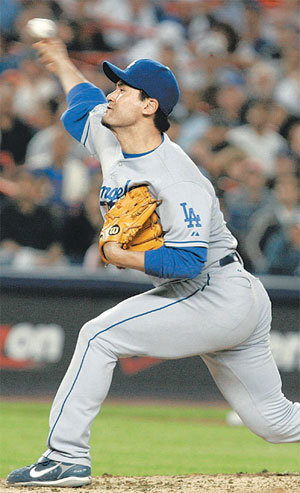
The distance between the pitchers mound and the tip of home plate is 18.44 meters. The distance can feel shorter or longer depending on how a pitcher throws.
An underhanded pitcher might feel farther away than a pitcher who throws overhand. The distance can also vary depending on the point of release. The later a pitcher releases the ball or is closer to the catcher, the shorter the distance becomes. In certain cases, the distance is cut by as much as a meter.
This might explain how pitcher Park Chan-ho of the Los Angeles Dodgers, 35, recently threw as fast as 158 kilometers against the Colorado Rockies. This season, Park is 2-1 with a save, and more importantly, an earned-run average of just 2.09.
Baseball commentators have praised the revival of Parks fastball.
○ Lively fastball
Prior to the first round of the Beijing Olympics Asian regional qualifiers last year, Parks balls were timed at 145 kilometers an hour at most. Then national team coach Sun Dong-yeol said, He uses only his arm in throwing. He does not switch his weight to his right leg. Thats why.
These days, however, Parks fastball has exceeded 150 kilometers on average.
MBC commentator Heo Gu-yeon said, Park has changed his pitching form and thats the secret behind his faster pitches and better ball control. Previously, Parks arm lingered behind, but now, he pulls it up high in the air and strides his left leg deep toward the catcher, releasing the ball at the closest point to home plate.
○ Strong legs sustain ball speed
Last winter, Park consulted with the National Pitching Association run by Tom House to fix his form, rebalancing himself and regaining his power.
Korea Baseball Organization committee member Kim Shi-jin said, The secret? Look at his pitching form. His body weight moves closer to the ground than last year. Hes now a lot better at switching his bodys center of gravity, which in turn has dramatically improved his speed and control.
beetlez@donga.com



![하루 방귀 몇 번이 정상일까? 가장 많이 뀌는 시간대는…[건강팩트체크]](https://dimg.donga.com/c/138/175/90/1/wps/NEWS/IMAGE/2026/06/12/134098245.3.jpg)



 About Dong-A Ilbo