

Jamaican Bolt Sets New World Mark in 100 Meters
Jamaican Bolt Sets New World Mark in 100 Meters
Posted June. 02, 2008 03:00,
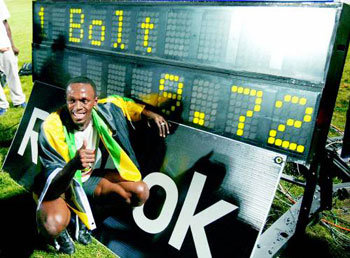
Usain Bolt of Jamaica yesterday set a new world record in the men`s 100-meter dash, shortening the previous mark by 0.02 seconds.
At the Reebok Grand Prix in New York, Bolt enjoyed prime conditions for racing, including a tailwind of 1.7 meters per second.
Fellow Jamaican sprinter Asafa Powell had set the record of 9.74 seconds about eight months ago.
Bolt first attracted attention at the 2002 IAAF World Junior Field and Track Championships in Jamaica, winning the 200 meters and finishing second in the 400 meters and 1,600-meter relays. This earned him the nickname Thunder-Bolt.
The runner was aiming to win the 200 meters, and reportedly used the 100 meters as speed training for the 200 meters.
Bolt first broke the 20-second barrier in the 200 meters in 2004, finishing with a time of 19.93 seconds. He broke last year a Jamaican record that had stood for 36 years with a time of 19.75 seconds.
Last year, Bolt ran as an adult and finished second to Tyson Gay of the United States in the 200-meter dash in the Osaka world championships.
Bolt then won the 100-meter dash in an invitational competition in Jamaica last month in 9.76 seconds. Sprinter Gay said, "He ran a perfect race. I`ve got to take my hat off to him."
At 6-feet-5 (196 centimeters), Bolt is taller than the six-foot (183 centimeters) Gay.
The eye-popping new record has Bolt setting his sights on the Beijing Summer Olympics. He could pull off a sprint double, or two gold medals in two sprint events. Few runners have done so in the Olympics, including Jesse Owens in 1936 and Carl Lewis in 1984.
With the world record broken in less than a year, people are curious again over how fast a human can run. In September last year, Powell was the first to break 9.75 seconds, which had been thought to be unreachable.
Armanin Hary of West Germany was the first to break the ten-second benchmark in 1960. Eight years later, Jim Hines of the United States lowered the mark to 9.95 seconds. Fifteen years later, fellow American Calvin Smith set the figure at 9.93.
Runners, however, have gotten faster with the development of science and training methods.
A research team at Waseda University of Japan ran a simulation test, compiling technology renovation patterns and record setters features. It concluded that a runner could run the 100 meters in 9.5 seconds by 2050.
In Korea, national track and field coach Seo Mal-gu retains the national record of 10.34 seconds in the 100 meters, a mark which he set in the 1979 Mexico Universiade.
why@donga.com



![[오늘의 운세/5월 14일]](https://dimg.donga.com/c/138/175/90/1/wps/NEWS/IMAGE/2026/05/14/133919138.1.jpg)
![[단독]“이익 좀 났다고 나눠 갖자고 하면 미래 없어… 한때 반도체 강국 獨, 순식간에 주도권 뺏겨”](https://dimg.donga.com/c/138/175/90/1/wps/NEWS/IMAGE/2026/05/14/133919193.1.jpg)



 About Dong-A Ilbo