

Lee Jae-myung targets chip windfall for AI
Lee Jae-myung targets chip windfall for AI
Posted July. 14, 2026 08:40,
Updated July. 14, 2026 08:40
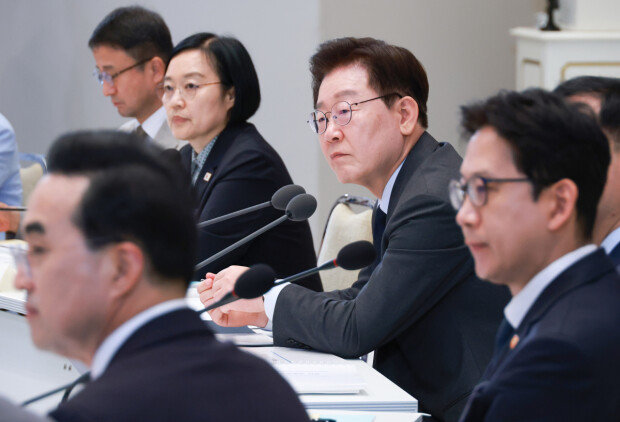
President Lee Jae-myung said Monday that the government will channel additional tax revenue from an expected semiconductor boom into long-term investment, describing the global race for artificial intelligence as a pivotal moment that will determine the country's future competitiveness. He said a new Future Response Fund will be established to invest in four priority areas: future industries, youth, regional development and education.
Speaking at the National Fiscal Strategy Meeting at the Blue House State Guest House, Lee said the government will mobilize all available resources to advance three flagship initiatives: semiconductors, physical AI and AI data centers. He said securing stable supplies of electricity and water is only the starting point, adding that the government will also expand transportation and logistics infrastructure, improve housing, education, health care and cultural amenities, and strengthen the innovation ecosystem needed to create new engines of growth. As part of that effort, the government will accelerate construction of fabrication plants at the Yongin semiconductor cluster. In physical AI, it aims to make South Korea the global leader by 2030 by developing export-oriented industrial hubs in North Jeolla and South Gyeongsang provinces.
The government expects national tax revenue next year to top 500 trillion won, well above its initial forecast of 412 trillion won, as the semiconductor industry rebounds. Based on that projection, it plans to increase total government spending for 2027 by more than 10 percent from this year's budget to more than 800 trillion won. Some of the additional revenue will be set aside in the Future Response Fund to finance long-term growth initiatives. At the same time, the government plans a broad overhaul of public spending. Every government program will be reviewed from the ground up, with discretionary spending reduced by 15 percent and mandatory spending by 10 percent. The overhaul is expected to free up about 50 trillion won for reinvestment in strategic industries.
The government also plans to expand support for young people. By 2030, it aims to train more than 200,000 specialists in artificial intelligence, semiconductors and green transition technologies while creating 200,000 jobs for young people across the public and private sectors. It also plans to introduce a youth-focused Individual Savings Account (ISA) next year and temporarily ease income eligibility rules for newly married couples applying for home loans, helping young adults build wealth and reducing the financial burden of marriage.
Lee also called on politicians to move beyond partisan conflict and compete over performance instead of political point-scoring. "No society has a future if people spend their time attacking one another, hoping others fail or standing in each other's way," he said. "I hope everyone in politics, myself included, competes to serve the public better."
윤다빈 기자 empty@donga.com







 About Dong-A Ilbo