

Samsung targets 2029 Yongin fab opening
Samsung targets 2029 Yongin fab opening
Posted July. 13, 2026 08:38,
Updated July. 13, 2026 08:38
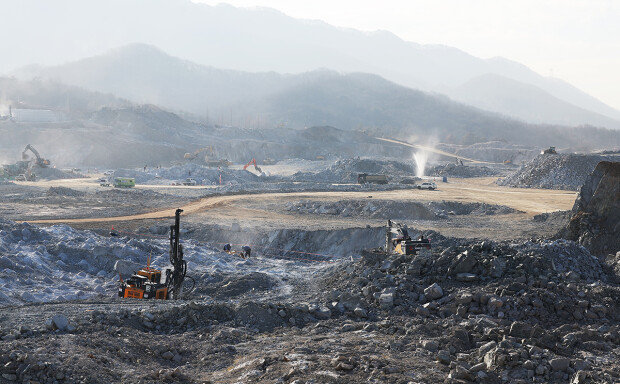
South Korea's government and Samsung Electronics are working to bring the first semiconductor fabrication plant at the Yongin National Industrial Complex online in 2029, two years ahead of schedule, as they seek to accelerate the country's flagship chip project and strengthen its lead in the global memory semiconductor market.
Industry sources said Sunday that the revised timeline was a key agenda item at a July 6 public-private review meeting on major national projects chaired by President Lee Jae-myung. Officials and Samsung agreed that expanding domestic chip production has become increasingly urgent as countries race to secure manufacturing capacity to meet soaring demand for AI memory semiconductors. After the meeting, Presidential Chief of Staff Kang Hoon-sik said the government would move up every stage of the project, from land acquisition and compensation to power, water and other supporting infrastructure, allowing the 10 fabs planned for Yongin to be built on a significantly faster timetable.
The accelerated schedule will require an equally aggressive government response. Since construction of an advanced semiconductor fab, equipment installation and production qualification typically take at least two years, work on the site must begin no later than the first half of 2027. That leaves little time to complete land acquisition and compensation by the Korea Land and Housing Corp. The government must also ensure that high-capacity power supplies and industrial water systems essential for advanced chip production are ready on schedule. A presidential office official said land compensation is expected to be completed by year-end under President Lee's directive. Site preparation will begin parcel by parcel as compensation is finalized, allowing construction to proceed without delaying Samsung's production timetable.
Kim Yong-beom, the presidential chief policy secretary, reinforced the message in a Facebook post Saturday, writing, "Manufacturing capacity is the new national strength." He said technological leadership may define the AI era, but production capacity is what ultimately translates innovation into national competitiveness. Warning that delays could allow latecomers such as China to narrow the gap, Kim said the government's responsibility is to provide the industrial foundation companies need to compete. That includes removing bottlenecks in electricity, water supplies, transmission infrastructure, permitting and other areas that only the government can address.
Lee Jong-hwan, a professor of system semiconductor engineering at Sangmyung University, said the government's commitment to expanding the industry's talent pool and investing in power and water infrastructure was a welcome step. "The direction is the right one," he said. "The remaining question is how quickly it can be put into action."
이동훈 dhlee@donga.com








 About Dong-A Ilbo